

AEO (answer engine optimisation) and GEO (generative engine optimisation) are labels for one job: making your content easy for AI answers to find, understand and cite. This page is the map. It sets out what matters, in the order to work on it, and links to our detailed guides. We update it as new guides go live.
Facts attributed to Google below come from its guide to generative AI features, last updated in July 2026. Statements marked “our view” are our own judgement, not Google’s.
What Google says the job is
Google says SEO best practices still apply because its generative AI features are rooted in its core ranking and quality systems. It describes two techniques. Retrieval-augmented generation uses ranking systems to fetch relevant pages, which the model reviews to write a response with links. Query fan-out runs several related searches at once to gather more material. From Google’s perspective, optimising for generative AI search is optimising for the search experience, so it is still SEO. Our explainer on the terms is AEO, GEO and AI SEO.
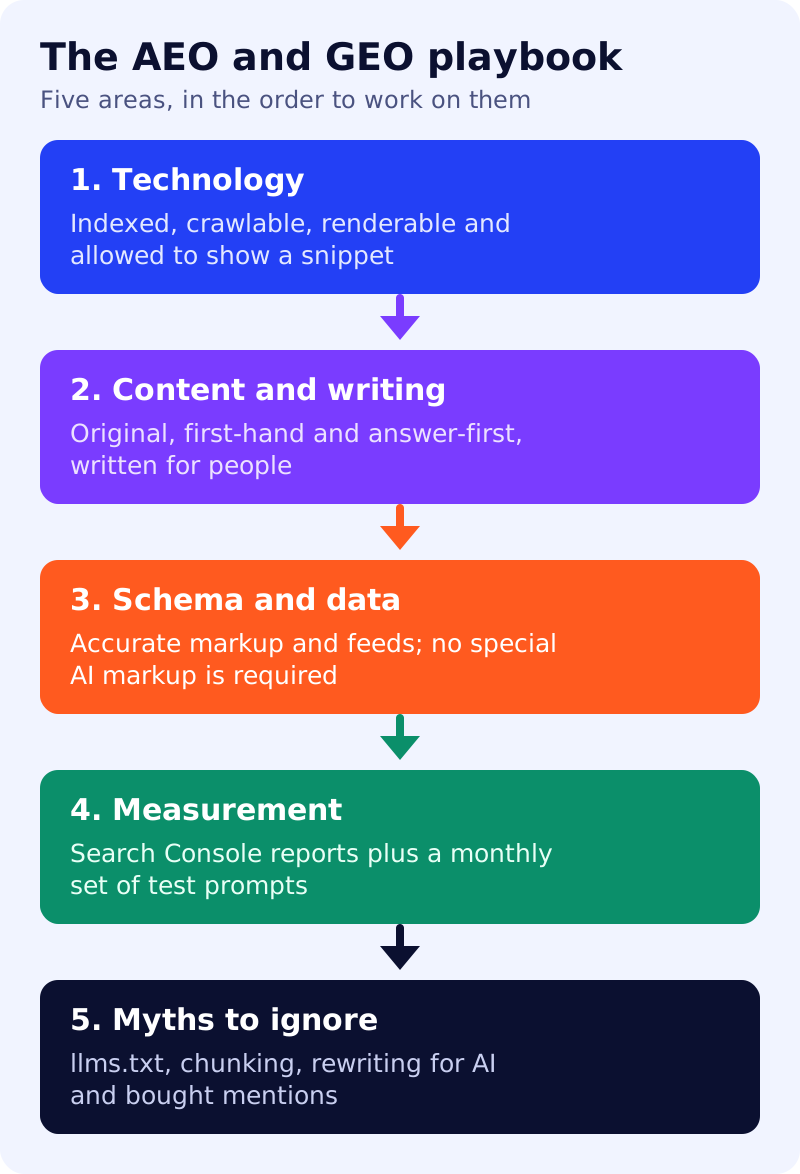
1. Technology
Google says a page must be indexed and eligible to be shown in Search with a snippet to appear in its generative AI features. Content must be crawlable, and JavaScript is processed as long as it is not blocked. Indexing is never guaranteed.
- Run the quick test in five checks for AI search visibility and the longer practical checklist.
- Understand how the systems differ in AI Mode vs Search.
- For Microsoft’s side, see getting cited in Copilot and Bing.
- For AI crawlers and training, see the reported shared AI training opt-out.
- To check that ChatGPT’s crawlers can reach you, run the 10-minute GPTBot, OAI-SearchBot and ChatGPT-User test.
- To see which crawlers actually visit, follow our ten-minute server log method.
2. Content and writing
Google says original, non-commodity content, with a unique point of view and first-hand experience, will likely influence presence in generative AI search more than any other tip. Content that restates what others have said adds little.
Our view: write the answer first, then the detail, and put your own evidence in the middle of the page. These guides show how:
- Answer-first pages
- 12 sentence rewrites that make a page easier to quote
- First-hand evidence: eight kinds you can add to any page
- Writing content that AI summarises without killing your credit
- FAQs for AEO without looking spammy
- Internal linking for AEO and GEO
- Brand entity clean-up
3. Schema and data
Google says structured data is not required for generative AI search and that there is no special schema.org markup to add. It still recommends structured data as part of SEO because it helps eligibility for rich results. For shops and local businesses, it names Merchant Center feeds and Business Profiles as ways to appear in AI responses. Our view: accurate markup that matches the visible page is worth keeping; markup added to chase AI is not. Use our schema decision table by page type, and for shops start with AEO for e-commerce.
4. Measurement
Google points to the Generative AI performance report in Search Console and warns against third-party tools that claim to use internal Google metrics. See what the report shows and leaves out and Bing’s AI Performance report compared. Our view: add a monthly set of 20 test prompts and record whether your brand and pages appear, and use our 20-prompt AI visibility test with a scoring sheet. For a deeper view of trust, see testing whether AI engines trust your site. To check what AI tools say about your business, use our six-question brand audit worksheet. To see what AI traffic does reach you, use our four-step analytics setup.
5. Myths to ignore
Google lists several tactics it says you can ignore for Google Search:
- llms.txt and special markup. Google Search ignores them. See do you need an llms.txt file.
- Chunking content into tiny pieces. Its systems understand pages with multiple topics, and there is no ideal page length.
- Rewriting content just for AI. Its systems understand synonyms and meaning.
- Seeking inauthentic mentions. Core ranking and spam systems still apply.
- Over-focusing on structured data.
Google also warns that creating separate pages for every query variation, mainly to manipulate AI responses, violates its scaled content abuse policy.
For each myth in turn, with what to do instead, see four AEO and GEO myths checked against Google’s guide.
Before you pay for a citation promise, read no one can guarantee an AI citation.
By page type
Data worth knowing
- AI-referred shoppers delivered 83% more revenue per visit in September, Adobe data shows
- Google opens a Connected Apps preview for Gemini and AI Mode in Search: what it means for brands
What to do first
- Check indexing and snippet eligibility for your top ten pages.
- Rewrite one page answer-first, with something only you can say.
- Remove one myth-driven task from your list.
- Set up your monthly prompt test.
Source: Google Search Central documentation, as linked above. This page is updated as new guides are published.