

Much AEO and GEO advice online is a list of hacks. Google’s own guide to generative AI features has a section called “Mythbusting generative AI search”. We read it in full. This post goes through four of its points, says what Google states, and adds our view, clearly labelled. One limit matters: the guide describes Google Search. It does not say how ChatGPT, Copilot or other assistants behave.
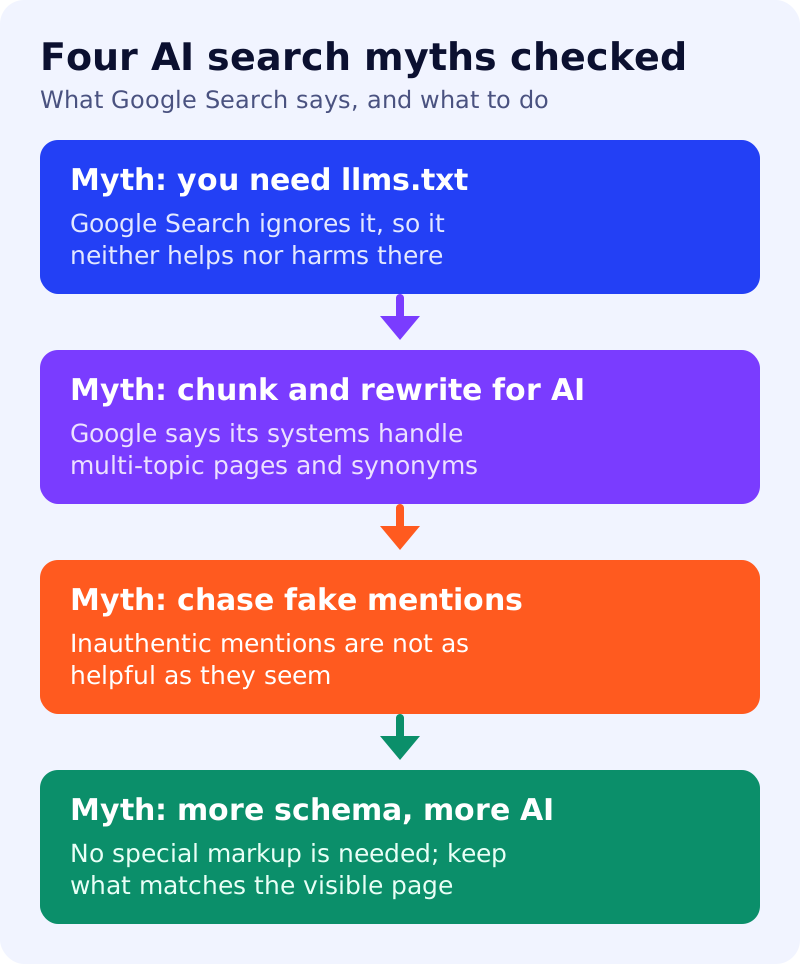
Myth 1: you need an llms.txt file
What Google says: you do not need new machine-readable files, AI text files or special markup to appear in Google Search, because Google Search does not use them. It adds that creating such files for other services is fine and will neither help nor harm your visibility in Google Search.
Our view: treat it as optional, not as a ranking task. See do you need an llms.txt file.
Myth 2: chop pages into pieces and rewrite them for AI
What Google says: there is no requirement to break content into tiny pieces, its systems understand several topics on one page, and there is no ideal page length. It also says you need not write in a special way, because its systems understand synonyms and meaning, so you do not need every long-tail variation.
Our view: edit for clarity, not for machines. Our sentence rewrites are ordinary editing for readers.
Myth 3: collect mentions wherever you can
What Google says: its AI features can reflect what is said about products across blogs, videos and forums, but seeking inauthentic mentions is not as helpful as it might seem, and its ranking and spam systems still apply.
Our view: real customer reviews, press and honest community answers are worth earning. Paying for or faking them carries risk and Google says it is not as helpful as it might seem.
Myth 4: more schema means more AI visibility
What Google says: structured data is not required for generative AI search and there is no special schema.org markup to add. The guide still recommends it as good SEO where it fits.
Our view: keep markup that matches visible content, and remove markup added only to chase AI. Use our schema decision table.
One related warning
Google says creating separate pages for every query variation, mainly to manipulate rankings or AI responses, violates its scaled content abuse spam policy.
What to do
- List every AI-related task on your plan and tick those that match one of the four myths.
- Remove or pause them, and move the time to your best existing pages.
- Check that each page can be indexed and shown with a snippet, which Google says is the technical requirement.
- Add something only you can say to one page this week: first-hand testing, data or a worked example.
- Re-test with our 20-prompt AI visibility test.
The full map is in our AEO and GEO playbook.