

Four acronyms confuse most marketers. Here is what each means, and how one plan can serve them all.
The four terms
- ASO (app store optimisation) improves how an app appears and ranks in an app store.
- SEO improves how web pages appear in search engines.
- AEO (answer engine optimisation) and GEO (generative engine optimisation) describe efforts to appear in AI answers. Google’s guide says that from its perspective, optimising for generative AI search is still SEO.
What each system documents
Apple says App Store search results are based on text relevance (title, subtitle, keywords and primary category) and user behaviour such as downloads, ratings and reviews. Google’s generative AI guide says its AI features are rooted in core ranking and quality systems, and it lists things you can skip, such as llms.txt files, “chunking” content, rewriting only for AI, and seeking inauthentic mentions. Google’s helpful content guidance asks whether content is created for people, with first-hand expertise and clear authorship.
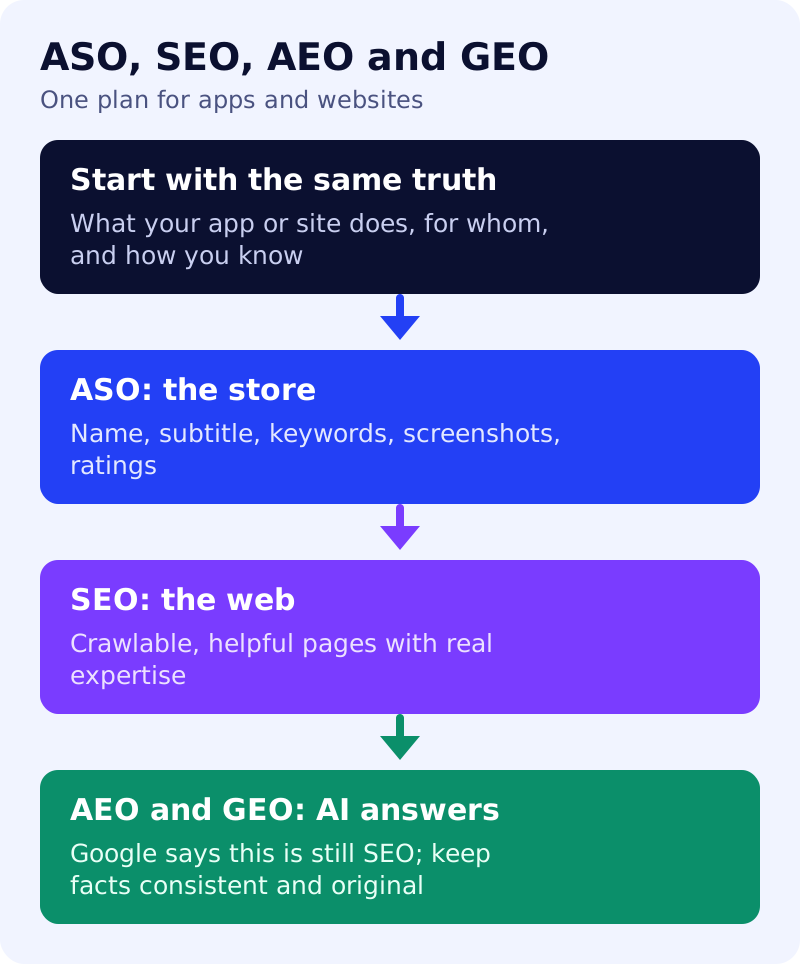
One plan
- Write your truth once. Define what your product does, who it is for, and how you know. Use those facts everywhere.
- ASO: reflect that truth in your name, subtitle, keywords and screenshots, and ask honestly for ratings.
- SEO: publish helpful pages with real expertise, a byline and clear sources. See brand entity clean-up.
- AEO and GEO: keep pages crawlable, put answers first, and avoid shortcuts. See answer-first pages.
- Measure by channel: store analytics for ASO, Search Console for Google, and referral traffic for ChatGPT.
Combined keyword thinking
People search in different words in each place. In a store, they may type a feature or problem (“budget tracker”). On the web, they may ask a question (“how to track expenses”). In AI tools, they ask longer questions. Start from real questions and map each to the right asset: a store keyword, a web page or an answer-first section.
What to avoid
Google lists warning signs including producing lots of content on many topics in the hope some will rank, and relying on extensive automation. Quality beats volume in every channel.
Sources: Apple Developer and Google Search Central documentation, as linked above.