

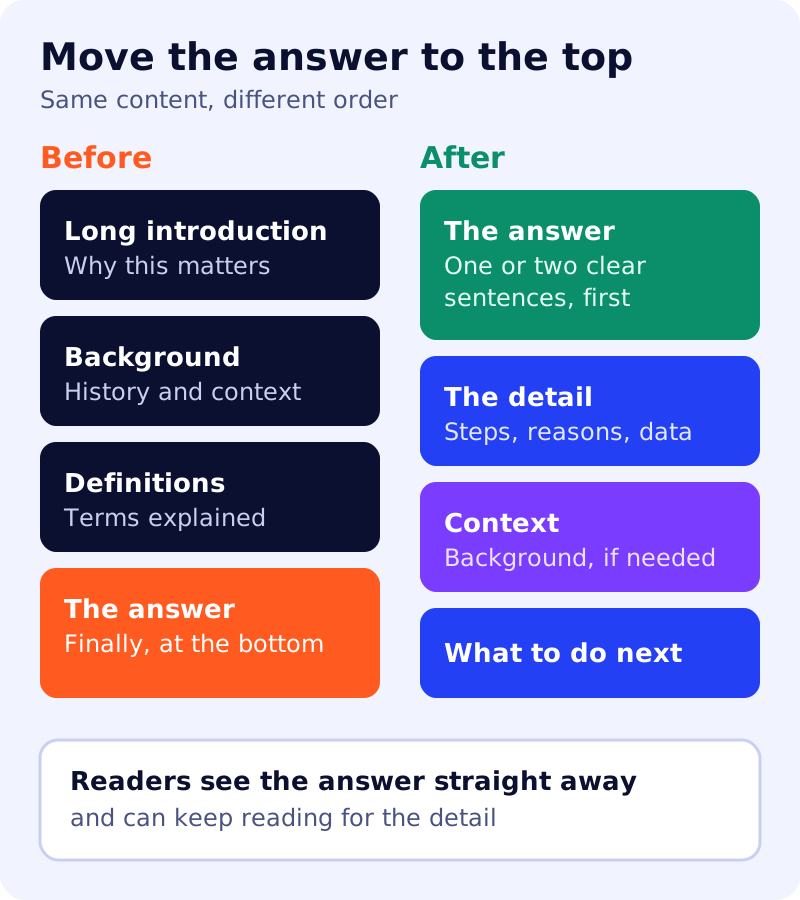
Many pages make readers wait for the answer. They open with a long introduction, then background, then definitions, and give the answer last. An answer-first page reverses that order: the direct answer comes first, and the detail follows for readers who want it.
Why this layout helps
It helps people first. Someone searching “how long does a refund take” wants the number of days, not a story about your refund policy. The same clarity helps search features that summarise pages.
Google’s documentation shows how snippets work. It describes featured snippets as special boxes where the format of a regular result is reversed, showing the descriptive snippet first. They can also appear in a related questions group, known as People Also Ask. Google does not give a minimum length for a featured snippet.
What Google does not promise
Google’s guide to AI features says the best practices for SEO remain relevant, and that there are no additional requirements or special optimisations for AI Overviews or AI Mode. It also says you do not need new machine-readable files or special schema. It advises making sure important content is available in textual form.
So answer-first writing is not a hack that earns a place in a snippet or an AI answer. It is a clear way to write that suits both readers and summarisers. Google also says AI features may use “query fan-out”, searching related subtopics, so pages that cover a topic clearly in sections give them more to use.
How to restructure a page
- Find the main question the page answers.
- Write the answer in one or two sentences and place it directly under the heading.
- Add the detail next: steps, reasons, figures and examples.
- Move background and history lower, or cut them if readers do not need them.
- Turn sub-questions into headings, each opening with its own short answer.
- Finish with the next step, such as a link, a form or a checklist.
Mistakes to avoid
- Do not stuff keywords into the opening sentence. Write it for a person.
- Do not overstate. If the answer is “it depends”, say what it depends on.
- Do not hide key facts in images. Google advises keeping important content in text.
- Do not copy a competitor’s wording. State the answer in your own words, with your own evidence.
For a related checklist, see our guide to AI search visibility and our piece on optimising FAQs for AEO.
Sources: Google Search Central documentation, as linked above.