Google’s guide to generative AI search says that creating unique, non-commodity content will likely influence presence in AI search more than any other tip. Its page on helpful content, last updated 5 October 2026 as we read it, gives the test: does the content provide original information, reporting, research or analysis, and does it clearly show first-hand expertise, for example from having used a product or visited a place? It also lists warning signs, including mainly summarising what others say. This post gives eight kinds of evidence you can add. The list is our own, not Google’s.
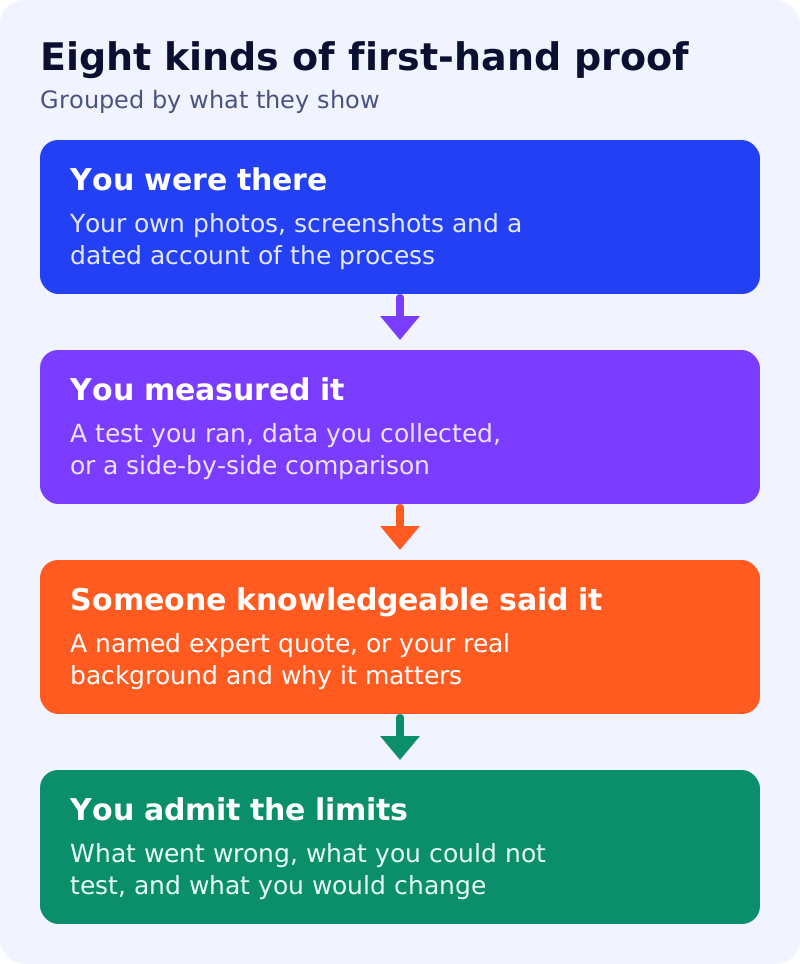
The eight kinds
| Kind of evidence | How to present it | What never to fake |
|---|---|---|
| 1. Your own photos and screenshots | Original images with a caption saying what and when | Stock photos passed off as your own |
| 2. A dated process note | ”On [date] we did [step] and saw [result]“ | Dates, or steps you did not take |
| 3. A test you ran | State the method, the setup and the result | Results you did not get |
| 4. Data you collected | Say the sample, period and how you counted | Numbers, samples or sources |
| 5. A side-by-side comparison | Same conditions for each item, shown in a table | Hidden advantages for one item |
| 6. A named expert quote | Name, role and when it was said, with permission | Quotes or experts that do not exist |
| 7. Your real background | A short line on your experience and an author page | Credentials, bylines or personas |
| 8. Mistakes and limits | What went wrong, what you could not test, what you would change | Perfection |
Why the last one matters
Limits are evidence too. A page that states what it could not verify, as we do in our news posts, is easier to trust than one that claims certainty. Google says trust is the most important part of what it calls E-E-A-T, and that the other parts contribute to it.
What not to fake
Google’s helpful content page now warns against fake authorship, as we covered in our news post on the 5 October update. The same applies to invented experience. If you cannot show that you used, tested or visited it, say what you can show instead: what you read, who you asked and what you could not check. Do not write “we tested” when you did not.
A worked before and after
Before: “This tool is easy to use and has many features.”
After: “On 12 October I set up the tool on a test site with 200 pages. Setup took 40 minutes. It missed redirects on 6 pages, which I fixed by hand.”
The numbers here are an illustration, not a real test. Yours must be real. The second version gives a reader and an AI summary something they cannot get anywhere else, which Google’s guide says is what matters. For wording tips, see our 12 sentence rewrites.
What to do
- Pick one page that mostly summarises other sources.
- Add two kinds of evidence from the table that you can honestly supply.
- Add a short “what we could not check” line.
- Add or update an author page with your real background.
- Track the page in your 20-prompt AI visibility test, and see the full map in our AEO and GEO playbook.