
Google has added a clear warning about authorship to its guidance on helpful content. The page, “Creating helpful, reliable, people-first content”, shows a last-updated date of 5 October 2026. We read the page itself. The coverage by Search Engine Land, Search Engine Roundtable and Search Engine Journal is described from search results, since we could not open those pages directly.
What the page says
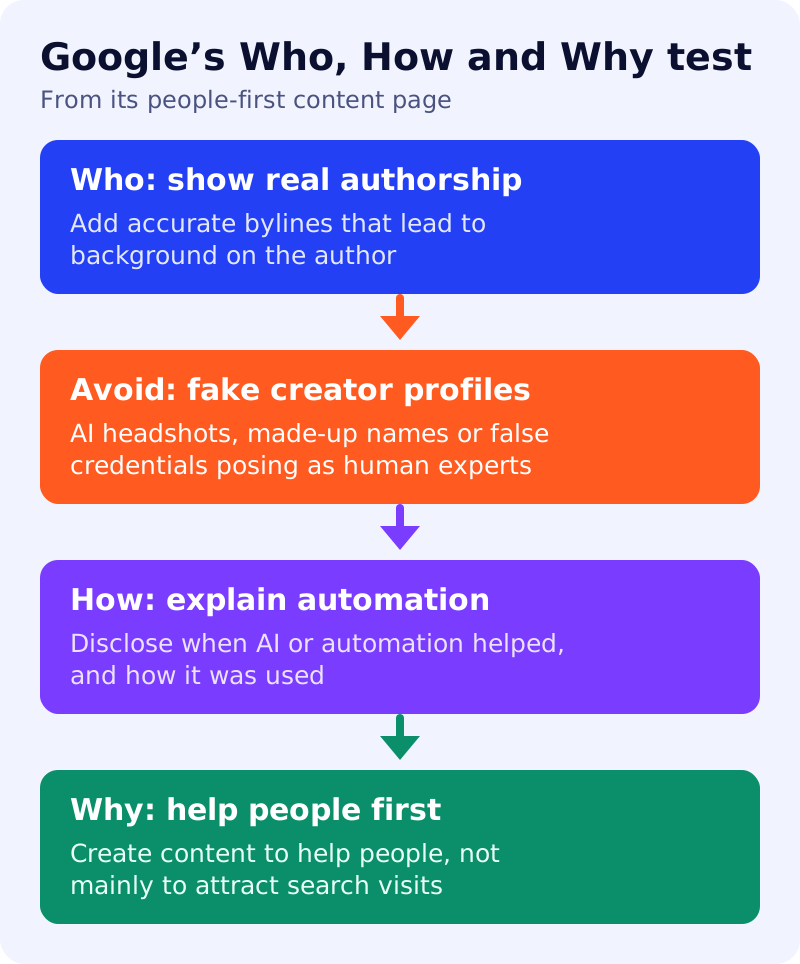
In its “Who, How and Why” section, Google says it helps people understand the E-E-A-T of content when it is clear who created it. It asks site owners whether it is self-evident who authored the content, whether pages carry a byline where one might be expected, and whether bylines lead to further information about the authors and the areas they write about.
Google says it strongly encourages accurate authorship information, such as bylines where readers might expect them. It then adds: avoid using deceptive authorship information. It gives examples of fabricating creator profiles, such as using AI-generated headshots, made-up names or false credentials to make content appear as if it was written by human experts. Google calls this a form of deception, and says any deception makes a page untrustworthy to both users and its automated quality systems, and is a signal of a low-quality page.
What the page does not say
The warning is about pretending. The same page says automated, AI-generated and AI-assisted content can be fine to publish, and asks whether the use of automation is self-evident to visitors through disclosures or other ways, and whether you explain how and why it was used. It suggests adding such disclosures where they would reasonably be expected. It also says that using automation primarily to manipulate search rankings violates its spam policies. See our guide to the September 2026 spam update.
Reports differ on how new the change is. Search Engine Roundtable says Google’s earlier stance had been that it was not worried about fake author information. Other commentary describes the wording as a sharper statement of an existing standard. We cannot compare it with the previous version of the page, so treat “new” as reported, not confirmed.
Our view: what to check
This section is our interpretation, not Google’s.
- Is every named author a real, accountable person? If a byline suggests a human expert, that person should exist and have written or reviewed the piece.
- Does the author page tell the truth? Credentials, photos and biographies should be accurate. See how to prepare health content with trust, sources and authors.
- Is AI use disclosed where readers would expect it? A short note on how a piece was produced is consistent with Google’s “How” questions.
- Does the page exist to help people? Google calls “Why” the most important question.
- Do your entity signals match? Names, profiles and biographies should be consistent. See brand entity clean-up.
What to do
- List every byline on your site and confirm each author is real and reachable.
- Remove invented names, stock or AI-generated headshots and unverified credentials from author pages.
- Add a plain-language note on how content is produced, including any AI use, and who is responsible for it.
- Make author pages link to real profiles and relevant work.
- Re-read the Google page and see our AEO and GEO playbook for the wider picture.
Sources: Google Search Central documentation (read directly), and coverage by Search Engine Land, Search Engine Roundtable and Search Engine Journal as summarised in search results. The “our view” section is our own interpretation.