

Health is among the most sensitive areas for search. Google calls topics that could significantly affect health, financial stability or safety “Your Money or Your Life” (YMYL) topics, and says its systems give even more weight to content with strong E-E-A-T for them. E-E-A-T stands for experience, expertise, authoritativeness and trustworthiness. Google says trust is the most important of the four.
This article is about publishing and SEO. It is not medical advice.
What Google says about AI Mode and health pages
Google’s guide to AI features says there are no extra requirements to appear in AI Overviews or AI Mode, and no special optimisation. A page must be indexed and eligible to appear in Search with a snippet. So a health article earns its place the same way it earns any ranking: by being helpful and reliable.
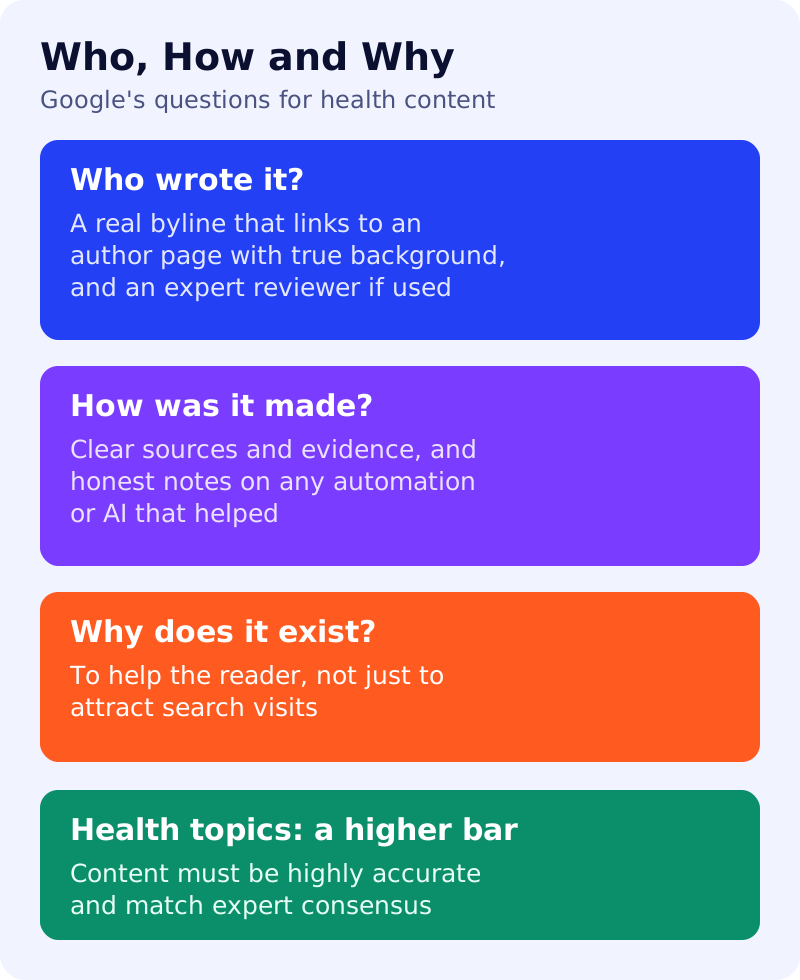
Who, How and Why
Google suggests asking three questions about every page.
- Who created it? Pages should carry a byline where readers expect one, and the byline should lead to an author page with background. Google warns against fabricating creator profiles, such as AI-generated headshots, invented names or false credentials, and calls this deception.
- How was it created? Explain sources, evidence and methods. Google says this includes disclosing any automation or AI that helped.
- Why does it exist? It should exist to help people, not mainly to attract search visits.
The accuracy bar
Google says that for YMYL topics, content must be highly accurate and consistent with established expert consensus. It also lists warning signs: producing lots of content on many topics hoping some performs, relying on extensive automation, and changing page dates to look fresh when nothing changed.
How to set up a health article
- Use a qualified author or reviewer and say so honestly, with a page that explains their real credentials.
- Cite primary sources such as clinical guidance or published research, and link them.
- Write from real experience or expertise, not a rewrite of other pages. Google’s guidance asks for original information and analysis.
- State limits clearly: who the advice is for, and when to see a professional.
- Date honestly. Update the date only when the content has substantially changed, and note what changed.
- Give the page a good experience: readable text, clear headings and no misleading headlines.
Check your work
Use Search Console’s generative AI report to see how your pages appear in Google’s AI features. Google also cautions against third-party tools that claim to use internal Google metrics. For related guidance, see our piece on brand entity clean-up and the AEO, GEO and SEO terms explained.
Sources: Google Search Central documentation, as linked above.