

Google’s spam policies page says spam means techniques used to deceive users or to manipulate Search systems, including attempts to manipulate generative AI responses. It says sites that violate the policies may rank lower or not appear at all, and that violations are found through automated systems and, when needed, human review that can lead to a manual action. We read the page (last updated 28 August 2026, as we saw it). This post paraphrases it in four groups. The grouping and the checks are our own.
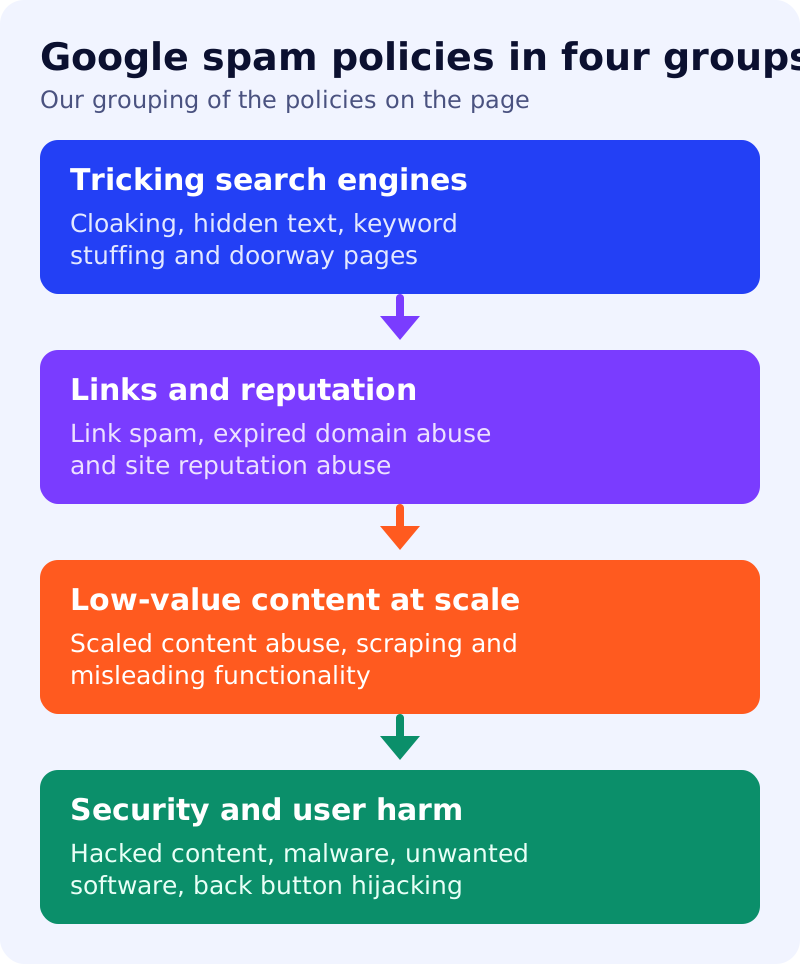
Group 1: tricking search engines
| Policy | In plain English | One-minute check |
|---|---|---|
| Cloaking | Showing search engines something different from what visitors see | Compare the page as a visitor and in the URL Inspection tool |
| Hidden text and links | Content placed so people cannot see it | Search your CSS for off-screen text and zero-size fonts |
| Keyword stuffing | Repeating words or lists of places unnaturally | Read a key page aloud |
| Doorway abuse | Many similar pages made to funnel people to one place | Look for near-identical city or query pages |
Google says ordinary design elements such as tabs, accordions and screen-reader-only text do not break the policy.
Group 2: links and reputation
| Policy | In plain English | Check |
|---|---|---|
| Link spam | Buying, selling or mass-creating links to pass ranking credit | Are paid links marked rel=“sponsored” or “nofollow”? Google says marked links are fine |
| Expired domain abuse | Buying an old domain to host low-value content | Do you own domains bought for their past history? |
| Site reputation abuse | Third-party content hosted to borrow a site’s ranking strength | Do partners publish on your domain without your oversight? |
For the last point, see our guide on coupons and the site reputation policy.
Group 3: low-value content at scale
Google describes scaled content abuse as many pages generated mainly to manipulate rankings rather than help users, usually with unoriginal content, however it is created. Its examples include using generative AI tools to produce many pages without adding value, scraping and transforming other sources, and stitching content together without added value. Scraping and misleading functionality, such as a fake tool that only shows ads, sit alongside it.
Our view: volume is not the test. Ask whether each page answers a real question, has a named source or original evidence, and would be worth publishing if search did not exist. Google’s AI guide also warns against separate pages for every query variation to manipulate AI responses.
Group 4: security and user harm
| Policy | Plain English | Check |
|---|---|---|
| Hacked content | Content added to your site without permission | Search site:yourdomain.com for unfamiliar pages |
| Malicious practices | Malware, unwanted software and back button hijacking | Test back navigation on key pages |
What to do
- Pick one check from each group and run it this week.
- Fix paid links with rel=“sponsored” or “nofollow”.
- Remove or noindex pages that exist only to catch query variations. Google’s page says to exclude such content from Search.
- Check Search Console’s Security and manual actions report.
- Read how the September 2026 spam update was handled, and our user-generated spam guide.