
New data from Adobe suggests that people who reach a shop from an AI platform are worth more per visit than the average shopper. The figures were reported by Search Engine Land and Retail TouchPoints. We could not open either page directly from our systems, so the numbers below come from those reports as summarised, and we recommend checking them against Adobe’s own release.
What Adobe reported
For U.S. retail websites in September, Adobe says:
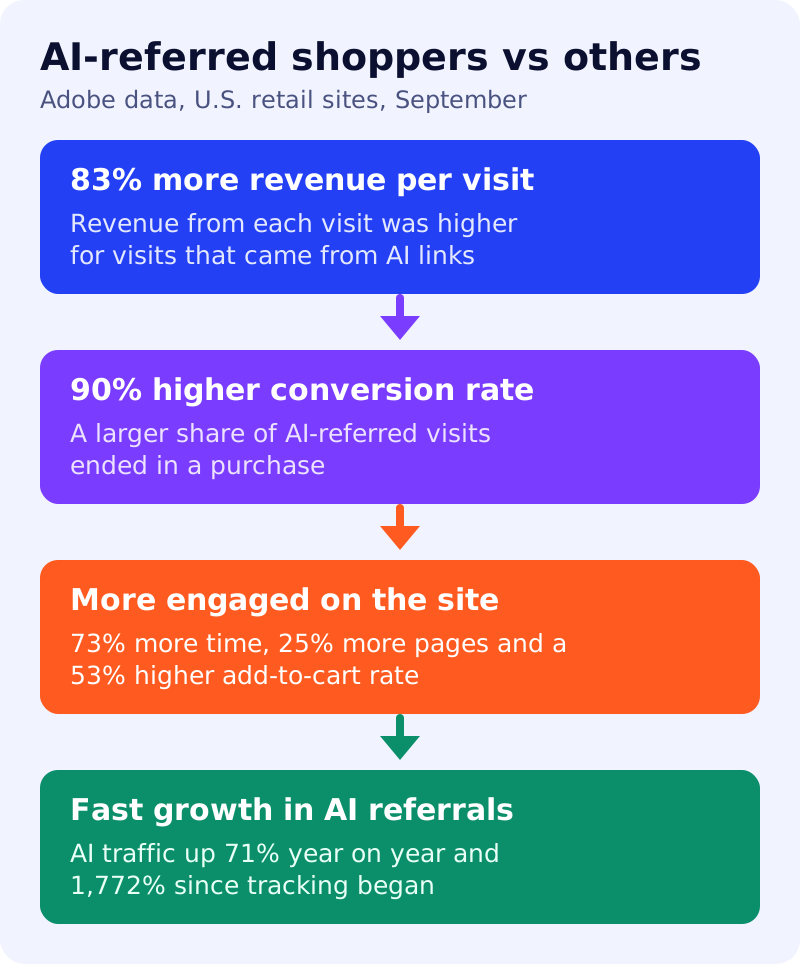
- AI-referred visitors generated 83% more revenue per visit than non-AI visitors.
- AI traffic converted at a 90% higher rate.
- AI-referred visitors spent 73% more time on site, viewed 25% more pages, and added products to their carts at a 53% higher rate.
- AI traffic to U.S. retail sites grew 71% year on year in September, and is up 1,772% since Adobe began tracking these referrals in October 2024.
Adobe also gave a comparison with a year earlier. In August 2025, AI visitors converted at a 9% lower rate than non-AI visitors, and in September 2025 revenue per visit was roughly equal. On these figures, the gap has reversed within a year.
Holiday forecast
Adobe expects AI-referred traffic to grow 159% year on year on Thanksgiving, 95% on Black Friday and 88% on Cyber Monday.
About the data
Adobe says it analysed online transactions from a dataset covering more than 1 trillion visits to U.S. retail sites, 100 million products and 18 categories. AI referrals are visits that come from clicks on links in AI platforms.
How to read the numbers
Our view, not Adobe’s:
- These are relative lifts. “90% higher” means the AI rate is 1.9 times the comparison rate. It does not mean 90% of AI visitors bought something.
- They describe a broad U.S. retail dataset. A single store may see a different result, and the sample covers retail only.
- Intent may explain part of it. A shopper who asks an AI tool a detailed question and then clicks a link may already be close to buying. The data shows an association, not what caused it.
- Volume is not value. Search Engine Land makes the point that traffic alone does not show business value, so track how many visits lead to purchases and how much revenue they bring.
How to track AI traffic
Our view: in your analytics tool, group visits whose referrer is an AI platform into one channel, and compare that channel with others on conversion rate and revenue per visit, not on visit counts. Check that the grouping catches the main AI tools your customers use, and re-check it each quarter because referrer names change. Some AI traffic may not be separable from other sources, so treat the channel as a lower bound. Google’s own Generative AI report in Search Console covers its AI features; see our guide to what that report shows.
What to do before the holidays
- Set up an AI referral channel in analytics before Thanksgiving, so you have a clean baseline.
- Compare revenue per visit, not just visits.
- Check your product and category pages answer shopper questions directly. See AEO for e-commerce and category pages in ChatGPT and AI Mode.
- Test what AI tools say about you with our 20-prompt AI visibility test.
- Keep the bigger picture in view with our AEO and GEO playbook.
Sources: Adobe data as reported by Search Engine Land and Retail TouchPoints, linked above. The interpretation sections are our own view.