

A common promise in AEO and GEO sales pages is a guaranteed place in AI answers. Google’s guide to generative AI search does not support that kind of promise for Google Search, and we know of no source that does for other assistants. This post sets out what Google says, adds our own view, clearly labelled, and gives a checklist for judging offers. It covers Google Search only where it cites Google. We have not tested every AI tool.
What Google says
Google’s guide says a page must be indexed and eligible to be shown in Search with a snippet to appear in its generative AI features. It adds that meeting all requirements, following best practices and complying with policies does not mean Google will crawl, index or serve the content, and that indexing and serving are not guaranteed. It also describes query fan-out, where the model runs several related searches, and says its AI systems look at a variety of sources. Both points make any single guaranteed citation harder to promise.
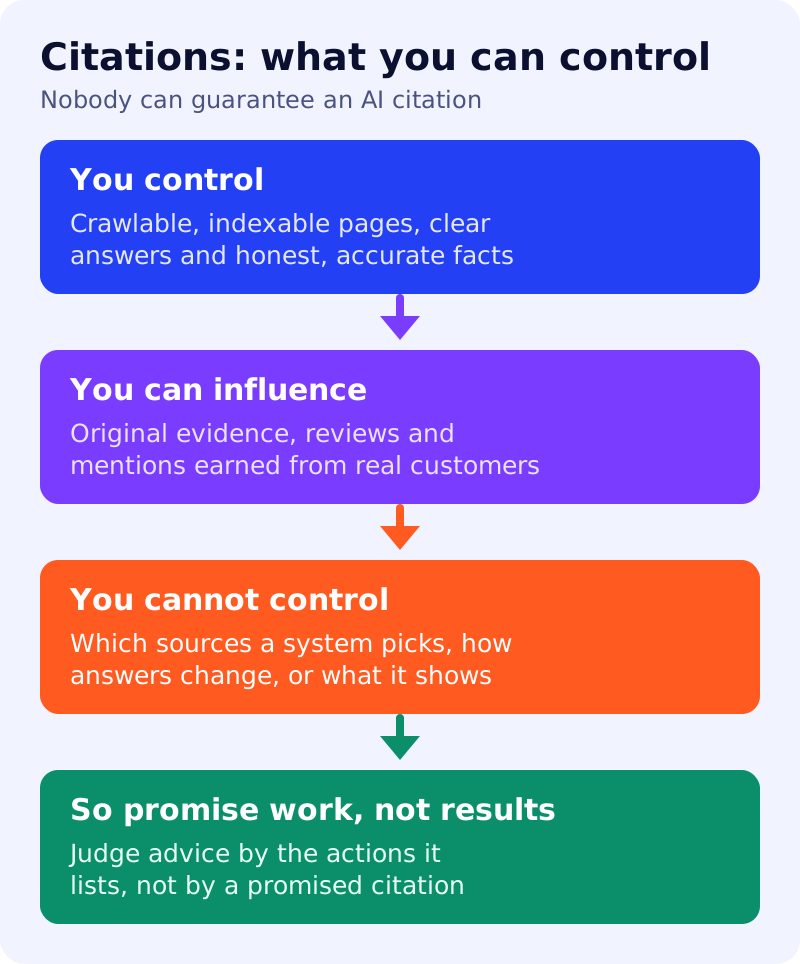
Our view: a control map
This is our judgement, not Google’s.
| Group | Examples |
|---|---|
| You control | Whether pages can be crawled and indexed, the clarity of your answers, the accuracy of facts and dates, your structured data matching visible content |
| You can influence | Original evidence on your pages, real reviews, honest mentions from customers and partners, how consistent your brand details are |
| You cannot control | Which sources a system chooses, how answers change between runs, what appears for a given user, or when a system changes |
Five red flags in a citation promise
- A guaranteed citation, ranking or number of mentions.
- A price tied to a result Google or another vendor controls.
- Special files or markup sold as the key. Google says it ignores llms.txt and has no special markup for AI features.
- Plans to create pages for every query variation. Google says that, done mainly to manipulate AI responses, it violates its scaled content abuse policy.
- Mentions bought or arranged in bulk. Google says seeking inauthentic mentions is not as helpful as it might seem.
How to judge advice
Ask the provider to name the actions, the pages they will change and how they will measure progress. Honest providers can promise effort, reporting and testing. They cannot promise outcomes. Google’s guide also points readers to its guidance on evaluating third-party SEO advice.
What to do
- Write down what you control and fix those items first. Start with five checks for AI search visibility.
- Measure with a repeatable test, such as our 20-prompt AI visibility test, and report ranges rather than single results.
- Ask any provider for a written list of actions and no outcome guarantees.
- Review the other claims we checked in four AEO and GEO myths.
- Keep the full map close: our AEO and GEO playbook.