Quick answer: AEO (answer engine optimisation) is the process of making your content clear, relevant and trustworthy enough that AI-powered search tools can understand it, extract an answer from it and show your site as a source. Think of it as the next step after SEO. Best for: site owners, marketers and writers who want their content to show up in AI Overviews, AI Mode, ChatGPT, Gemini, Copilot and Perplexity, and not only in Google’s blue links.
SEO vs AEO vs GEO
The three terms overlap, and AEO and GEO are not fully separate disciplines. Sources use them for close to the same job, and there is no settled rulebook.
| Parameter | SEO | AEO | GEO |
|---|---|---|---|
| Full form | Search engine optimisation | Answer engine optimisation | Generative engine optimisation |
| Primary objective | Rank webpages | Get selected as an answer | Get mentioned in AI-generated responses |
| Focus | Keywords and rankings | Questions and answers | Context, authority and citations |
| Where it shows | Google, Bing results | Featured snippets, voice search, AI answers | ChatGPT, Gemini, Perplexity, Claude |
| Success metric | Rankings, clicks | Answer visibility, answer inclusion | AI mentions, citations, referrals |
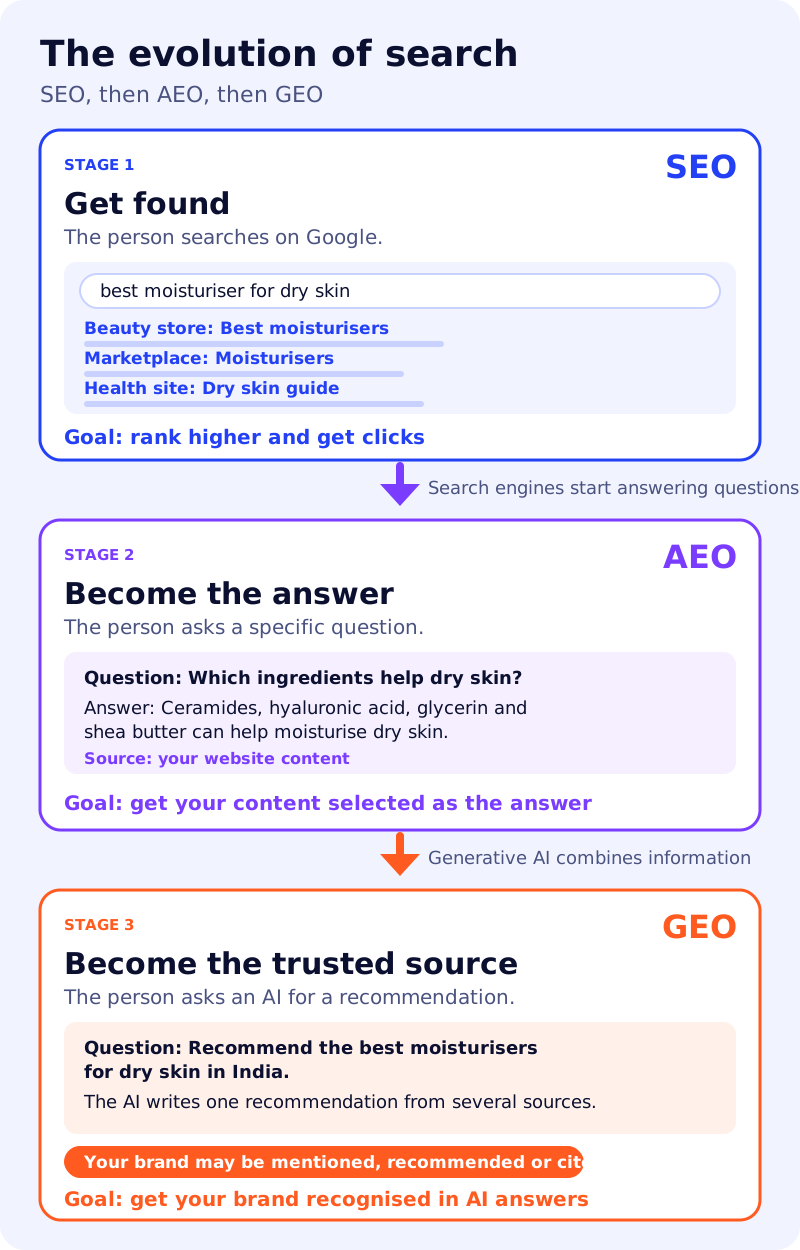
Where does each stage happen?
| Stage | Where it happens |
|---|---|
| SEO | Google Search, Bing |
| AEO | Featured snippets, AI Overviews, voice answers |
| GEO | ChatGPT, Gemini, Perplexity and other AI platforms |
Google takes a firmer line. Its guide says that from its perspective optimising for generative AI search is still SEO. Our view: build one search visibility strategy, not three. Our explainer on the terms is AEO, GEO and AI SEO.
How AEO works
Take a question someone types into any AI tool: “Which moisturiser is best for dry skin?” Traditionally, Google shows ten blue links. With AEO, the goal is that your page is clear enough for an answer engine to pull the answer out of it.
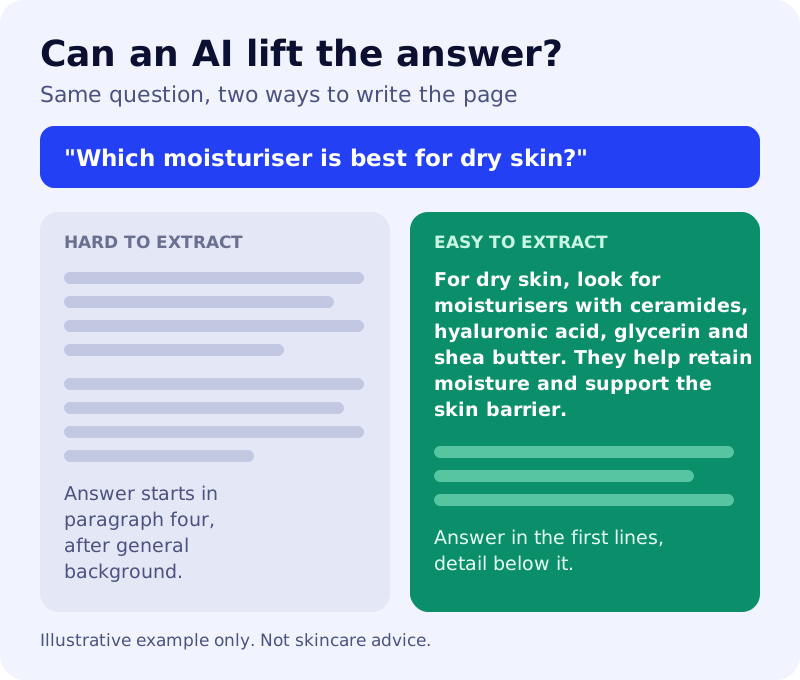
Your content becomes a possible answer source. The aim is not only to rank the page. It is to be useful enough to become part of the answer.
The business impact
Picture an online store that wants to own the search journey for moisturisers. The shopper moves through four steps, and the store needs something different at each one.
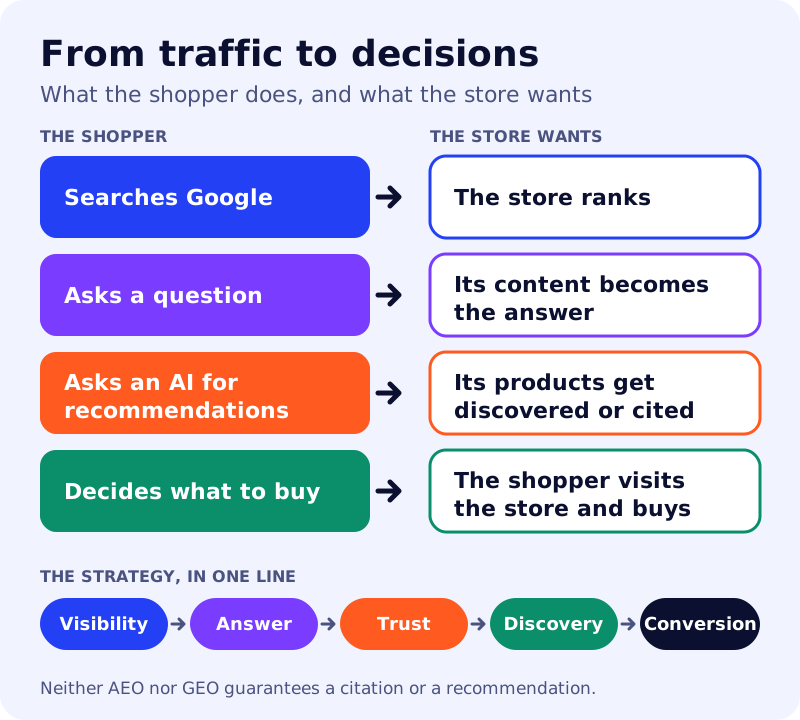
| What the shopper does | What the store wants |
|---|---|
| Searches Google | The store ranks |
| Asks a question | Its content becomes the answer |
| Asks an AI for recommendations | Its products get discovered or cited |
| Decides what to buy | The shopper visits the store and buys |
The ultimate strategy reads: visibility, answer, trust, discovery, conversion. That is the shift from chasing website traffic to influencing decisions across search engines and AI platforms. AEO focuses on being selected as an answer. GEO focuses on influencing generative AI responses. They overlap, and neither guarantees a citation or a recommendation.
The 7 pillars of AEO
This is our working framework, not an official list. Where Google’s guide says something different, the table says so.
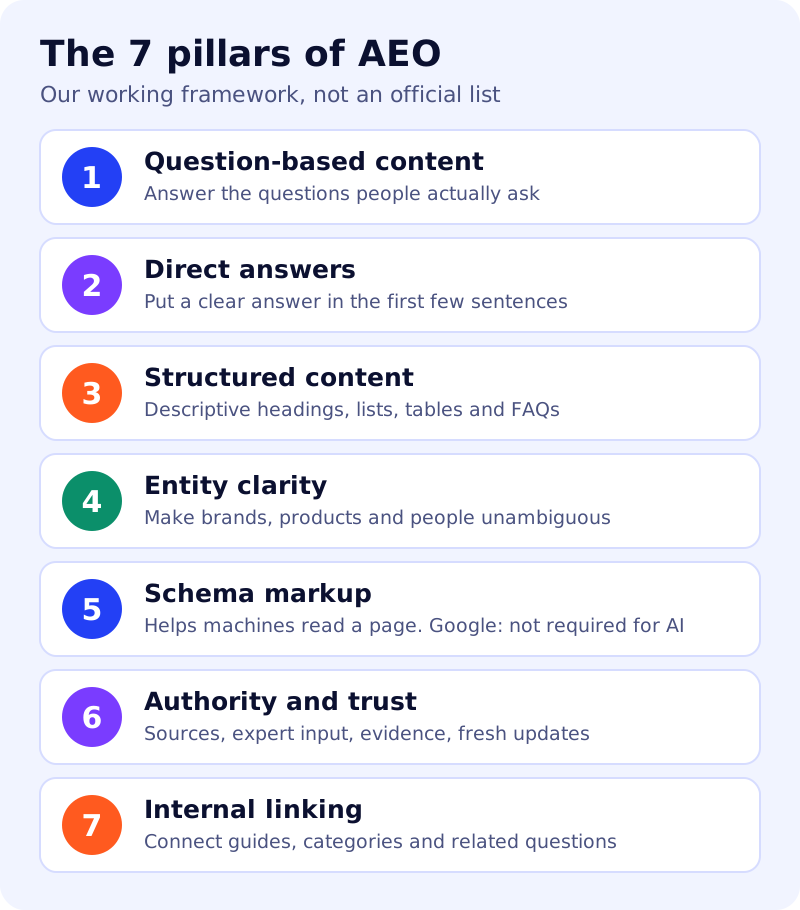
| Pillar and what to do | Caveat |
|---|---|
| 1. Question-based content. Cover the real questions users ask | Google warns that a separate page for every query variation, made mainly to influence AI answers, can violate its scaled content abuse policy. Put the questions on one page. |
| 2. Direct answers. Answer in the first few sentences | Google says you need not write in a special way for AI. Clarity helps readers either way. |
| 3. Structured content. Descriptive headings, lists, tables, FAQs | Google says chopping content into tiny pieces is not required. |
| 4. Entity clarity. Make products, brands, people and their relationships unambiguous | Our view. |
| 5. Schema markup. Use relevant structured data | Google says no special markup is needed for AI features. It still helps with rich results. See schema by page type. |
| 6. Authority and trust. Credible sources, expert input, evidence, updates | Google says original, non-commodity content likely matters most. |
| 7. Internal linking. Connect guides, categories and related questions | See internal linking for AEO. |
Different AI tools, different habits
This is where AEO stops being a Google topic. Google’s guide covers Google Search features only. For the rest, the evidence is thinner, and it says so.





| Platform | What we can say |
|---|---|
| Google AI Overviews and AI Mode | Pages come from Google’s Search index. A page must be indexed and eligible to show with a snippet. See AI Mode vs Search and optimising for AI Overviews. |
| Gemini | Google’s own assistant. Google’s guide covers Search features, not the Gemini app. See how Gemini decides when to ground answers. |
| ChatGPT | Search Engine Journal reported an Ahrefs study saying its most-cited sites tilt toward primary sources. See ranking in ChatGPT. |
| Microsoft Copilot | Reported to rely on Bing’s index. Bing Webmaster Tools has an AI Performance report. See Copilot and Bing. |
| Perplexity | One practitioner’s testing found heavy YouTube citation. A single test, so a clue, not a rule. See ranking on Perplexity. |
The bigger lesson comes from Search Engine Land’s reporting of AI citation data: there is no universal top source for brands, and each AI picks differently. Read more in why ChatGPT, Perplexity and Google cite different sources. Our view: do not chase one “AI ranking”. Build pages worth citing and test each platform.
How an AI finds your page
Google describes two techniques. Retrieval-augmented generation fetches relevant pages and the model reads them to write a response with links. Query fan-out runs several related searches at once. Google’s example: one question about a lawn full of weeds also searches for herbicides, chemical-free removal and prevention.
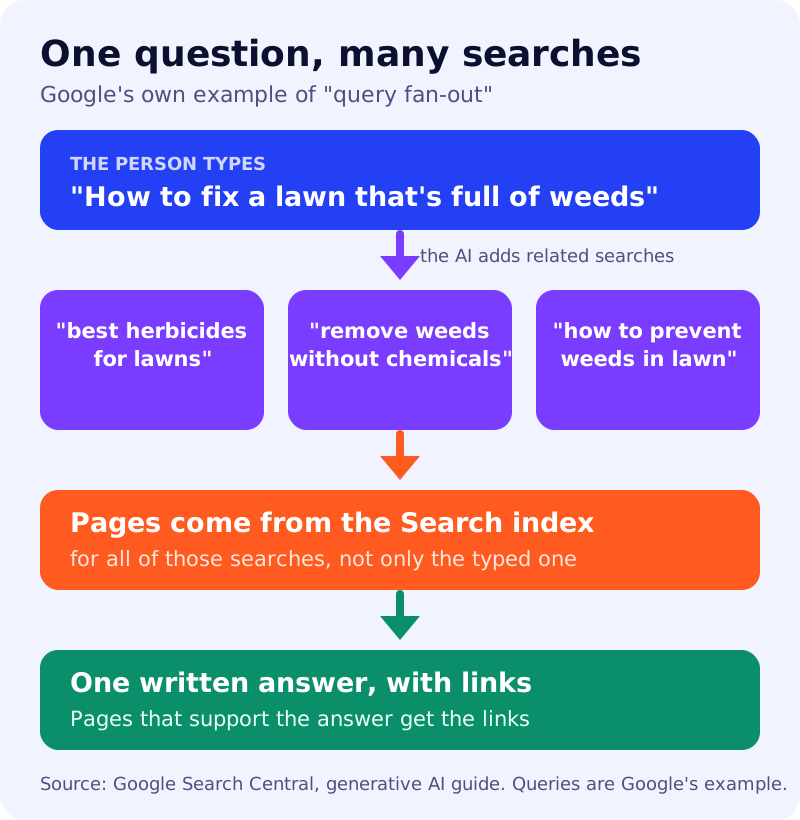
Your page can be fetched for any of those related searches, not only the one typed. Other tools use their own methods. See ChatGPT query fan-out.
What Google says matters most
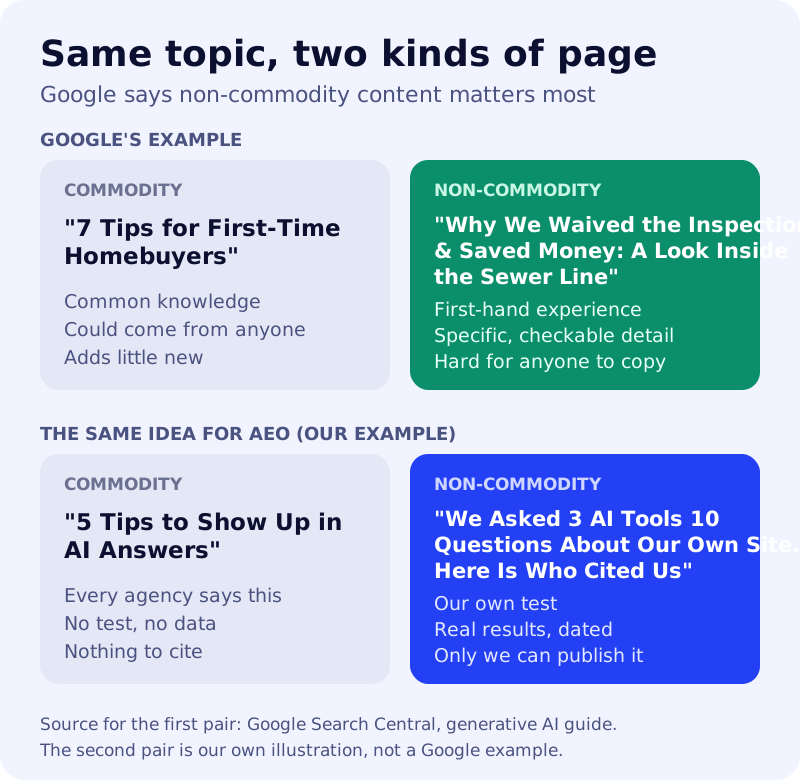
Google says unique, useful content will likely influence AI visibility more than anything else in its guide. It separates commodity content (common knowledge anyone could write) from non-commodity content (experienced takes beyond the ordinary).
What Google says you can skip
For Google Search, the guide says you do not need:
| Tactic | What Google says |
|---|---|
| llms.txt files and “special” AI markup | Google Search ignores them. Harmless if other services use them. |
| Chunking content into tiny pieces | Not required. No ideal page length. |
| Rewriting content only for AI | Not needed. Systems understand synonyms and meaning. |
| Seeking inauthentic mentions | Not as helpful as it looks. |
| Special structured data for AI | Not needed. Keep it for rich results. |
Search Engine Land published a commentary calling Google’s guide “naive and self-serving”, arguing that what the wider web says about you matters too. Both can be true. Seeking genuine mentions is different from faking them.
An example: one category page, three approaches
Take a moisturiser category page on an online beauty store.
| Approach | What the page targets |
|---|---|
| SEO | ”Best moisturisers for dry skin”, brand names, price, product descriptions |
| AEO | Questions answered on the page: What is the best moisturiser for dry skin? Which ingredients help? Should you use moisturiser in summer? How often should you apply it? Gel or cream? Is it fine for sensitive skin? |
| GEO | Accurate, well-connected information about brands, products, ingredients and skin concerns, with associations on trusted sources, so AI recommendations are more likely to cite the store |
Keep the AEO questions on the one page as sections or an FAQ. Six thin pages would run into the spam warning above. Health and skin topics need expert review. See how to prepare a health article.
Which AEO job is yours?
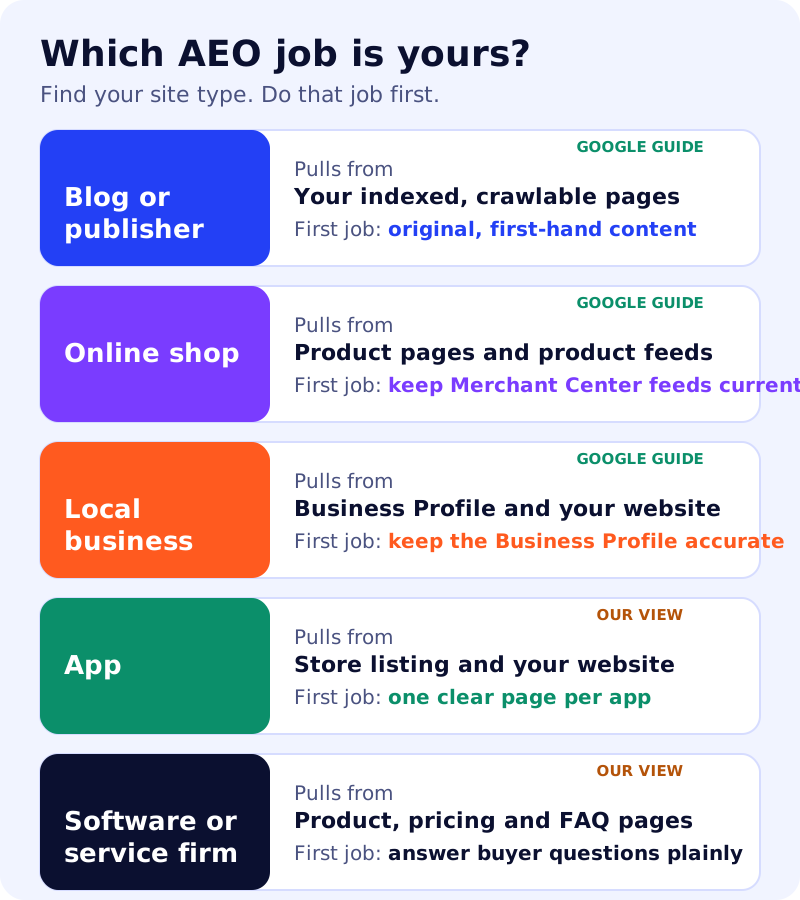
| Site type | First job | Go deeper |
|---|---|---|
| Blog or publisher | Original, first-hand content | Blog guide |
| Online shop | Keep Merchant Center feeds current | AEO for e-commerce |
| Local business | Keep Business Profile details accurate | Local business pages |
| App | One clear page per app | Apps in ChatGPT and Google |
| Software or service firm | Answer buyer questions plainly | SaaS landing pages |
The first three rows come from Google’s guide. The last two are our view.
How to measure AEO
SEO measures rankings and organic traffic. AEO needs more.
| Metric | What it measures | How to check |
|---|---|---|
| Answer inclusion | How often your content appears in answers | Scorecard below |
| AI citations | How often AI platforms cite your site | Scorecard; Bing Webmaster Tools AI Performance report for Copilot and Bing |
| AI visibility | How often your brand is mentioned | Scorecard (M marks) |
| Answer coverage | How many questions your site addresses | Count your question list against your pages |
| AI referral traffic | Visitors coming from AI platforms | Your analytics referral reports |
| Answer accuracy | Whether AI describes your brand and products correctly | Ask each AI about you and note errors |
For Google specifically, Google’s guide points to the Generative AI performance report in Search Console. It warns that no third-party tool has access to Google’s internal ranking or AI systems.
Run the scorecard monthly. For a fuller version, use our 20-prompt AI visibility test.
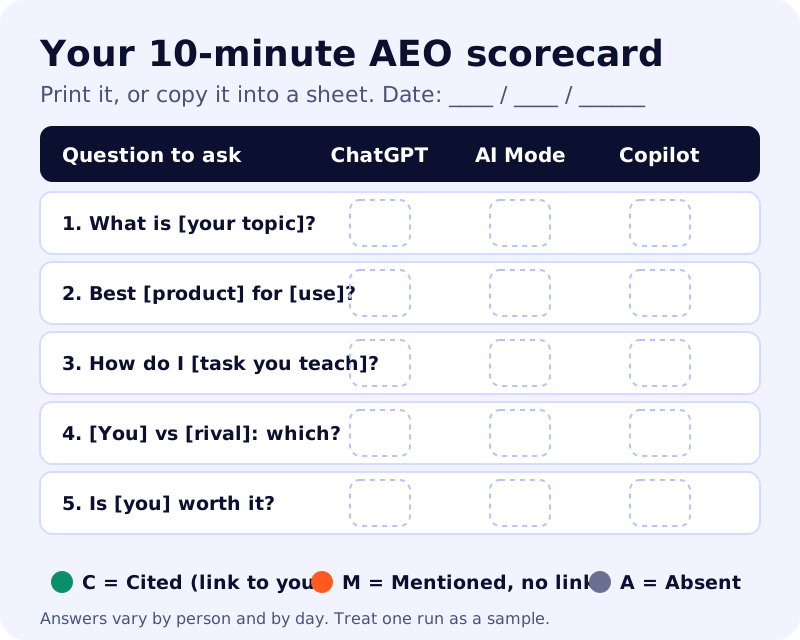
AI answers vary by person and by day. Treat one run as a sample, not a ranking.
Common questions
Is AEO different from SEO? Google says no. Others argue mentions on other sites also matter. Our view: treat it as one strategy.
Does AEO work for ChatGPT and Gemini, not only Google? The goal is the same, but the sources differ by tool. Test each one.
Can AEO guarantee I am cited? No. Nobody controls what an AI tool shows.
How long does it take? We do not have reliable figures, so we will not guess.
What to do
- List the questions your customers ask, and answer each on the right page.
- Open each page with a direct answer. See answer-first pages.
- Add one thing only you can supply: a test, a photo, a measured number. See first-hand evidence.
- Confirm key pages are indexed in Google and Bing.
- Run the scorecard across ChatGPT, AI Mode, Gemini, Copilot and Perplexity, and repeat monthly.
- Skip the tactics in the skip table. See four AEO myths checked.
Want a quick technical read on your own site? Try our website AEO analyzer. The full map is in the AEO and GEO playbook.
The goal: when someone searches, asks Google, talks to ChatGPT or consults Gemini, your brand has a chance of being found, recommended and trusted.