

Until now, a movie review search on Google meant star ratings from a few sites. For one of this week’s big releases, the answer looks different.
What the AI Overview shows
I searched “ramayan review” on Google. The AI Overview on the results page opens by saying Nitesh Tiwari’s Ramayana: Part 1 has had a “heavily divided but massive critical and audience response”. Then it breaks the answer into sections.
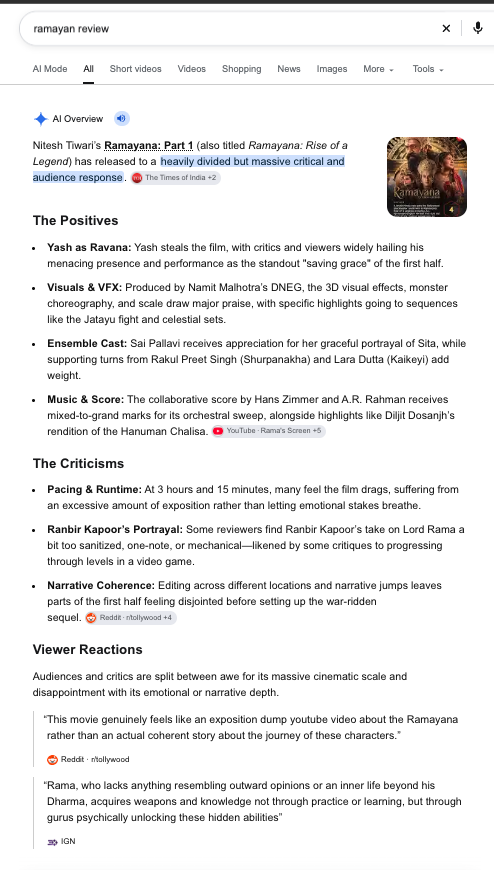
Source: Google search for “ramayan review”, our screenshot.
- The Positives: Yash as Ravana, the visual effects, the cast (Sai Pallavi, Rakul Preet Singh, Lara Dutta) and the music by Hans Zimmer and A.R. Rahman.
- The Criticisms: the three-hour-fifteen-minute runtime and pacing, some reviewers finding Ranbir Kapoor’s portrayal of Rama too sanitized or mechanical, and jumpy editing in the first half.
- Viewer Reactions: a line saying audiences and critics are split between awe at the scale and disappointment at the emotional depth, followed by two direct quotes. One is from a Reddit user in r/tollywood, who says it feels like an “exposition dump” video. The other is from IGN.
- Source links: The Times of India, YouTube and Reddit, shown as small labels next to each section.
Why this matters
A star rating tells you how many people liked a film. It does not tell you why. This answer gives the reasons, in the words of people who watched it: too much exposition, a slow first half, a villain who steals the film.
For someone deciding whether to spend three hours and the price of a ticket, that is more useful than a number. It also means real viewers, the people talking on Reddit, now shape how a film is summarized, next to the critics.
If you are a movie producer or run the digital team
Now you know where to focus. The answer is built from three places: critics, viewers talking on Reddit, and video reviews on YouTube. Your trailer and press kit are only part of it.
- Read the Reddit threads and YouTube reviews from opening day. They decide what the answer says about your film.
- Take the complaints seriously. If viewers keep saying the first half is slow, that line will keep appearing in the answer.
- Do not seed threads or buy reviews. Real conversation is what gets picked up, and fake conversation is easy to spot.
If you are a publisher or a review site
Do not give 5 stars when internet users are saying the film is bad. Readers can now see both in the same answer. If your rating does not match what viewers say, you lose their trust, and next time they will not believe your stars at all.
Give a rating you can defend and say why. Add what a thread cannot: a clear verdict, who the film is for, what you noticed that others missed. See first-hand evidence.
If you are a viewer
Check both sides: the critics and the viewer threads. Open the thread behind a quote and look at the date, because a quote is one person’s opinion and the AI chooses which ones to show. Then take your own call.
This is where AI search is going
The answer is built from many voices: critics, viewers and video. For it to work, everyone has to do their part. Producers have to listen, publishers have to be honest, and viewers have to look at both sides. If one channel is missing or faked, the whole answer goes wrong.
This is not only about movies. In my view, the same will happen to products, apps, restaurants and courses: whatever people say in public threads becomes part of the answer. Our guide on how Reddit became a top source for AI explains why that matters for brands.