

“What is X?” is one of the most common questions put to search and AI tools. It is also the most crowded: every dictionary, vendor and blog answers it. Google’s guide to generative AI search (updated 10 July 2026 as we read it) calls content based on common knowledge, which could come from anyone, commodity content. A bare definition is the clearest example. So the job is not to define the term. It is to define it well and add what others do not. Google gives no glossary-specific rule; the template below is our view.
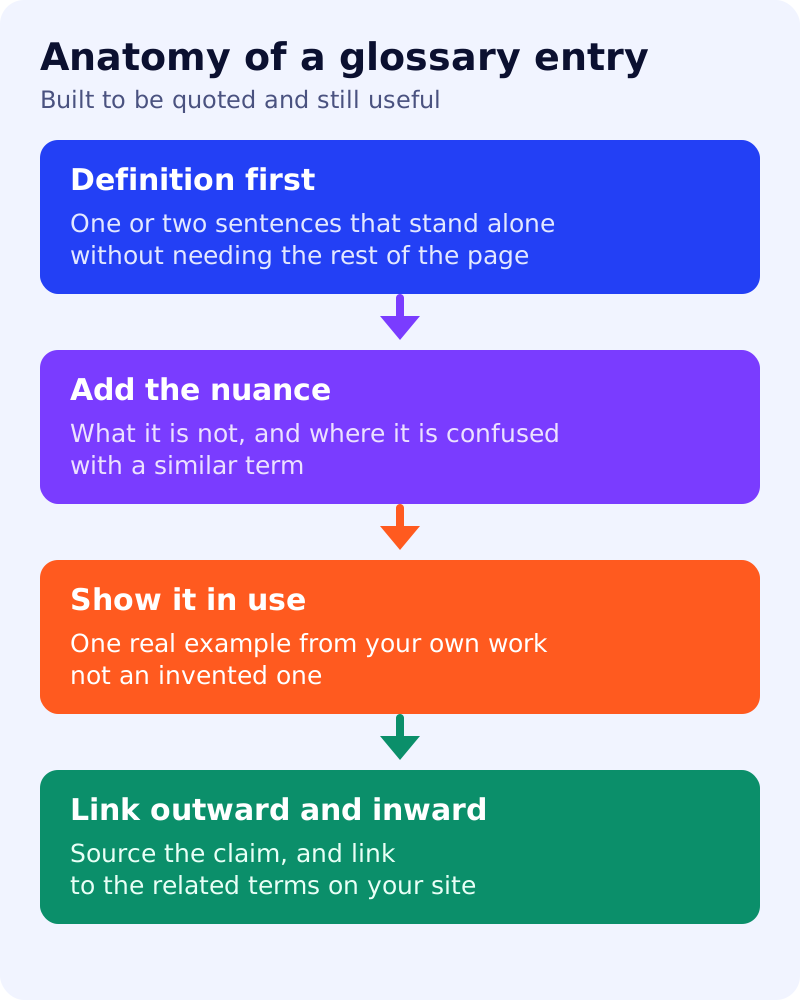
A four-part entry (our own)
- Definition first. One or two sentences that make sense on their own. If an AI summary lifts only these, the meaning survives.
- Nuance. What the term is not, and the term it is most often confused with.
- An example from your work. A real case, not an invented one. This is your first-hand material.
- Links. Link out to the source for any claim, and in to the related terms on your site.
Before and after
Before: “Canonical URL: a URL used for SEO.”
After: “A canonical URL is the address a site owner or Google treats as the main version of a page when several URLs show the same content. It is a signal, not a command. It is often confused with a redirect, which sends visitors elsewhere.”
The second works as a standalone answer, and it points to a real distinction. Compare with our guide to canonical URLs.
A quality check (answer yes to all)
| Check | Why |
|---|---|
| Does the first sentence define the term without needing the page? | It can be quoted whole |
| Does the entry say what the term is not? | Adds value beyond a dictionary |
| Is there one example only you could give? | Non-commodity material |
| Is the date or “last reviewed” honest? | Google warns against fake freshness |
| Is the entry written by a person who knows the topic? | Trust |
The trap
It is easy to produce hundreds of thin entries from a term list. Google says that creating separate content for every query variation, primarily to manipulate rankings or AI responses, violates its scaled content abuse spam policy, and that a high quantity of pages does not make a site higher quality. Publish fewer entries and make each worth reading. Entries you cannot improve are better merged into one guide, or left out.
Structured data
Google says structured data is not required for generative AI search and that no special schema.org markup is needed. A glossary needs good writing, clear headings and working links, not special markup.
What to do
- List your twenty most important terms and drop any you cannot improve.
- Rewrite each entry using the four parts.
- Add one real example to each.
- Link each entry to two related terms and your pillar guide, such as our AEO and GEO playbook.
- Test five entries in your monthly prompt test, and use the sentence rewrites for wording.