

People ask AI tools comparison questions all the time: which is better, what is the difference, which should I choose. A comparison page is a natural source, but most are commodity content: two feature lists copied from vendor sites. Google’s guide to generative AI search (updated 10 July 2026 as we read it) describes commodity content as based on common knowledge that could come from anyone, and says unique, first-hand material will likely matter more than any other tip. Google gives no rule specific to comparison pages. The structure below is our view.
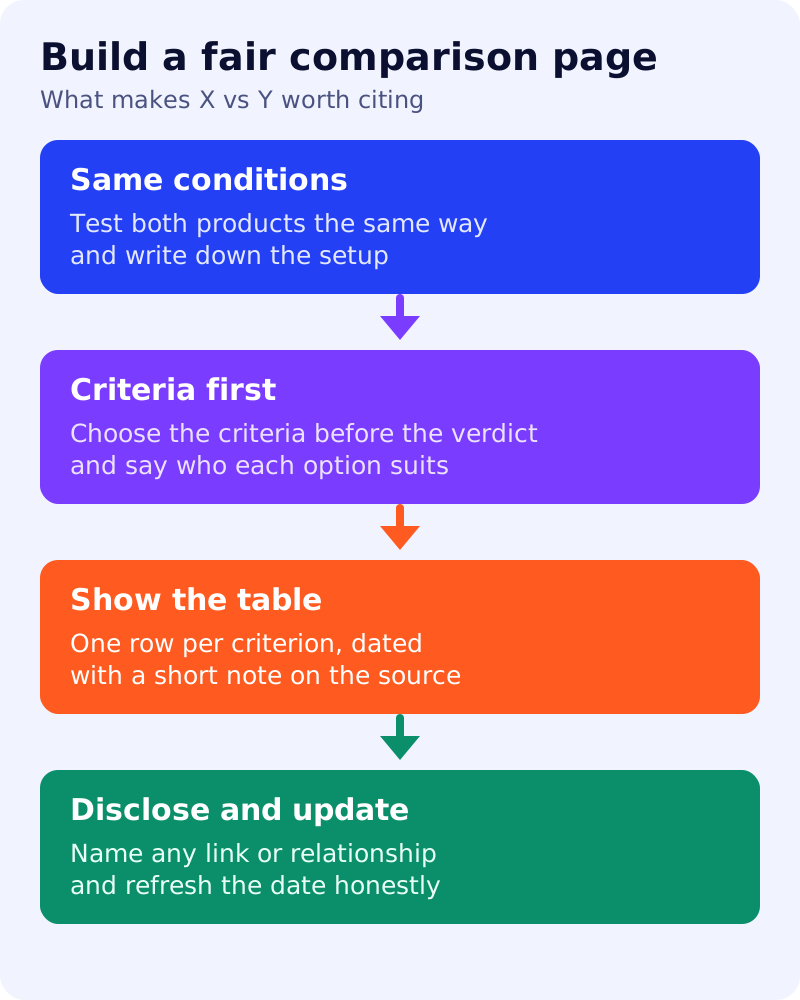
The four parts
- Same conditions. Test both options the same way and write down the setup: version, date, plan, data used.
- Criteria before verdict. Decide the criteria before you look at results, so the verdict does not shape the criteria.
- A dated table. One row per criterion, one column per option, plus a short note on where each fact came from.
- Disclosure. Say if you use, sell or earn from either option. Google’s helpful content page asks whether you have a clear sense of who made the content and how; hidden relationships weaken that.
A scoring rubric (our own)
Score each criterion for each option from 0 to 2 and keep the notes.
| Score | Meaning |
|---|---|
| 0 | Could not do it, or it failed in our test |
| 1 | Worked with effort or with limits |
| 2 | Worked well in our test |
Do not add a total unless you also show the weights. A total with hidden weights is an opinion dressed as a measurement.
Who it suits
End each comparison with two sentences: “Choose X if…” and “Choose Y if…”. This is the part an AI summary can lift without losing meaning, and it is the part commodity pages skip.
Mistakes to avoid
- Declaring a winner when you tested one side properly and read about the other.
- Copying vendor claims without a source and date.
- Stale tables. Google’s helpful content page warns against changing dates to look fresh when content has not changed; update the table and the date together.
- Publishing a page for every pair of products. Google says producing pages for every query variation mainly to manipulate rankings or AI responses violates its scaled content abuse policy.
What to do
- Pick one pair your customers genuinely ask about.
- Write the criteria first, then test both options and record the setup.
- Build the table and the “Choose X if” lines.
- Add a disclosure line and a review date.
- Add the page to your 20-prompt visibility test, and see eight kinds of first-hand evidence for what to add. The wider map is in our AEO and GEO playbook.
No one can promise that a page will be cited. See what you can control.