

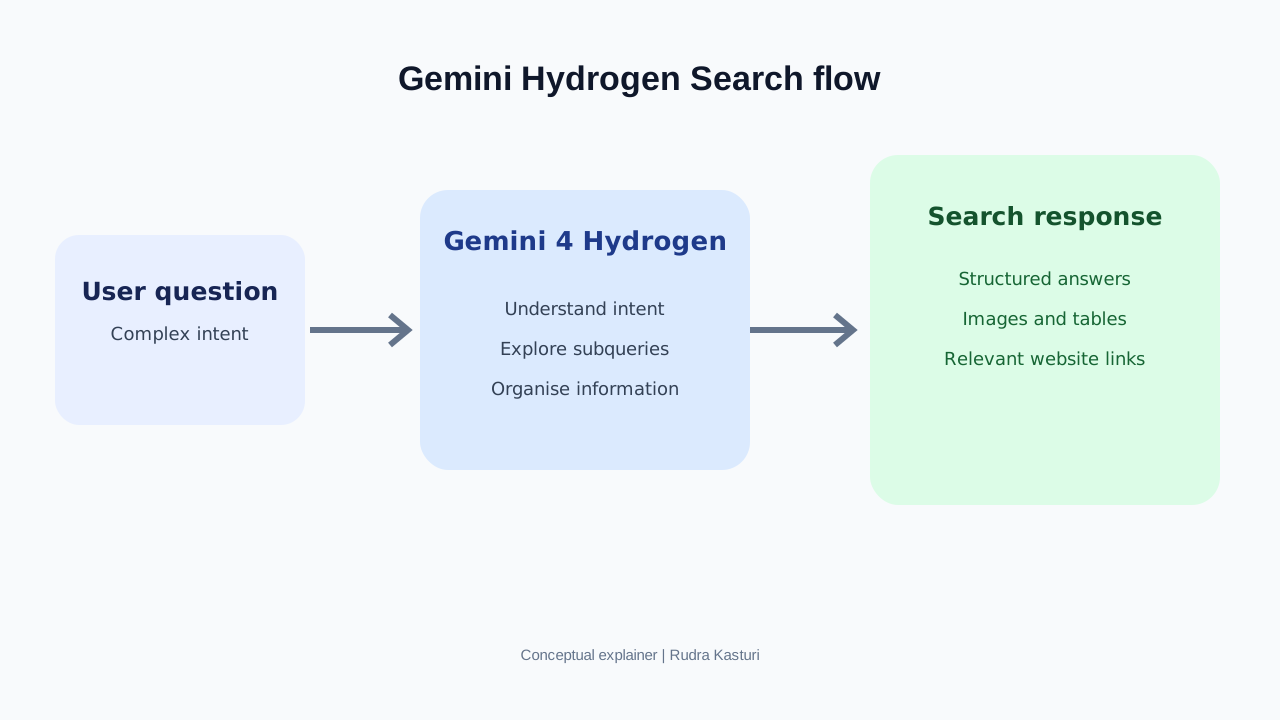
Google’s 12 November 2026 announcement brings Gemini 4 Hydrogen into Google Search globally. Google describes it as the biggest model upgrade to Search yet. The practical change is that Search is being designed to understand more of what a person means, investigate connected parts of a question and return a more structured response with useful links.
For a user, this could make Search feel less like entering one keyword and scanning a list, and more like explaining a task and getting help with the different parts of it.
For a publisher, the question is more complicated. If Search answers more of the question on the results page, some users may not click through. But if it understands the task better and explores more subtopics, it may also discover and surface websites that a simple keyword search would not have found.
Both outcomes can happen. The impact will depend on the query, the answer format, the website and what the user needs next.
1. What did Google Search look like before this upgrade?
It helps to separate three things that are often mixed together: traditional Google Search, AI Overviews and AI Mode.
Traditional Search starts with a query and returns a ranked set of results. A person might type “best air purifier for a 2BHK flat”, open several pages, compare room coverage, filter replacement costs, noise levels and service availability, and then make a decision. The user does much of the research by moving between websites.
AI Overviews place an AI-generated summary within the Search results for eligible queries. They can give a person a starting explanation and links to supporting pages. They do not appear for every search.
AI Mode is a more conversational Search experience. A user can ask a longer question, ask follow-ups and explore a topic in a more interactive way.
These experiences existed before Gemini 4 Hydrogen. The November announcement is not the launch of AI Overviews or AI Mode. It is an upgrade to the model capabilities being used within Google Search.
So what was the model before Hydrogen?
Google’s public Search announcement does not provide a complete model-by-model migration table for every Search surface. That distinction matters. We should not state that one named model was replaced everywhere.
Contemporary reporting says Gemini 4 Hydrogen became the default model in AI Mode and is being used for the hardest questions in AI Overviews. Earlier in 2026, Google had described Gemini 3.5 Flash as the default in AI Mode. However, the exact routing for every AI Overview query has not been fully documented publicly.
The safe explanation is this: Search already had AI-powered experiences. Hydrogen is a newer model upgrade intended to improve how those experiences understand, reason through and present complicated requests. It does not mean every ordinary search is now handled as a long AI conversation.
2. What exactly has changed with Gemini 4 Hydrogen?
Google’s announcement points to four important improvements.
A. Search can understand the complete request
Earlier, a user might have needed to split a complicated task into several searches.
For example, imagine a family in Hyderabad planning a five-day holiday in December. They want a destination that is suitable for a six-year-old child, not too expensive, reachable by train, with pleasant weather and activities that do not involve long drives.
A basic search journey might look like this:
- Best family holiday destinations in December.
- Hyderabad to destination train options.
- Weather in each destination.
- Family-friendly hotels.
- Activities for children.
- Approximate five-day trip cost.
Hydrogen is designed to understand more of those conditions from the original question. It can follow multiple requirements and address different parts of the request in one experience.
What the user may notice: less need to rewrite the question repeatedly, and answers that reflect more of the conditions they gave.
What this does not guarantee: that every answer will be complete, current or correct. Users should still verify prices, schedules, availability and important decisions on the original provider’s website.
B. Search can investigate related questions at the same time
This is one of the most important changes for SEO.
Google refers to query fan-out. In simple terms, Search can break a large question into smaller related searches and explore them simultaneously.
Take the air purifier example. The main question is not just “best air purifier”. The useful answer may need to consider:
- Room size and air changes.
- CADR and filter performance.
- Replacement filter cost.
- Noise at night.
- Electricity use.
- Availability of service in the user’s city.
- Independent testing and product limitations.
A system that explores these subtopics can find relevant sources beyond pages that repeat the exact phrase “best air purifier”.
Google says Hydrogen improves this process and can connect users to a broader range of helpful links, including websites they might not otherwise have discovered.
Why publishers should care: a page may be discovered because it provides a strong answer to one important sub-question, even if it does not target the user’s entire original sentence.
This increases the value of genuinely useful supporting pages. It does not mean creating dozens of thin pages for every possible variation. The pages must add distinct information.
C. Answers can become more visual and easier to compare
Google says Search can show more images, structured responses, comparison tables and custom tools.
Think about a person comparing two cities, three mobile phones or different investment account features. A structured comparison may help them understand the differences faster than reading a long block of text.
For users, this can reduce effort. For websites, it changes the competition. A page is no longer useful only because it contains the right keyword. It must contribute information that makes the answer better.
That could be original product testing, a clear price breakdown, a useful calculator, local availability, expert explanation or a comparison based on transparent criteria.
D. Search is designed to understand supported languages more naturally
Google says the improvements bring more nuanced responses across languages supported by its AI models.
This matters in India. A person may ask a question in English, use Telugu or Hindi phrases, mix languages, make spelling mistakes or describe a need in everyday language rather than formal search terms.
The opportunity for publishers is to understand how people actually express problems. A Telugu-speaking user may search for a service using a local phrase, while a formal English page may describe the same topic differently.
This is not a reason to publish machine-translated pages at scale. Language quality, local context, accurate terminology and useful answers still matter.
3. What will a normal Google user experience?
The change is easiest to understand through a before-and-after example.
| User task | Earlier search journey | What Hydrogen is designed to improve |
|---|---|---|
| Plan a family trip | Search destination, weather, trains, hotels and activities separately | Understand the combined requirements and explore related subtopics |
| Compare phones | Open multiple reviews and product pages | Present more structured comparisons and relevant sources |
| Research a health topic | Search symptoms, causes, tests and questions separately | Better understand a multi-part question and organise the response |
| Find a local service | Try several phrases and compare listings | Understand more context and surface relevant information |
| Learn a technical topic | Search definitions, examples and implementation separately | Address connected parts of a complex request more coherently |
The important phrase is “designed to improve”. Google has announced the capability direction, not a guarantee that every user will see the same layout or receive the same answer.
A user should still expect normal Search results to exist. The upgrade does not announce the removal of websites, organic listings or the open web.
4. What does this mean for website traffic?
There are two forces at work. One can reduce clicks. The other can create new discovery.
The click-loss possibility
If a person gets a satisfactory summary, comparison or explanation directly in Search, they may not need to open several websites.
This is most likely to matter when the query can be resolved with a short factual answer or a simple comparison. Publishers whose pages offer little beyond information already visible in the answer may face more pressure.
For example, a page that only lists five generic tips may have less reason to earn a click than a page with original research, a downloadable checklist, a detailed cost model or first-hand testing.
The discovery opportunity
Google says improved query fan-out can connect users to a broader range of relevant websites.
A specialist website may be useful for one part of a larger question. A local publisher may have current information about a city. A product reviewer may have conducted a real test. A technical blog may explain a specific implementation problem.
These sources can contribute value even when they do not own the broadest keyword.
The business outcome is not the same as the traffic outcome
A website may receive fewer visits but still influence a purchase or decision through an AI answer. Another website may receive more impressions but no additional qualified visitors.
That is why one traffic number is not enough.
| Possible outcome | What it means | What to measure |
|---|---|---|
| More exposure | A page appears for more related searches | Search Console impressions and query coverage |
| More clicks | Users choose to visit the website | Organic clicks, sessions and landing pages |
| More AI references | A page is linked or cited in an AI answer | Repeatable AI citation observations |
| More brand discovery | People remember or search for the brand | Branded queries, direct traffic and mentions |
| More business value | Visibility contributes to an action | Leads, sales, subscriptions and assisted conversions |
| Less click-through | The answer satisfies the user before a visit | CTR changes by query group, alongside impressions |
Do not add citations, impressions, visits and brand mentions into one made-up visibility total. They are different outcomes and should be reported separately.
5. Which websites could be most affected?
The effect will vary by business model and query type. These are hypotheses to test, not confirmed traffic forecasts.
News publishers: Basic breaking-news summaries may face pressure if the user only needs the headline and a short explanation. Original reporting, local detail, exclusive data, analysis and continuing coverage give readers a stronger reason to visit.
Affiliate and review websites: Generic lists may be easier to summarise. Real product testing, clear comparison methods, ownership costs, limitations and updated availability can make a review more useful.
E-commerce websites: Product discovery may become more conversational. Product attributes, accurate availability, delivery details, return policies, reviews and comparison information become important inputs to a useful buying decision.
Local businesses: A user may describe a need in detail rather than search for a category alone. Accurate business information, service areas, hours, contact details and credible local reviews remain important.
B2B and specialist websites: These may benefit when they answer a difficult sub-question with genuine depth, evidence, documentation or a tool that helps a buyer evaluate options.
6. What should SEO teams change?
The response should be a better content and measurement system, not a new collection of AI keywords.
Step 1: Build pages around user tasks
Move beyond asking only, “Which keyword should this URL rank for?”
Ask:
- What is the user trying to decide or complete?
- What information do they need before taking the next step?
- Which conditions change the answer?
- What could go wrong if they follow incomplete advice?
- What evidence would make the page more trustworthy?
A good page should solve a meaningful part of the user’s task.
Step 2: Add information that cannot be copied from ten other pages
This is where publishers can build a real advantage.
Examples include:
- Original surveys and research.
- First-hand product or service testing.
- Local prices and availability with dates.
- Expert interviews with clear attribution.
- Screenshots, calculations and transparent methodology.
- Case studies that explain what was tried and what happened.
- Useful tools, templates and decision frameworks.
Do not invent experience or claim that a test was conducted when it was not.
Step 3: Make the page easy to understand and verify
Use descriptive headings, direct explanations, tables where comparisons genuinely help, clear dates and links to primary sources.
Keep the page focused. Answer the main question early, then explain the detail. Make important limitations visible rather than hiding them at the bottom.
Structured data should accurately describe visible page content and follow Google’s documentation. Schema is not a shortcut to an AI citation.
Step 4: Build connected topic coverage
A useful topic cluster might contain:
- A main guide explaining the subject.
- Supporting pages answering specific sub-questions.
- A comparison page for alternatives.
- A practical checklist or calculator.
- A case study showing real-world application.
- Timely updates when facts change.
Link these pages where the connection helps the reader. Do not create internal links simply to increase their number.
Step 5: Measure AI visibility without confusing it with rankings
Create a fixed set of real user questions for each important topic. Test them periodically across relevant Search experiences. Record whether the brand or page appears, which URL is linked, what context is given and whether the answer is accurate.
This is a sample, not a complete view of Google’s AI system. Results can vary by location, language, account, device and time.
7. A 30-day measurement plan for publishers
Do not compare one random day before the announcement with one random day after it. The November 2026 Core Update began on 10 November, while the Hydrogen Search announcement was published on 12 November. These overlapping changes make simplistic attribution unreliable.
Use the following measurement approach.
| Period | Work | Output |
|---|---|---|
| Days 1 to 3 | Save the previous 28-day baseline from Search Console and analytics | Baseline by query group, page type and country |
| Days 4 to 7 | Create a sample of 30 to 50 user questions across key topics | Repeatable AI visibility test set |
| Days 8 to 14 | Review pages with high impressions, falling CTR or changing query coverage | Opportunity and risk list |
| Days 15 to 21 | Improve a small set of pages with evidence, comparisons and clearer task completion | Controlled improvement cohort |
| Days 22 to 30 | Compare the cohort with similar pages that were not changed | Early directional read, not final causal proof |
Track at least these metrics:
- Search exposure: impressions by query group and page type.
- Search visits: clicks, CTR and average position.
- Audience quality: engaged sessions, returning users and meaningful page actions.
- AI discovery: identifiable referrals and repeatable citation observations.
- Brand demand: branded search impressions, direct visits and qualified mentions.
- Business results: leads, sales, subscriptions and assisted conversions.
Use a 28-day pre-announcement baseline and continue monitoring for at least 28 days after the rollout is understood. Compare equivalent weekdays and account for seasonality, campaigns, technical changes and the Core Update.
A simple scorecard
For management reporting, give each topic cluster a score out of 100:
- Search exposure: 20 points.
- Qualified organic visits: 20 points.
- AI references and citations: 15 points.
- Brand demand: 15 points.
- Engagement and return visits: 10 points.
- Conversions and assisted value: 20 points.
This is a proposed internal measurement framework, not a Google metric. Keep the component numbers visible so a high score cannot hide a fall in clicks or conversions.
8. What should not change?
Do not stop doing SEO. Google still relies on the web and its links to help people discover information.
Do not rewrite every page because a new model has arrived. Improve pages where evidence shows a user problem or a competitive weakness.
Do not add an FAQ section to every article just to imitate conversational queries. Add questions only when they help the reader.
Do not assume that mentioning Gemini, AI Mode or AI Overviews will make a page visible in those experiences.
Do not confuse a citation with an endorsement, a click or a sale.
And do not attribute every ranking movement to Hydrogen. The November Core Update and other changes are happening around the same period.
9. What Google has confirmed, and what remains unknown
Confirmed by Google: Gemini 4 Hydrogen is being brought to Search globally. Google says it improves intent understanding, query fan-out, visual responses and language understanding across supported languages.
Reported by industry publications: Hydrogen is the default model in AI Mode and is used for the hardest questions in AI Overviews. Google has not published a complete public routing specification for every query and Search surface.
Not yet quantified: How many additional links will appear, how often a given site will be cited, how click-through rates will change, which query categories will see the largest impact and how much traffic any publisher will gain or lose.
This distinction is important. A responsible SEO strategy should respond to product changes without turning Google’s product claims into unsupported traffic predictions.
Our conclusion: SEO is becoming a discovery and decision-support discipline
Gemini 4 Hydrogen does not make websites irrelevant. It raises the standard for why a website deserves to be found and visited.
A page that repeats common information may be easy for an AI answer to summarise. A page that brings original evidence, practical experience, clear comparisons, local knowledge or a useful tool gives both the search system and the reader a stronger reason to consider it.
For users, the promise is less effort in finding a useful answer. For publishers, the challenge is to be more than one interchangeable source among many.
The next phase of SEO should measure four separate stages: discovered, referenced, visited and chosen. A publisher needs to know where it is visible, whether it earns a click, whether people trust it and whether that attention creates a meaningful outcome.
That is a more useful way to prepare for AI Search than chasing a new ranking trick every time Google changes its model.