

A person planning a weekend in Paris may not begin with a hotel or flight search. They may ask a more immediate question: what can we do this Saturday, how much will it cost and where can we book it?
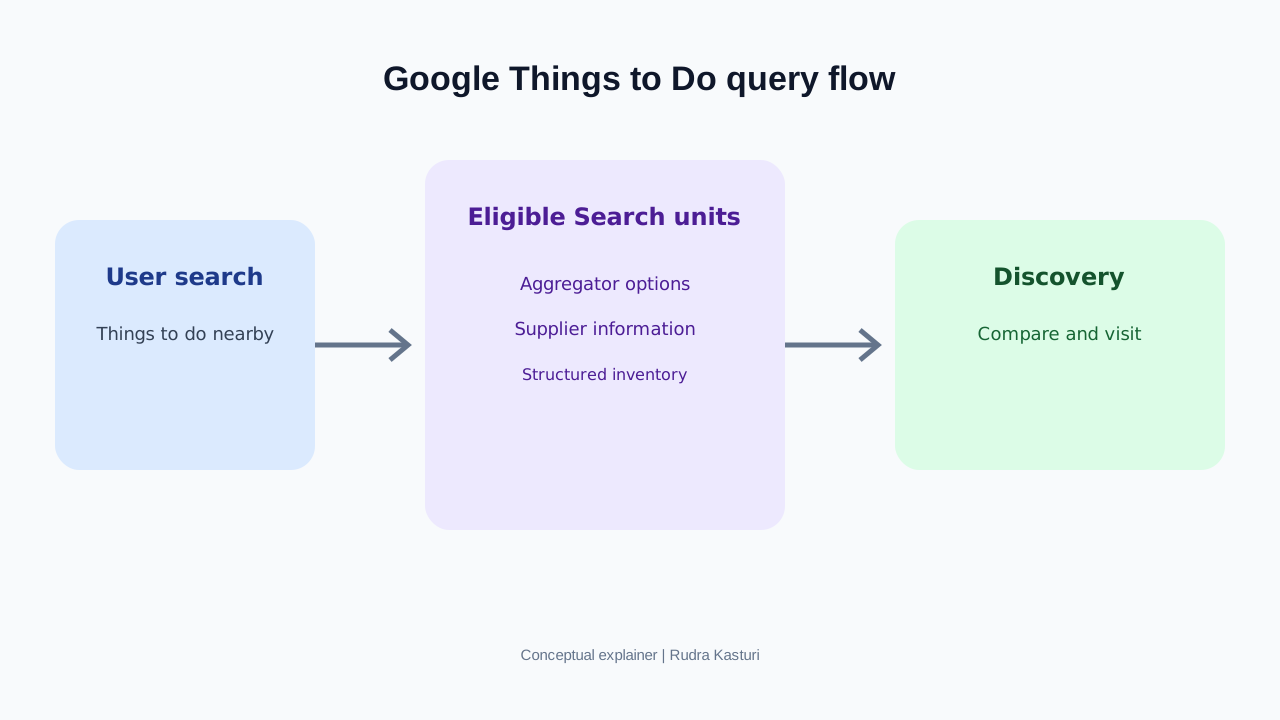
Google Search has been developing specialised experiences for these kinds of searches. On 9 November 2026, Google Search Central updated its aggregator and supplier unit documentation to include support for “Things to Do” queries.
This is relevant to activity marketplaces, tour booking platforms, experience aggregators and individual providers. But there is an important qualification: Google’s current documentation describes these aggregator and supplier experiences for people searching in European Economic Area countries. An Indian travel company should understand the opportunity, but must not assume the same unit is already available to Indian users.
1. What exactly did Google change?
Google’s Search documentation now includes Things to Do queries as a supported query type for aggregator units and supplier units.
The update is a documentation and feature-support change. It does not mean Google has announced a general ranking boost for travel content, or that every page about tourist attractions will appear in a new Search feature.
The distinction is important because these units are designed around businesses and services that can supply structured, useful information about bookable or discoverable experiences.
2. What is an aggregator unit?
An aggregator brings together options from multiple providers.
Imagine a traveller searching for guided walking tours in Rome. A travel marketplace may list 20 tour operators, with different routes, durations, prices, ratings and availability.
The marketplace is not necessarily running every tour. It helps users discover and compare offerings from multiple suppliers.
Google describes aggregator units as a multi-provider feature for vertical search services. Its examples include online travel agencies, comparison shopping services, metasearch engines and directories.
An eligible aggregator may provide results relevant to the user’s query. The unit can help the user compare options from the provider.
3. What is a supplier unit?
A supplier is the business that directly provides the service.
For example:
- A local guide offering a heritage walk.
- A museum selling timed-entry tickets.
- An adventure company offering a rafting experience.
- A boat operator offering a city tour.
- A theme park selling entry tickets.
The supplier is responsible for the actual experience, availability and service details. The aggregator helps users discover and compare multiple suppliers.
A single company can operate as a supplier, while a marketplace may operate as an aggregator. Some businesses may have more than one role, depending on how their inventory and service are structured.
4. What might a user see?
Imagine someone searches for “things to do in Barcelona this weekend”.
An eligible Search experience may help surface activity options from participating providers. Depending on the query and available data, users may see details such as photos, prices, ratings or other information that helps them evaluate options.
The business opportunity is to reduce the distance between discovery and booking.
But Google decides when and where these experiences appear. Participation does not guarantee that a particular listing will be shown for every query.
5. Who should pay attention?
Online travel agencies: Platforms that aggregate tours, attractions and experiences from several operators.
Activity marketplaces: Businesses that let users compare and book local activities.
Tour operators: Companies that own and operate guided experiences.
Attractions and venues: Museums, parks, cultural sites and ticketed attractions.
Local experience businesses: Providers offering activities that travellers can discover and book.
A travel blog publishing “25 things to do in Jaipur” is not automatically an aggregator or supplier. Editorial content can help users research a destination, but it is not the same as operating a qualifying service or supplying eligible inventory.
6. What information should a business prepare?
Google’s aggregator guidance emphasises relevant content, data supplied through appropriate integrations and rich entity details. Its recommendations include:
- Accurate and descriptive titles.
- High-quality original images.
- Detailed descriptions and specifications.
- Verified ratings and review counts where available.
- Useful categories, amenities and operating hours.
- Current pricing and availability.
- Data feeds or real-time APIs where required for the relevant feature.
For a Things to Do business, useful inventory information could include:
- Activity name and provider.
- Location and meeting point.
- Duration and language.
- Age or accessibility restrictions.
- Available dates and time slots.
- Price and inclusions.
- Cancellation terms.
- Genuine reviews and ratings.
- A direct landing page where the user can verify and book.
The precise data requirements depend on the feature and business model. Read the current supplier or aggregator documentation rather than assuming that adding a generic schema type is sufficient.
7. Does this matter to Indian travel companies?
Yes, as a product and data-readiness issue. But regional eligibility must be understood correctly.
Google’s current aggregator documentation says these experiences are seen by people in European Economic Area countries. It also explains how eligible businesses can express interest and provide relevant data.
An Indian travel platform serving European travellers may want to examine whether its business model and inventory meet the documented requirements. A business serving only Indian users should not promise clients that a new Things to Do unit will appear in Indian Search as a result of this update.
The broader lesson still applies to Indian travel discovery: structured and accurate activity information makes it easier for users and platforms to understand what is being offered.
For example, a Hyderabad-based heritage walk operator should maintain clear information about meeting points, languages, duration, group size, accessibility, dates and booking conditions. That is useful even before any specialised Search feature is available locally.
8. What should a travel business do now?
For aggregators
- Map the activity categories and providers in the inventory.
- Check whether the business qualifies as a vertical search service under Google’s documentation.
- Review the required feed or API integration.
- Remove expired activities and duplicate inventory.
- Make provider identity, pricing and availability consistent between feeds and landing pages.
- Review the Google participation process and regional eligibility.
For suppliers
- Maintain one accurate source of truth for activities and schedules.
- Use descriptive activity names and original photographs.
- Explain duration, inclusions, exclusions and restrictions.
- Keep prices and availability current.
- Make booking and cancellation conditions clear.
- Ensure the landing page matches the data supplied to Google.
For SEO teams
- Separate editorial destination guides from bookable inventory pages.
- Build useful activity pages with specific details, not generic keyword copy.
- Link guides to relevant activities where it helps the traveller.
- Monitor Search Console and referral traffic by country and page type.
- Check regional Search availability before reporting a feature as launched in a market.
9. What should you measure?
A travel platform should not measure this initiative only through rankings.
Track:
- Eligible inventory coverage.
- Percentage of listings with complete data.
- Price and availability mismatch rate.
- Listing impressions and clicks where reporting is available.
- Referral visits to activity pages.
- Search-to-detail-page progression.
- Booking conversion rate.
- Cancellation and refund rate.
- Revenue per available activity.
A useful internal readiness score could allocate 25 points to inventory completeness, 20 to data accuracy, 20 to landing page quality, 15 to provider verification and 20 to booking experience. This is a proposed operational score, not a Google ranking metric.
What this update does not mean
It is not a universal ranking update for travel websites.
It does not guarantee a listing, rich result or increase in bookings.
It does not mean a blog article becomes a supplier listing because it contains an activity description.
It does not remove the need for accurate inventory, a trustworthy provider and a useful booking experience.
It also does not establish that the same Search unit is available in every country. Regional differences matter.
Our reading
Travel discovery is moving closer to the actual activity a person wants to book. Search is not only helping people read about a destination. In eligible markets, it can also help them compare providers and move toward a transaction.
For travel businesses, the first task is not to add more keywords. It is to make the inventory real, complete, current and easy to evaluate.
For Indian companies, prepare the data and user experience, watch regional eligibility and avoid selling a Google feature to clients before it is actually available in their target market.