

“Best of” pages and reviews are a crowded category, and thin ones are easy to spot. Google’s review guidance (last updated 10 December 2025 as we read it) lists what separates a useful review from a summary.
Best for: review editors, affiliate sites, publishers and ecommerce content teams.
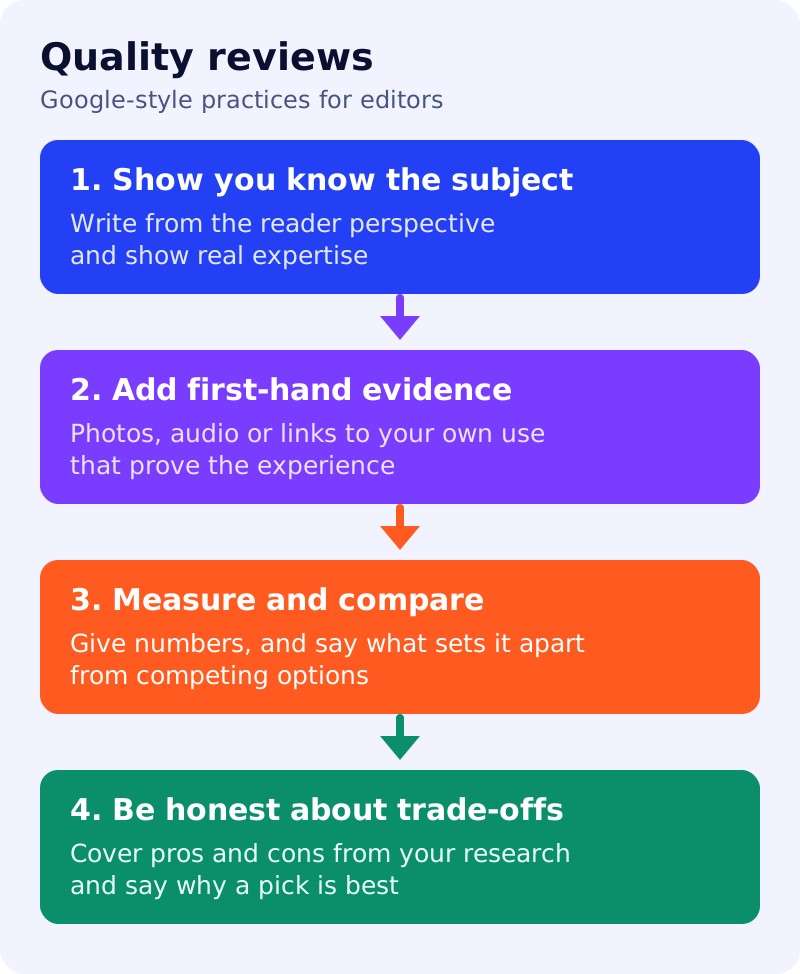
What Google says
Reviews can cover products, services, destinations, games, movies and other topics, and can come from an expert staff member or merchant, an independent blogger or a publisher’s editorial team. Google’s practices include:
- Evaluate from a user’s perspective, and show that you are knowledgeable about what you review.
- Provide evidence such as visuals, audio or links showing your own experience, to support your expertise and the authenticity of the review.
- Share quantitative measurements of how something performs in various categories.
- Explain what sets something apart from competitors, and cover comparable things to consider or which suits which circumstances.
- Discuss benefits and drawbacks based on your own original research.
- Describe how a product has evolved from previous models, and focus on the most important decision-making factors.
- Describe key design choices and their effect on users beyond what the manufacturer says.
- Include links to other useful resources, and consider links to multiple sellers.
- When recommending something as best overall or for a purpose, say why, with first-hand supporting evidence.
- Make ranked lists stand on their own even if you also write single in-depth reviews.
- If you use affiliate links, see Google’s position on affiliate programs.
- Focus on quality and originality, not length.
What to do: editor’s scoring sheet
Score each review 0 to 2 per row. The scoring is ours.
| Row | Evidence to record |
|---|---|
| Expertise visible | Author page, relevant background |
| Own evidence | Photos, audio, test notes, dates |
| Measurements | At least two numbers from your own testing |
| Comparison | Named alternatives and who each suits |
| Trade-offs | At least two drawbacks from your testing |
| Decision factors | The two or three that matter most |
| Where to buy | More than one seller, if relevant |
| Ranked list | Each pick explains why it is best |
A total under 10 of 16 goes back for another round.
What to do: step by step
| Step | Owner | Time | How to check | Done when |
|---|---|---|---|---|
| 1. Plan the testing | Reviewer | 1 hour | A checklist of measurements | Tests are defined before buying |
| 2. Capture evidence as you go | Reviewer | During testing | Dated photos, notes, files | A folder per product |
| 3. Draft with trade-offs | Writer | 3 hours | Each pro has a con | No review is all praise |
| 4. Run the scoring sheet | Editor | 20 min | Score each row with evidence | Total is 10 or more |
| 5. Check links and disclosure | Editor | 15 min | Affiliate links labelled as sponsored | See our link labelling guide |
| 6. Revisit when products change | Editor | Quarterly | Dated update notes | Review shows an honest date |
Common mistakes
- Rewriting manufacturer specifications as a review.
- Ranking products you did not test.
- Using length as a substitute for evidence.
- Hiding affiliate relationships. See rel sponsored, ugc and nofollow.
Related: first-hand evidence, the Who, How and Why review and honest page dates. Results are not guaranteed.