
A robots.txt line only controls the visitors that obey it. Google’s three crawler pages (last updated 30 October, 17 September and 19 August 2026 as we read them) show that Google’s own visitors fall into groups with different rules.
Best for: SEO leads, developers and anyone editing robots.txt or reading server logs.
What Google says
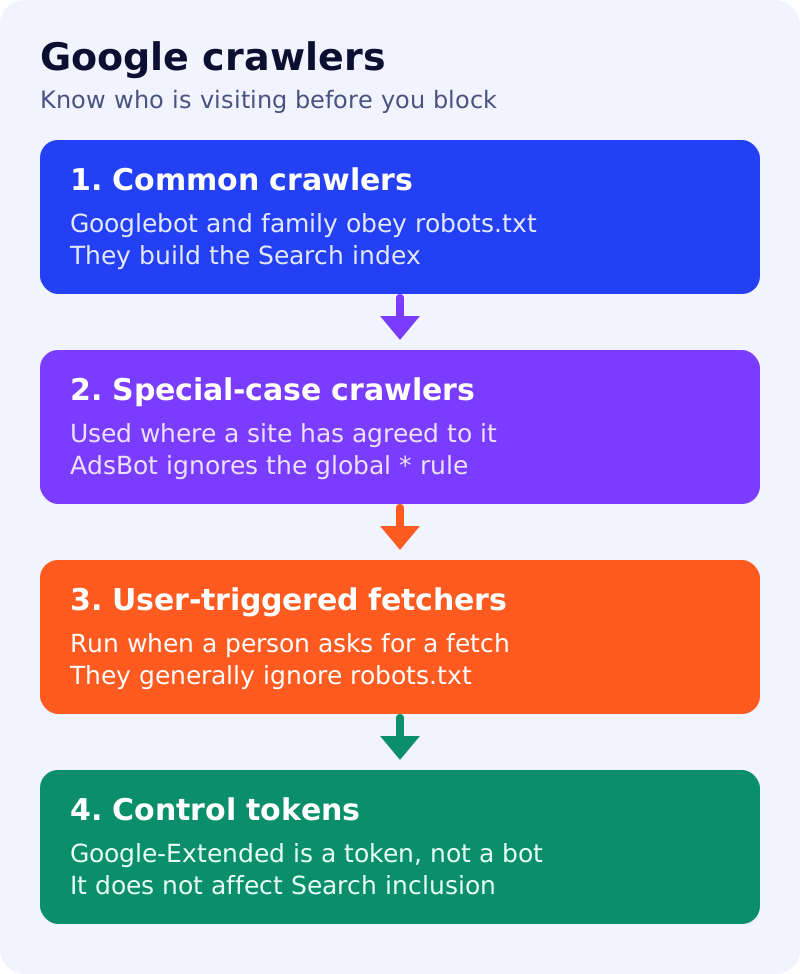
- Common crawlers build Google’s indexes and always obey robots.txt when crawling automatically. They include Googlebot (smartphone and desktop), Googlebot-Image, Googlebot-Video, Googlebot-News, Storebot-Google, Google-InspectionTool, the generic GoogleOther family and Google-CloudVertexBot.
- Crawl preferences for the Googlebot token affect Google Search, including Discover and all Search features, plus other products such as Images, Video mode and News. Storebot-Google affects Google Shopping surfaces. Google-InspectionTool affects testing tools such as the Rich Results Test and URL inspection, and has no effect on Search itself.
- Special-case crawlers are used by specific products where the crawled site and the product have an agreement. They may ignore robots.txt and use different IP ranges. AdsBot, for example, ignores the global
*user agent with the ad publisher’s permission. - User-triggered fetchers run because a person asked for a fetch, so they generally ignore robots.txt. Examples on the page include Google Site Verifier, Feedfetcher, Google Read Aloud, Google Publisher Center, Google Messages link previews, Gemini Notebook and Google-Agent, which Google describes as used by agents hosted on Google infrastructure to navigate the web and act on a user’s request.
- Google-Extended is a robots.txt token only, with no separate user agent string. Google says it manages whether crawled content may be used for training future Gemini models and for grounding in Gemini Apps and Vertex AI. It does not impact Search inclusion and is not a ranking signal. Google also says it intends to support the AIPREF training preference signal in early 2027.
- User agent strings can be spoofed, so verify a requester using Google’s published IP ranges or reverse DNS.
Decision table
| You want to | Use | Remember |
|---|---|---|
| Keep a folder out of Google Search crawling | A Googlebot robots.txt rule | It does not remove already-indexed pages. See noindex vs robots.txt |
| Keep images out of Google Images | A Googlebot-Image rule | Images appear in several features |
| Opt out of Gemini training and grounding | Google-Extended | It does not affect Search inclusion |
| Stop an ad quality check | An AdsBot-Google rule | The global * rule is ignored |
| Stop a user’s own fetch | Authentication or removal | robots.txt generally does not apply |
What to do: step by step
| Step | Owner | Time | How to check | Done when |
|---|---|---|---|---|
| 1. Read your robots.txt aloud | SEO | 15 min | List every User-agent token | Each token matches a row on Google’s pages |
| 2. Mark each rule’s intent | SEO, legal | 30 min | Write why it exists beside it | No rule without a reason |
| 3. Pull 24 hours of logs | Developer | 30 min | Filter on Google tokens | A count per crawler exists |
| 4. Verify the top five visitors | Developer | 30 min | Reverse DNS and published IP lists | Spoofed requests are separated |
| 5. Check Google-Extended | Leadership | 20 min | Decide on training and grounding | A recorded choice and owner |
| 6. Re-review quarterly | SEO | 30 min | Compare to Google’s current pages | A dated note is saved |
Common mistakes
- Blocking
Googlebotto stop AI training. That token affects Search. - Assuming robots.txt stops every Google fetch. User-triggered fetchers generally ignore it.
- Trusting a user agent string without verifying it. See our server log method.
Related: blocking AI bots in robots.txt and can ChatGPT reach your site. Crawler lists change, so re-read Google’s pages before editing.