

Teams often review content for keywords and grammar. Google’s helpful content guidance (last updated 5 October 2026 as we read it) suggests three different questions: Who, How and Why. This worksheet turns them into a repeatable review.
Best for: editors, content leads, SEO and AEO teams running a publishing process.
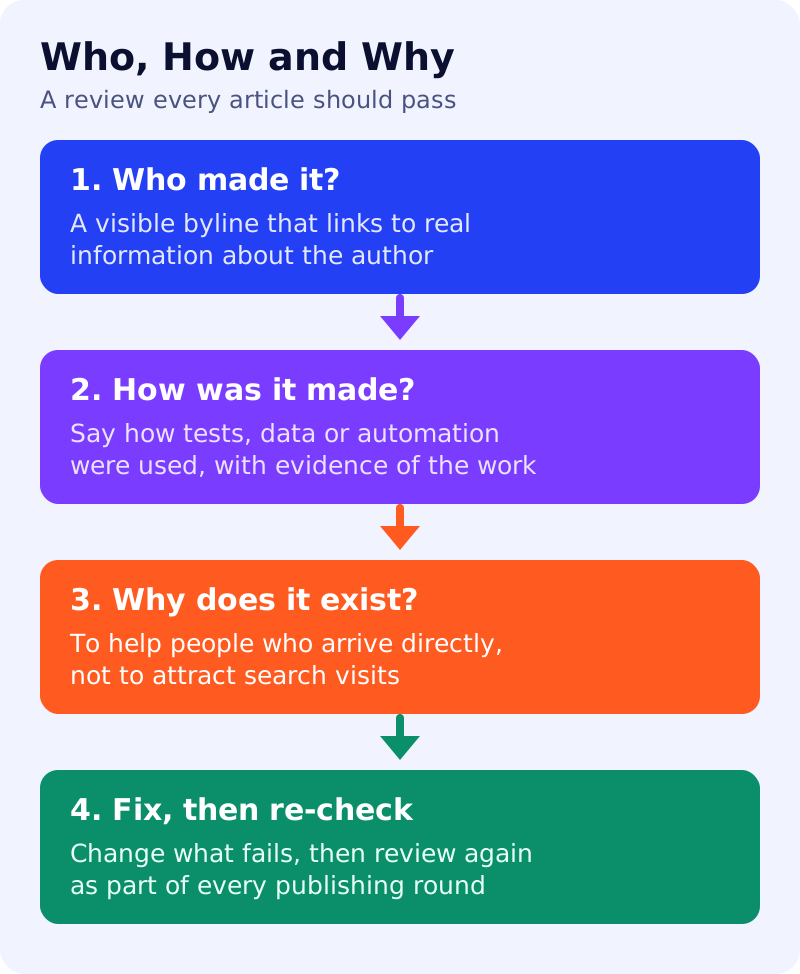
What Google says
- Who. It helps readers when it is clear who created the content. Ask whether authorship is self-evident, whether pages carry a byline where expected, and whether bylines lead to information about the author. Google strongly encourages accurate authorship, and says fabricated creator profiles, such as AI-generated headshots, made-up names or false credentials, are deceptive and a low-quality signal.
- How. Explaining how content was produced builds trust. For product reviews that means what was tested, the results and how, with evidence such as photographs. For automated or AI-assisted content, ask whether use of automation is evident and explained.
- Why. The most important question. The reason should be to help people who arrive directly. If the main reason is to attract search visits, that is not what Google’s systems reward, and using automation mainly to manipulate rankings violates its spam policies.
The worksheet
Score each question 0 (no), 1 (partly) or 2 (yes), and write the evidence.
| Question | Score | Evidence to write |
|---|---|---|
| Is there a visible byline? | 0 to 2 | Link to the byline |
| Does it lead to a real author page? | 0 to 2 | Link to the author page |
| Does the author have a real connection to the topic? | 0 to 2 | One line, verifiable |
| Does the article show how it was made or tested? | 0 to 2 | Method, date, photos |
| Is automation use clear where readers would expect it? | 0 to 2 | The disclosure sentence |
| Would it be useful to someone who arrived directly? | 0 to 2 | The reader and their task |
| Is the main purpose to help, not to catch searches? | 0 to 2 | The editor’s judgement |
A score under 9 of 14 goes back for revision. The scoring is our own, not Google’s.
What to do: weekly routine
| Step | Owner | Time | How to check | Done when |
|---|---|---|---|---|
| 1. Pick five new or updated articles | Content lead | 10 min | Last week’s publishing list | Five links in the worksheet |
| 2. Score each on the worksheet | Editor | 45 min | Fill every evidence cell | No blank evidence cells |
| 3. List fixes for scores below 9 | Editor | 15 min | One fix per failed question | A fix list exists |
| 4. Assign and complete fixes | Writer | 1 to 2 hours | Re-score after the change | Each article is 9 or above |
| 5. Hold an outside read | Peer or outsider | 30 min | Ask someone not on the team | One note per article |
| 6. Track the average | SEO lead | 10 min | A running monthly average | The trend is recorded |
Common mistakes
- Adding a byline without an author page. See author and profile pages.
- Disclosing AI use but publishing unchecked facts. See using generative AI content.
- Using the review to defend a ranking drop instead of improving content. See what to do after a core update and first-hand evidence.
Reviews do not guarantee rankings.