

An author page is where a reader, and a search system, can check who is behind your content. Many are a name and a stock sentence. Google’s documentation points to what makes them useful.
Best for: blogs, news sites, forums and company sites with named creators.
What Google says
- ProfilePage markup is for sites where creators, people or organisations, share first-hand perspectives. It helps Google understand the creators behind content.
- The primary focus of the page must be a single person or organisation affiliated with the website. Valid examples include an author page on a news site, an “About Me” page on a blog, an employee page and a forum profile.
- A store home page, or a review site for an organisation not associated with the site, is not a valid use.
- Google’s examples use
name,alternateNameandsameAslinks on a Person. - The helpful content guidance encourages accurate bylines where readers expect them. It warns that fabricated creator profiles, such as AI-generated headshots, made-up names or false credentials, make a page untrustworthy.
Google’s generative AI guide says no special markup is needed for AI features. Our view: an honest author page still helps, because it gives every system the same checkable facts.
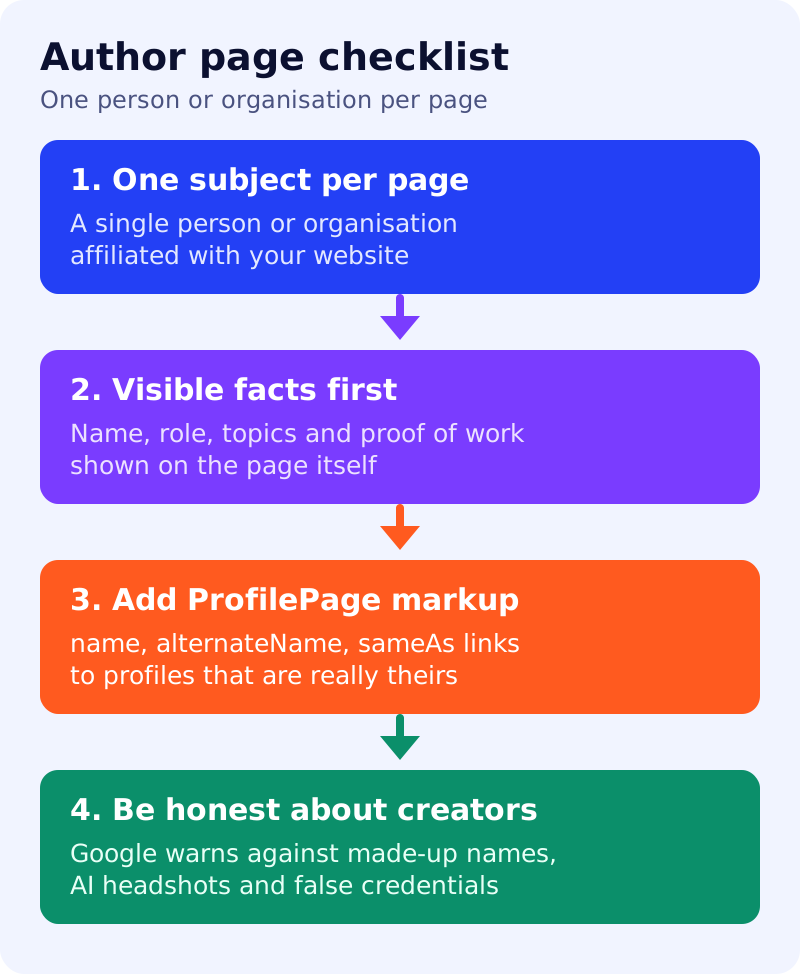
The four-point checklist
| Check | Pass if |
|---|---|
| One subject | The page is about one person or organisation |
| Visible facts | Name, role, topics covered and examples of work are on the page |
| Markup | ProfilePage with Person, and sameAs links only to real profiles |
| Honest details | Every credential and photo is real |
A worked example (made-up)
Before: “Admin” with a stock bio. After: “Priya Nair, senior editor, covers travel and rail. Articles: five linked titles. Profiles: her publisher page and professional profile.” Each statement is true and checkable.
What to do
- List your authors and merge “Admin” pages into real names or an organisation page.
- Add a short bio, topic list and links to recent work.
- Add ProfilePage markup and validate it.
- Link each article byline to the author page. See Article schema that matches the page.
- Read first-hand evidence and schema for AEO.