

Teams use AI to draft, research and structure content. Google’s guidance (last updated 1 October 2026 as we read it) does not ban that. It sets two conditions: accuracy and added value.
Best for: content leads and editors who use AI tools and need a standard review before publishing.
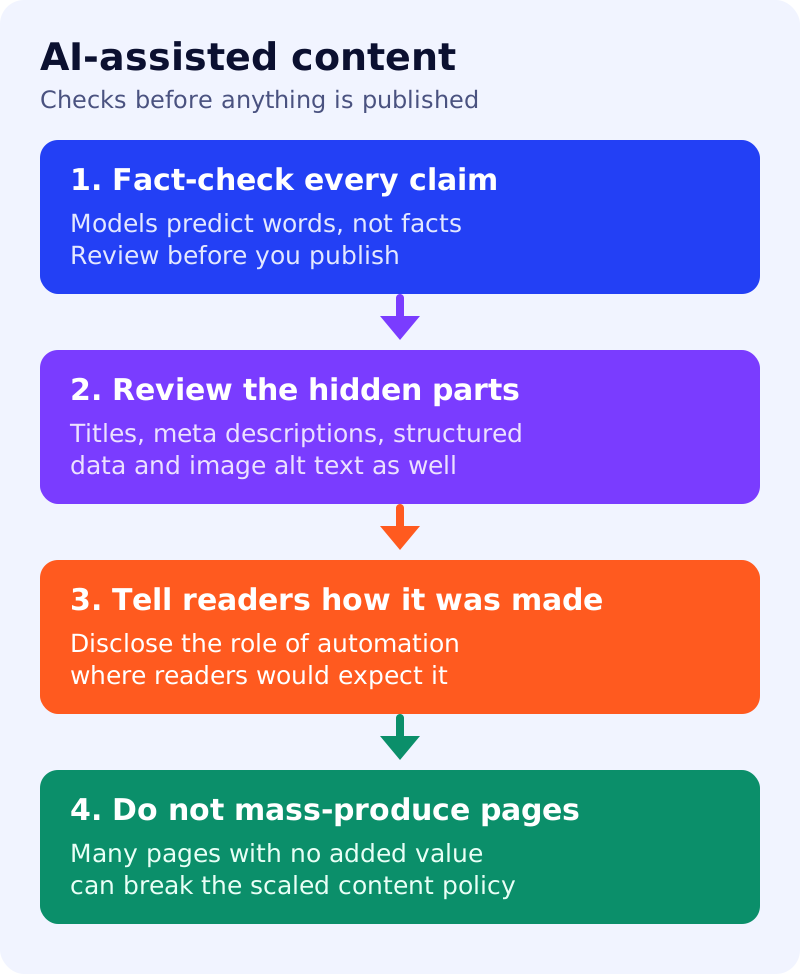
What Google says
- Generative AI can help with researching a topic and adding structure to original content.
- Using it to generate many pages without adding value for users may violate the spam policy on scaled content abuse.
- Generative models do not retrieve facts; they predict a likely sequence of words, so outputs may contain inaccuracies. Google calls manual fact-checking and review critical before publishing.
- That review also applies to title elements, meta descriptions, structured data and image alt text.
- Sharing how content was created gives readers context, for example how automation was used.
- Merchant Center has its own policies: AI-generated images need the IPTC
TrainedAlgorithmicMediametadata, and AI-generated product titles and descriptions must be specified separately and labelled. - The Search Quality Raters guidelines (sections 4.6.5 and 4.6.6) describe how raters evaluate scaled content abuse and low-effort main content. Google says they are not a ranking guide.
What to do: pre-publish checklist
| Step | Owner | Time | How to check | Done when |
|---|---|---|---|---|
| 1. Trace every claim to a source | Editor | 20 min per article | Open each source and compare | Each number and quote has a link |
| 2. Check names, dates and prices | Editor | 10 min | Compare against primary pages | No unverified specifics remain |
| 3. Review hidden elements | SEO | 10 min | Read the title, meta description, alt text and markup | None contains unchecked AI text |
| 4. Add first-hand value | Subject expert | 30 min | Does the page contain something only you could write? | At least one original example, test or number |
| 5. Disclose where readers would expect it | Editor | 5 min | Is the role of AI clear where it matters? | A plain sentence or note is added |
| 6. Run the scale test | SEO lead | 15 min | How many similar pages exist? | Near-duplicates are merged or dropped |
| 7. Log the process | Editor | 5 min | A shared record of who checked what | The log is saved with the draft |
Common mistakes
- Checking the body but publishing an unchecked meta description.
- Letting a tool write structured data that does not match the page. See structured data policies.
- Treating disclosure as a replacement for quality.
- Publishing hundreds of near-identical pages. Our spam policy guide explains the policy in plain words.
Our view
Use AI for structure and first drafts if you want, but let a named person own accuracy. Pair this checklist with first-hand evidence, which is what separates a page from a summary.