

Every week a new tool or agency promises AI visibility. Google has a page on how to weigh such offers, and its generative AI guide adds a warning about tools that claim to use internal Google metrics. This post turns both into a scorecard a team can use before buying or acting on any advice.
Best for: SEO and AEO leads, marketing heads and anyone signing a tool or agency contract. Learners are welcome: each step names who does it and how to check it.
New to SEO or AEO? AEO means answer engine optimisation: work aimed at being shown in AI answers. GEO is the generative version of the same idea. Tools in this area promise to measure or improve it, and this post helps you ask whether the promise holds.
SEO and AEO angle: Google’s guidance covers both labels together: for SEO and AEO teams alike, claims should be checked against official guidance.
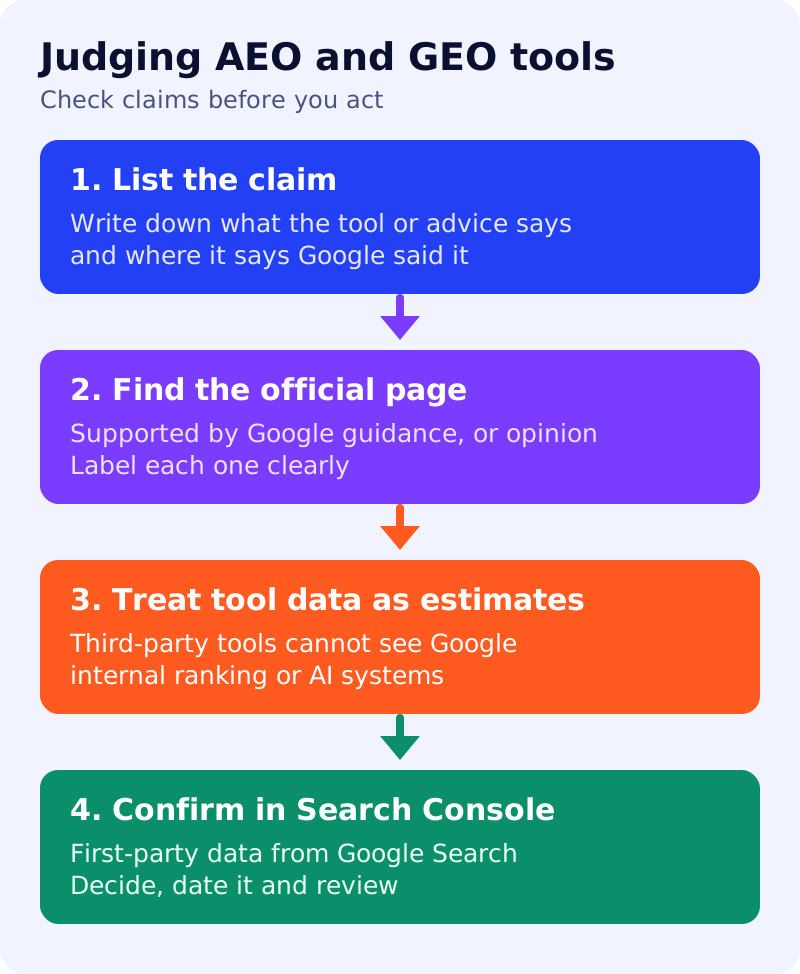
What Google says
- Good advice either qualifies its claims as opinion based on data or experience, or backs them up by citing official Google guidance. Some advice misinterprets what “Google says”.
- Services and tools in this space include sitemap generation, indexing directives, “SEO-optimized” content, ranking improvements and “AEO” or “GEO” tools. Google says it does not evaluate third-party services, so be wary of claims that something is “acceptable” or “approved” by Google Search.
- Using a service or tool does not guarantee ranking success.
- Some tools provide data that users misread as coming from Google. Third-party tools do not have access to Google’s internal ranking data, cannot guarantee performance, and their predictions are their own.
- Google encourages using Search Console, its first-party tool, in either case.
- In its generative AI guide, Google says to be wary of tools that promise ranking success or claim to use “internal” Google metrics, and that no third-party tool has access to its internal ranking or AI systems. Tools can still be used if they help your workflow, as long as the advice is checked against official guidance.
What to do: step by step
| Step | Owner | Time | How to check | Done when |
|---|---|---|---|---|
| 1. Write down each claim | SEO | 30 min | A sheet with claim, source and date | Every claim listed |
| 2. Find the official page | SEO | 45 min | A link to a Google page that supports it | Supported, opinion or unsupported marked |
| 3. Separate opinion from official | SEO lead | 20 min | Opinion is labelled as opinion in the report | Nobody presents opinion as policy |
| 4. Check the data source | Analyst | 30 min | Does the tool say where its numbers come from? | Estimates labelled as estimates |
| 5. Compare with Search Console | Analyst | 1 hour | Tool trend against your own first-party data | Differences explained in writing |
| 6. Decide and date it | Marketing head | 15 min | Keep, trial, or drop, with a review date | A decision and a date on file |
Example (made up)
A vendor says its score “matches Google’s AI ranking”. The team finds no Google page that says so, notes that Google says tools cannot see internal systems, and treats the score as the vendor’s own estimate. They trial the tool for one month and compare its trend with Search Console.
Common mistakes
- Repeating “Google says” without a Google page to point to.
- Buying a tool because it promises a guaranteed citation.
- Reporting tool scores as if they were Google data.
- Never revisiting a tool decision.
Related: no one can guarantee an AI citation, four AEO and GEO myths checked and the Search Console generative AI report. Results are not guaranteed.