

A person searches in Hindi and sees a result from an English page, with the title and snippet already in Hindi. That is a translated result. Google’s page on it explains what it does and how to opt out. This post turns it into a routine for publishers who serve readers in more than one language.
Best for: publishers, ecommerce and SaaS sites with international or regional-language audiences. Learners are welcome: each step names who does it and how to check it.
New to SEO or AEO? Machine translation can show your page’s title and snippet in another language when someone searches in that language.
SEO and AEO angle: Google’s pages do not say how translation relates to AI features, so measure translated results in Search Console and treat AI features separately.
What Google says
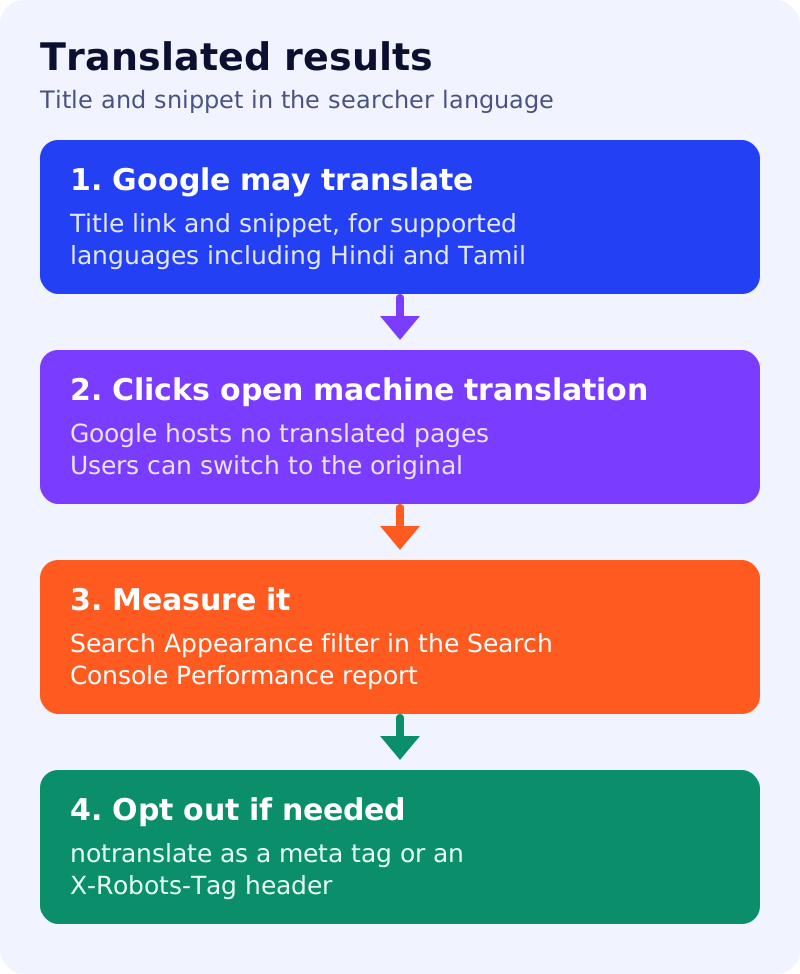
- To help close content and perspective gaps when users search in their local language, Google may translate the title link and snippet of results that are not in the language of the query, when available.
- Google may translate results into these languages: Arabic, Bengali, English, French, German, Gujarati, Hindi, Indonesian, Kannada, Korean, Malayalam, Marathi, Persian, Portuguese, Spanish, Tamil, Telugu, Thai, Turkish, Urdu and Vietnamese. It is available on mobile and desktop.
- If the user clicks the translated title link, they get a machine-translated page, with an option to view the original. Google does not host translated pages: opening one is no different from opening the original through Google Translate or Chrome’s in-browser translation. JavaScript on the page is usually supported, as are embedded images and other page features.
- If you run an ad network, you may need extra steps so ads display correctly after a click on a translated result.
- To monitor clicks and impressions, use the Search Appearance filter in the Performance report in Search Console.
- You do not need to opt in. To opt out of all translation features in Google Search, use the
notranslaterule as a meta tag (<meta name="robots" content="notranslate">, orgooglebotto apply only to Google) or as anX-Robots-Tag: notranslateHTTP header.
What to do: step by step
| Step | Owner | Time | How to check | Done when |
|---|---|---|---|---|
| 1. Check your languages | SEO | 30 min | Your content languages against Google’s list | Overlap noted |
| 2. Measure | Analyst | 30 min | Search Appearance filter in the Performance report | Clicks and impressions recorded |
| 3. Test the experience | QA | 1 hour | Open a translated result and use the page | Core actions work after machine translation |
| 4. Check ads | Ad ops | 1 hour | Ads and consent still display | Ad network confirmed |
| 5. Decide | Marketing lead | 30 min | Keep, or add notranslate to pages where translation would mislead | Decision per page type |
| 6. Review quarterly | SEO | 30 min | Same filter, new dates | Dated review |
Example (made up)
A legal information site finds that translated results bring Hindi readers to English guides. QA finds the machine-translated pages work. The team keeps the feature for guides but adds notranslate on pages with exact legal wording, where a machine translation could mislead.
Common mistakes
- Assuming Google stores a translated copy of your page.
- Never checking how a translated page behaves for users.
- Adding notranslate site-wide without a reason.
- Forgetting that ad networks may need extra steps.
Related: robots meta tag and X-Robots-Tag rules, Google softens its stance on automated translation and visual elements of a search result. Results are not guaranteed.