

AEO teams track how often their brand appears in AI answers, and many tools do it by sending large numbers of queries. Google’s spam policies contain a short section on automated traffic. This post explains what it says and how to design tests and tool choices with it in mind. It is not legal advice.
Best for: AEO and SEO leads who run visibility tests, and anyone buying a rank-tracking or AI-tracking tool. Learners are welcome: each step names who does it and how to check it.
New to SEO or AEO? Rank checkers and AI visibility tools send many queries to see where you appear. Google’s spam policy limits automated queries sent to Google.
SEO and AEO angle: This post is mainly for AEO teams, but the same rule applies to classic rank tracking, so SEO teams should read it too.
What Google says
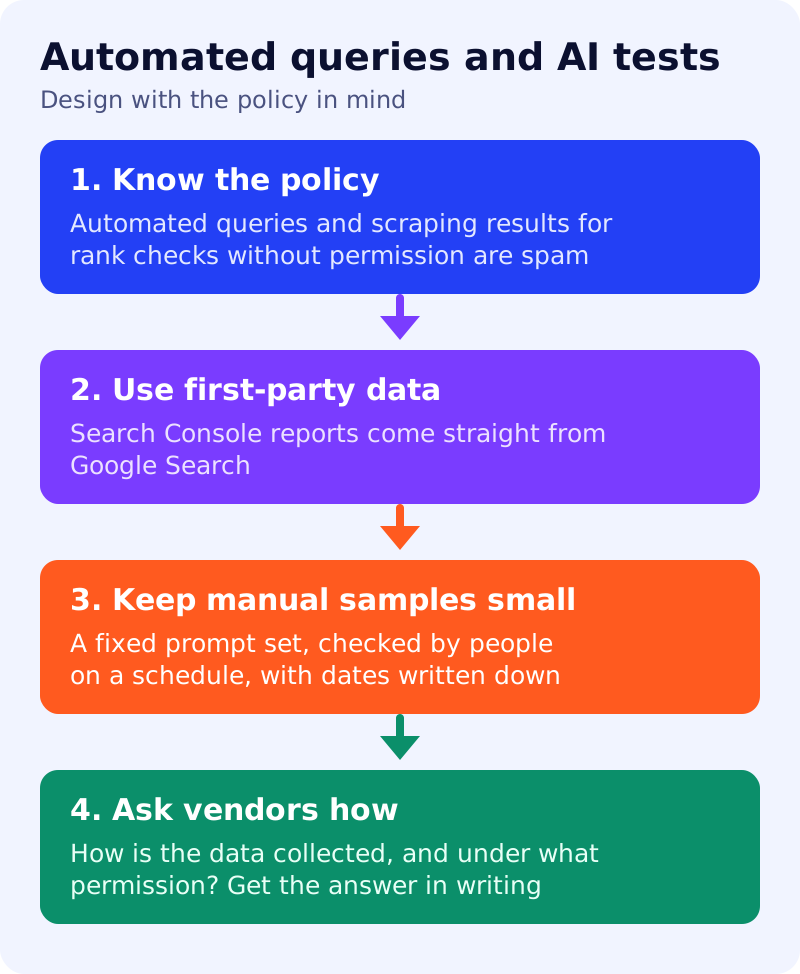
- Machine-generated traffic (also called automated traffic) is sending automated queries to Google. Google’s examples include scraping results for rank-checking purposes and other automated access to Google Search conducted without express permission.
- Google says it consumes resources and interferes with its ability to serve users, and that such activity violates its spam policies and the Google Terms of Service.
- Google’s third-party guidance says third-party tools do not have access to its internal ranking data, cannot guarantee performance, and that some provide data users misread as coming from Google. It encourages Search Console, a first-party tool, in either case.
- Google’s generative AI guide points to the generative AI performance report in Search Console to measure visibility in AI features on Search and Discover.
- The page covers Google Search. Other AI products have their own terms; read each one before you automate.
What to do: step by step
| Step | Owner | Time | How to check | Done when |
|---|---|---|---|---|
| 1. List current tests | AEO lead | 30 min | Every manual and automated query routine | A list with owner and tool |
| 2. Mark automated ones | Analyst | 1 hour | Which send automated queries to Google or other engines | Automated routines flagged |
| 3. Read the terms | Legal or lead | 1 hour | Terms of each product and tool vendor | Allowed and not allowed noted |
| 4. Prefer first-party data | Analyst | 1 hour | Search Console reports first | First-party data is the base |
| 5. Keep manual samples small | AEO lead | Ongoing | A fixed prompt set checked by people on a schedule | Sample size and dates written down |
| 6. Question vendors | Procurement | 1 hour | How does the vendor collect its data, and under what permission? | Written answer on file |
Example (made up)
A team had a script that sent 2,000 queries a day to a search engine to check rankings. After reading the policy it stops the script, uses Search Console for Google data, checks a fixed set of 20 prompts by hand each month, and asks its tool vendor to explain how its numbers are collected.
Common mistakes
- Assuming a tool’s collection method is permitted without asking.
- Scaling a prompt test to thousands of automated queries.
- Treating tool scores as Google data.
- Skipping Search Console because a tool looks easier.
Related: judging AEO and GEO tools, the Search Console generative AI report and spam policies self-audit. Results are not guaranteed.