

OpenAI says ChatGPT now handles roughly one fifth as many search-like queries as Google. The claim comes from ChatGPT consumer product lead Adam Fry, who spoke to Alex Kantrowitz of Big Technology at an OpenAI-hosted dinner in New York on Monday night, 2 November. We read the part of the Big Technology interview that is free to read. The rest is behind a paywall, so we report only what that part says. We also list 9to5Google’s coverage of the same claim, which we have not opened.
What OpenAI said
According to the Big Technology report, OpenAI says:
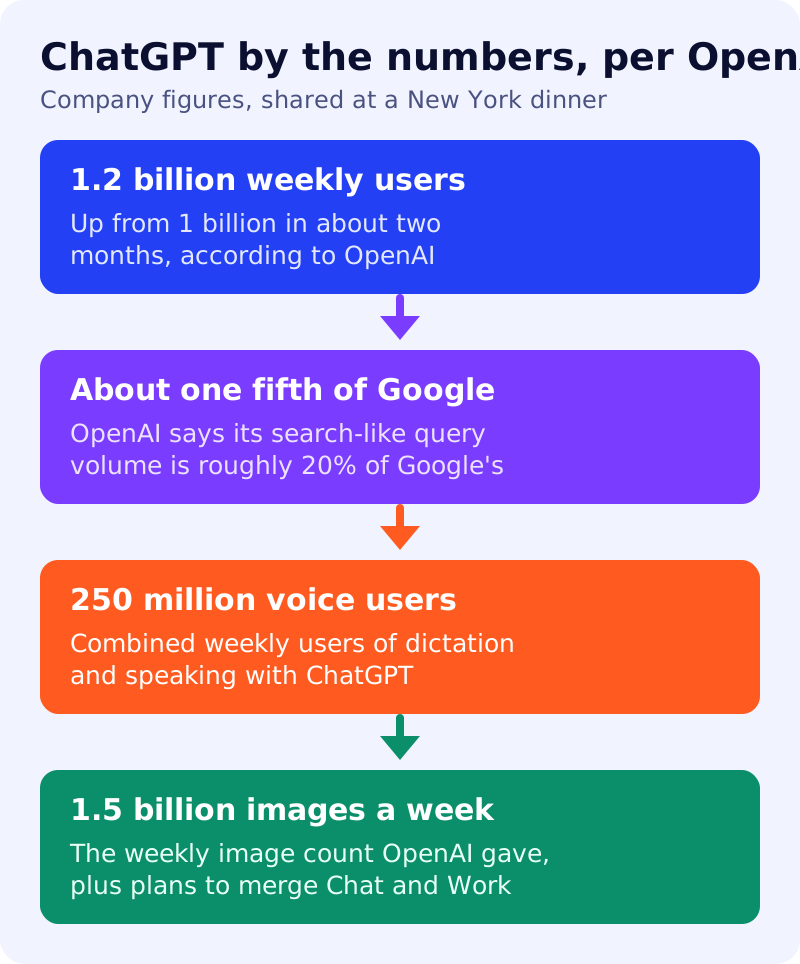
- ChatGPT’s weekly active users went from 1 billion to 1.2 billion in 60 days, which is 200 million added in about two months.
- The volume of search-like queries on ChatGPT is now roughly one fifth of Google’s.
- Users create 1.5 billion images a week.
- Voice mode, counting dictation and speaking with ChatGPT, has 250 million combined weekly active users.
Fry said ChatGPT started about a year and a half ago with no up-to-date information, and called the growth “just going big”. He also said OpenAI plans to merge ChatGPT’s Chat and Work modes, and discussed the cost of serving its personal assistant, Dots, and topics including image generation, advertising and education, which are in the part we could not read.
How OpenAI defines a search
Kantrowitz asked what counts as a search, given that one conversation can contain many prompts. Fry’s answer, as reported, is that people first came to ChatGPT for writing and coding help, which are not things you search for. Over the past year they have added topics where up-to-date information matters, such as looking up a person, place or thing, and finance or health questions where answers should be current and factual. For those, ChatGPT does a web search. In his words, it is basically anything a user would once have taken to a traditional search engine and now takes to ChatGPT.
What was not said
In the part we could read, Fry did not give the Google figure he compared with, the time period, or the regions. We do not know whether every prompt in a conversation is counted. So treat “one fifth” as OpenAI’s own estimate of a defined set of queries, not as an independent measurement.
Our view
This is our opinion, not OpenAI’s. Three points for site owners:
- Query volume is not traffic. A query answered inside ChatGPT may send no visit to your site. Do not read “20 percent of Google” as “20 percent as many clicks”.
- Current, factual pages matter more. Fry names finance and health among the topics where ChatGPT searches the web for current facts. If you publish in those areas, show dates, sources and authorship, and keep pages updated.
- Measurement is shaky. As we covered in where your ChatGPT traffic went in October, ChatGPT visits were recently misfiled as Direct for several days.
What to do
- Set up an AI referral channel in your analytics, following our four-step setup.
- Make sure ChatGPT’s crawler can reach your pages, using our ten-minute access test.
- Run the monthly 20-prompt AI visibility test to see whether you are cited, whatever your traffic shows.
- Keep our AEO and GEO playbook open as your checklist.