Google finished rolling out its November 2026 core update on 24 November. Then, less than an hour later, it announced another core update for December.
That is the headline. But the more important story is what is happening around these updates. This is part of a wider pattern covered in our AEO research and updates hub, where we track how Google, Gemini and other answer engines are changing discovery.
In November, Google introduced Gemini 4 Hydrogen into Search, describing it as a major upgrade to how Search understands complicated questions and explores related topics. A few days later, it expanded Personal Intelligence in AI Mode, allowing people to connect more of their Google apps so responses can use personal context. And now, the company has preannounced a core update that specifically mentions longer, more complex questions and personalised results.
Put these developments together and a bigger question emerges: is Google changing the way Search works faster than publishers can understand the changes?
The answer is that Search is clearly evolving on several fronts. But we need to be precise. Google has not said that Gemini, Personal Intelligence, AI Overviews and every recent product change are components of the December core update. They are related developments in the wider evolution of Search, not one confirmed algorithm package.
The under-an-hour gap that caught the industry’s attention
Here is the timeline from Google’s own Search Status Dashboard. All times below are US Pacific Time.
| Event | Date and time | What it means |
|---|---|---|
| November core update completed | 24 November, 06:03 PST | The November rollout was marked complete |
| December core update preannounced | 24 November, 07:03 PST | Google announced a further core update scheduled for December |
The gap between the two dashboard updates was about 59 minutes - under an hour, but not the back-to-back minutes some early social posts suggested.
The November update had run for 13 days and 20 hours. The December update, however, has only been announced. It has not started rolling out as of 24 November.
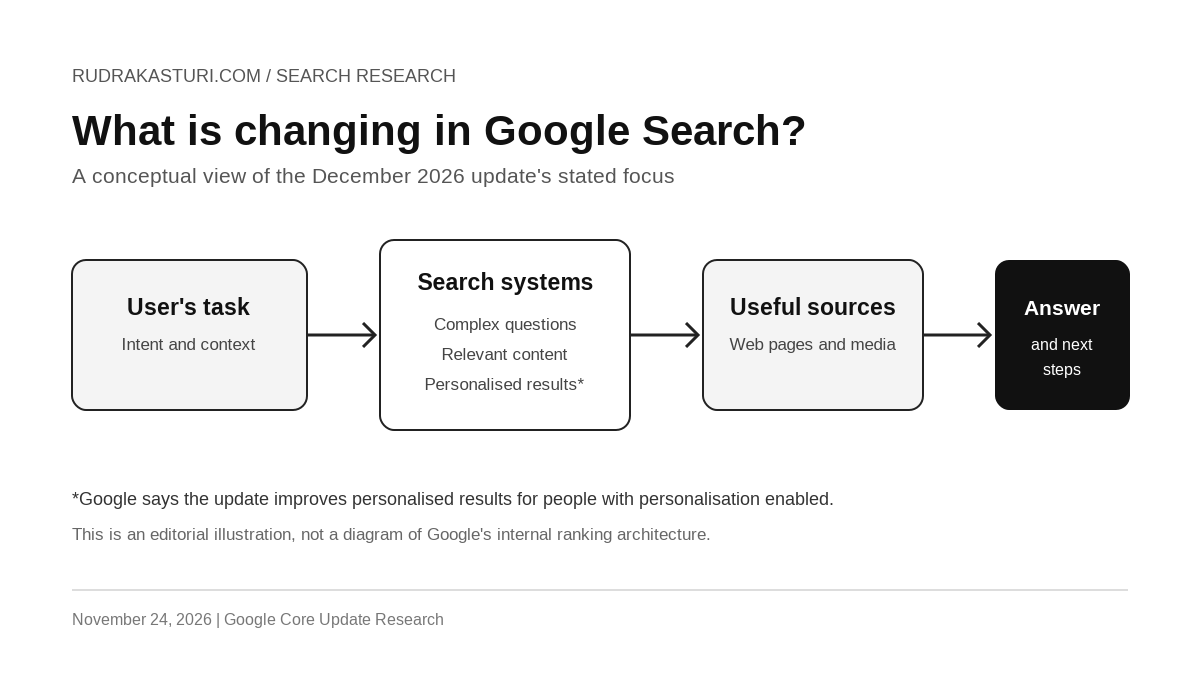
Google’s notice says the December update will improve how its systems understand and rank relevant content, including for longer and more complex questions. It also says the update will improve personalised results for people who have personalisation turned on. The update is intended to apply across all locations and languages where Google Search is available.
This is unusual because Google has given the industry an advance description of the next core update before its rollout begins. It gives publishers a little more context, but not a checklist of ranking factors or a prediction of which websites will gain or lose visibility.
The under-an-hour gap is a newsworthy timeline. It is not evidence that the December update is a correction to the November update. Google has not said that one update caused the other or that the December update is a response to complaints about November.
Why the December update matters beyond another ranking shake-up
The wording in Google’s announcement deserves attention.
It does not simply say that Search will rank better content. It specifically calls out longer and more complex questions, as well as personalised results.
Think about how people search today.
A person looking for a health insurance policy may not stop at “best health insurance”. They may ask which policy covers parents, has a short waiting period for pre-existing conditions, offers cashless treatment in a particular city and fits a monthly budget.
A small business owner may search for an affordable accounting tool that supports GST filing, inventory, e-invoicing and integration with an existing system.
These are not single-keyword searches. They are decision-making tasks with several conditions.
Google’s announcement suggests that its ranking systems are being improved to understand relevance in these more involved situations. It does not reveal exactly how the systems will do this, and it does not mean that traditional keyword-based search has disappeared.
For publishers, the implication is practical: a page should answer the real question behind a search, not just repeat the words used in the query.
Search is changing on at least four fronts
The core update is only one part of the story. Google’s recent product announcements help explain the broader direction.
1. Gemini 4 Hydrogen is changing how Search understands a question
On 12 November, Google announced Gemini 4 Hydrogen for Search. Google says the model improves its understanding of nuanced, complicated and multi-part questions.
One of the most important details is its improved query fan-out capability.
In simple terms, a search system can take one complicated question, break it into related sub-questions, search across those topics and bring together information that may help answer the original request.
Imagine someone asks: “I am moving to Bengaluru for a new job. Which neighbourhood should I rent in if my office is near Whitefield, my budget is limited and I need public transport?”
The system may need to explore rental costs, commute options, neighbourhoods, transport links and local amenities. The person asked one question, but the research involves several connected topics.
Google says Hydrogen improves this process and can connect users to a broader range of relevant links. It also says Search responses can include more visual material, comparison tables and custom tools. We have examined the Search rollout and its implications in our detailed guide, Gemini 4 Hydrogen and SEO: what changes for Google users, website traffic and AI visibility.
For publishers, this changes the discovery opportunity. A detailed page may be useful for one sub-question within a larger search journey, even if it does not rank first for the broad query.
It also creates a measurement challenge. A publisher may be referenced in an AI response without receiving a click. A page may receive traffic from a more specific question that the publisher has not traditionally tracked.
Our explainer on query fan-out in AI search looks at how this retrieval approach works.
2. Personal Intelligence is making some Search responses more personal
On 23 November, Google announced that people could opt in to connect Google Wallet to Personal Intelligence in AI Mode. Google said support for Drive and the Gemini app would follow in the coming weeks. Gmail, Calendar and Photos were already part of the connected-app experience.
The idea is straightforward. If a person chooses to connect these services, AI Mode can use relevant personal context to make certain responses more useful.
For example, a person planning a trip may want an answer that takes account of previous research or travel-related information. Someone reviewing spending may want suggestions informed by information in Wallet.
This is a meaningful shift in the Search experience. The system is not only interpreting the words in a query. Where the user has enabled the feature and connected relevant apps, it can also use selected personal context. Availability is not universal, however. Google’s Search Help says Google Wallet and Photos connections are not available in every region, while Drive connections are currently limited to the US in English. Gemini app support was listed as coming soon when the help page was reviewed. Indian users should therefore check the current availability in their own account rather than assume every connection is live in India.
But there is an important distinction for SEO teams.
Personalised AI responses are not the same thing as proof that private Gmail, Wallet or Drive data is being used as an organic ranking signal for websites. Google’s announcement describes personalisation in the Search experience. It does not say that a publisher’s ranking is determined by another user’s private app data.
The practical question for publishers is how content gets selected and presented when the user’s context changes the answer they need. Google’s official Personal Intelligence announcement explains the Wallet, Drive and Gemini connections. This sits alongside a separate move towards completing tasks inside Search and Gemini, which we examine in Google Connected Apps bring shopping and services closer to Search and Gemini.
3. Search is becoming an answer experience, not just a list of links
AI Overviews and AI Mode are changing how users interact with results. Instead of always scanning ten blue links, a person may receive a generated explanation, a comparison, a follow-up question or a set of sources.
This does not make websites irrelevant. Google’s own explanation of AI features says the same foundational principles still apply: pages need to be accessible, indexable and useful. There is no separate technical markup that guarantees inclusion in AI Overviews or AI Mode.
However, publishers need to measure more than conventional ranking positions.
A page can rank well but attract fewer clicks if the answer is resolved directly on the results page. Another page may not receive a large volume of organic clicks but may be cited in an AI response. A third may be discovered through a specific follow-up question.
These are different forms of visibility. They should not be combined into one traffic number. Google has also been changing the way links appear inside AI answers. Its October announcement introduced more prominent inline links, official-site sections and creator profiles. In November, its Dive Deeper links began giving users another route to publisher articles. Read our explainers on the October AI Mode and AI Overviews link changes and Google AI Mode’s Dive Deeper links.
4. The discovery ecosystem is wider than a publisher’s own website
People do not research every decision through search engines alone. They watch product demonstrations, read community discussions, compare creator reviews and look for first-hand experiences.
A Semrush study published in November examined citations to a selected group of social and user-generated content domains across Google AI Overviews, AI Mode, Gemini and ChatGPT. It reported that citations to this group rose 52% across Google’s AI products between January and August 2026.
That is a useful signal, but it needs context. The finding applies to the domains and dataset examined by Semrush. It does not prove that every social platform is gaining visibility or that social activity is a direct Google ranking factor.
For publishers, the lesson is not to manufacture mentions on every platform. It is to build credible coverage and useful material that people may refer to across the wider information ecosystem. Our Semrush citation analysis examines the platform-level differences and the limits of that dataset.
For a technology story, that might include original testing, a video demonstration, expert commentary and a detailed article. For a local news story, it may include on-ground reporting, documents, public statements and community evidence.
5. Google is also moving Search closer to completing tasks
The connected-app story goes beyond personal context. Google’s November 20 announcement added services for tasks such as grocery shopping, finance and tax preparation to Search and Gemini. The announced integrations are US-focused, so they should not be described as an India-wide rollout. But the direction is important: Search is moving from helping people find information towards helping them act on it. We explain the commerce and service implications in Google Connected Apps bring shopping and services closer to Search and Gemini.
The content warning from Google’s Liz Reid: AI has less room for commodity pages
There is another November development that publishers should not ignore. In a 23 November interview on the FOMO Sapiens podcast, Google’s Head of Search, Liz Reid, said people do not want purely AI experiences; they want AI combined with the web. She contrasted basic information that an AI answer can provide directly, such as a time-zone fact, with fashion advice, specialist perspectives, communities and in-depth research that people still want from trusted sources.
The implication is not that Google has announced a new thin-content penalty. Reid was explaining how the value of different kinds of content changes when AI can answer simple questions directly. She said there remains demand for personal expertise, unique experience and in-depth research. That is a strategic signal for publishers, not a newly published ranking factor.
We have covered the interview in Google’s Liz Reid on AI Search: why thin content pages may lose traffic and pulled together 11 things Liz Reid told publishers. The original conversation is S15 E8: Elizabeth Reid, VP of Search at Google.
A useful editorial test follows from her comments: if a reader can get the complete value of a page from a short AI-generated answer, what reason do they have to visit the page? The answer should be more than extra words. It could be original reporting, tested experience, a useful comparison, a local perspective, expert judgement, evidence or a tool that helps the reader make a decision. Thin content is not simply short content. A short page can be valuable if it answers a specific need exceptionally well; a long page can still be commodity content if it only repeats what is already known.
Are all these changes connected to the December core update?
This is where the industry needs to resist an easy but misleading conclusion.
There are three different layers.
| Layer | What is changing | What we can safely conclude |
|---|---|---|
| Ranking systems | November update completed; December update announced | Google has confirmed changes to relevance, complex questions and personalised results in the December update |
| Search product and AI models | Gemini 4 Hydrogen, AI Mode, query fan-out and richer responses | Google is changing how Search interprets questions and presents answers |
| Personal context | Connected apps and recent search context | Some users can receive responses tailored to information they choose to connect |
These layers influence the overall Search experience, but they are not interchangeable. Google is also experimenting with Preferred Sources, which lets users signal publishers they want to see more often. That is a relationship and product-discovery feature, not proof of a universal ranking boost for every page on a selected domain. Google’s wider shift towards a conversational assistant is explored in Google Search is changing: from a page of links to an AI assistant.
A core update changes ranking systems. A model upgrade changes the capabilities used in an AI-powered product. A personalisation feature changes how a response can be tailored to an individual. They may interact, but Google has not confirmed that every one of them is governed by the December core update.
This distinction matters because publishers often make expensive decisions based on incomplete explanations. A fall in clicks may be blamed on an algorithm update when the actual cause is a change in demand, a different results page, a seasonal trend or a technical issue.
We need evidence before assigning a cause.
What should publishers expect in December?
No one outside Google can reliably predict which sites will gain or lose rankings from an update that has not started. But publishers can prepare for the areas Google has explicitly identified.
Expect more attention on complex search tasks. Review whether your pages answer the complete decision a reader is trying to make. A page about a financial product, for example, should explain eligibility, fees, exclusions, risks and relevant comparisons where those details matter.
Expect more variation in AI-assisted discovery. A single broad query may lead to several related searches. Track the pages that answer specific sub-questions, not only the page targeting the main keyword.
Expect personalisation to make some results less uniform. When users enable personalisation, their context may influence the response they receive. Do not assume that one manual search from one location represents every user’s experience.
Expect clicks and visibility to tell different stories. AI answers may expose users to a publisher without producing a website visit. Measure citations, referral sessions and conversions separately.
Expect volatility, but do not react to every movement. Wait until Google confirms that the December rollout is complete. Then compare equivalent periods and inspect query groups and individual URLs.
A practical monitoring framework for SEO and editorial teams
Instead of creating another vague “Google update score”, teams should maintain a Search Change Monitor with five separate measures.
| Measure | What to track | Why it matters |
|---|---|---|
| Organic visibility | Impressions, clicks, CTR and average position by query and URL | Shows traditional Search movement |
| Complex-query coverage | Visibility across comparison, multi-condition and follow-up queries | Shows whether pages answer broader tasks |
| AI answer presence | Cited URLs, cited domains and answer appearance across relevant prompts | Shows visibility beyond blue links |
| Visit quality | Engaged sessions, leads, subscriptions and sales from organic and AI referrals | Shows whether discovery creates business value |
| Brand discovery | Branded searches, direct traffic and credible third-party references | Shows whether people recognise and seek the publisher |
Keep the measures separate before drawing conclusions. For example, if AI citations rise while organic clicks fall, that may indicate a change in how users discover information. It does not automatically mean the strategy is working. Check whether those citations are generating qualified visits, brand searches or measurable outcomes.
For a useful baseline, record the following now:
- Export Search Console data for the four weeks before the December rollout.
- Annotate 10 to 24 November as the November core update period.
- Record the date the December rollout actually begins and the date Google marks it complete.
- Group queries by intent, including informational, comparison, transactional, local and multi-condition searches. Separate basic fact queries that AI can answer directly from queries where readers need evidence, experience, advice or original research.
- Maintain a fixed set of AI prompts and check them consistently across the relevant AI search products.
- Record cited URLs and domains, not just whether a brand appeared in an answer. Our guide to tracking the exact URLs cited by ChatGPT, Gemini and Perplexity explains why domain-level tracking is not enough.
- Compare performance after the rollout has completed, allowing at least a full week before drawing conclusions.
Google’s core update guidance remains important. Also account for the separate Search Console Generative AI reporting anomaly affecting 9 to 11 November, which Google said was a logging issue rather than a real visibility loss. Our November update and AI Search reporting anomaly analysis explains how to keep the two events separate. There is no special action that guarantees recovery from a core update. The right response is to understand which pages and queries changed, assess whether the content genuinely serves the reader and avoid making rushed site-wide changes based on a few days of data.
The bigger story: Google is changing the meaning of Search
For years, publishers largely organised their strategy around keywords, rankings, clicks and landing pages. Those measures still matter. But they no longer describe the entire search journey.
A user may begin with a broad question, move through AI-generated comparisons, ask follow-up questions, receive a personalised response and visit only one or two sources. Another user may follow a traditional search path and click several websites.
Both journeys can exist at the same time.
The November update is complete. The December update has been announced. Gemini 4 Hydrogen is expanding the way Search handles complex questions. Personal Intelligence is bringing selected user context into AI Mode. AI Overviews and AI Mode are changing how information is presented.
The strongest conclusion is not that one update explains everything. For the wider framework, see our AEO and GEO playbook and AEO guide across Google AI Overviews, AI Mode, ChatGPT, Gemini and Perplexity. It is that Google is evolving Search across ranking, retrieval, presentation and personalisation.
For publishers, the response should be equally broad. Build pages that answer real questions with evidence. Create original reporting and analysis that cannot be replaced by a generic summary. Make information easy to verify. Develop useful coverage across the formats and platforms where audiences research. And measure visibility as well as the business value that follows it.
The next core update may change rankings. The larger transformation is that Search itself is changing.
Editorial note: This article was prepared on 24 November 2026. The December 2026 core update had been preannounced but had not begun rolling out at the time of writing. The article separates Google’s confirmed statements from editorial interpretation. Recheck the official Search Status Dashboard before publication.