

If someone searches for the time in Japan, an AI answer can provide it immediately. The person may have no reason to open a separate article that repeats the same information.
That is the challenge Google Search chief Liz Reid was discussing in a November 23 interview on Patrick McGinnis’ FOMO Sapiens podcast. As AI answers more basic questions directly, publishers may find it harder to earn visits from pages that offer little beyond information already available elsewhere.
Reid made a useful distinction. A simple factual answer can be generated directly, but people may still seek fashion advice, personal experience, expert opinion and perspectives from writers or creators they trust.
For publishers, this is a traffic and editorial strategy issue. It is not an announcement of a new Google ranking factor.
What did Google’s Liz Reid say about AI search and publishers?
Reid used a basic time-zone page to explain how AI can reduce the need to visit a webpage for a simple fact. She contrasted that with fashion advice, where a reader may value the judgement and taste of a trusted person.
Her broader point was that original expertise, unique experience, communities and in-depth research continue to have value. She also described Google’s aim of making Search more connected to the wider web.
The important distinction is between information that can be answered directly and content that gives a reader something more. Reid did not announce that Google will penalise all informational articles, nor did she provide a new SEO ranking formula.
Which pages are most exposed to AI answers?
A page is more exposed when it is thin content: it repeats information that is easy to find and summarise without adding reporting, evidence, experience or a useful point of view.
For example, a thin content page that only states the current time in another country, defines a common term or rewrites a public fact may have limited value beyond the direct answer. An AI answer can combine such information without requiring the user to visit several websites.
This does not mean that every definition, explainer or basic guide will lose traffic. Accuracy and clear answers remain important for SEO and AEO. The risk is higher when a page is thin content: it adds no reporting, evidence, experience or useful next step.
A basic explainer can still earn a visit if it answers a more specific question, explains an important exception or helps the reader complete a task.
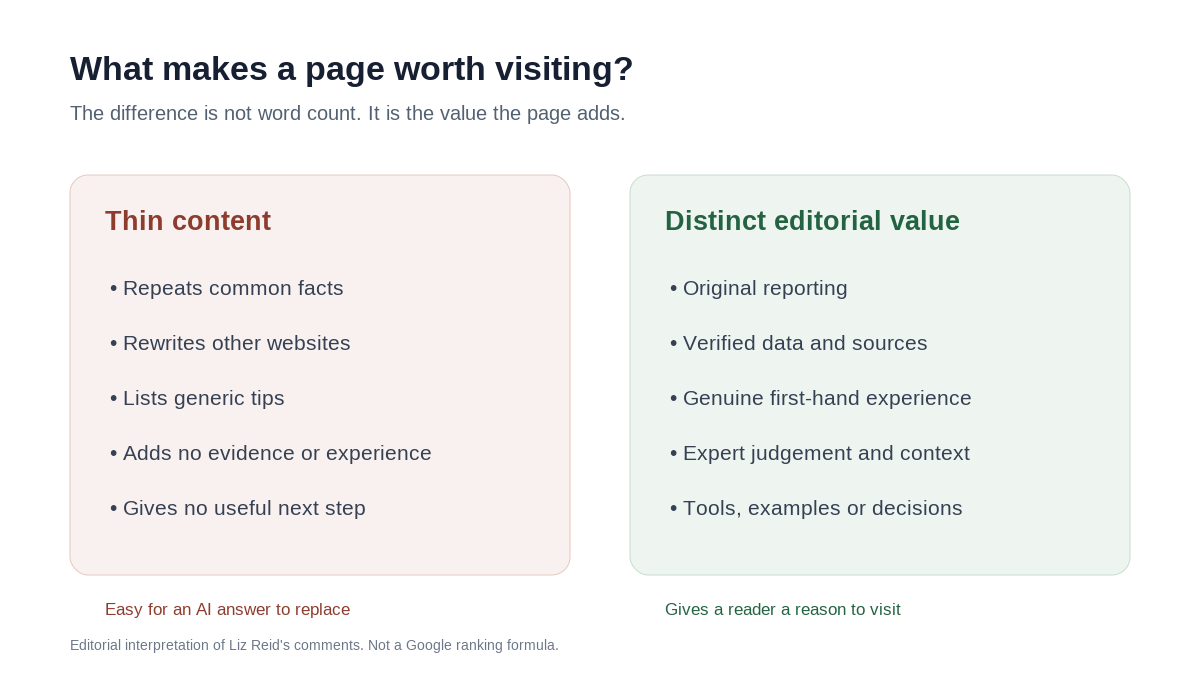
What should publishers create instead?
The practical response is not to make every article longer. It is to give each page a clear reason to exist.
A product review should contain genuine testing or clearly attributed evidence, not a rewrite of the manufacturer’s product page. A policy article should link to the official notification and explain who is affected. A technology story should show what has changed, who it affects and what remains uncertain.
For example, a generic article explaining what a new AI feature does may be easy for an assistant to summarise. A reported comparison showing how the feature performs on three real tasks, with screenshots, limitations and a repeatable method, gives the reader something more useful to inspect.
That is the difference publishers should build into their editorial planning.
What does this mean for SEO and AEO?
SEO still helps search engines discover, crawl and understand a publisher’s pages. AEO adds another practical concern: whether the page gives a clear, accurate answer that can be understood and referenced in AI-generated responses.
Neither approach can guarantee a citation or a click. But both benefit when a page has a clear subject, direct language, reliable sourcing and information that is not simply copied from elsewhere.
Publishers should review pages that attract impressions but offer little original value. Improve them with reporting, evidence, expert context, examples or a useful tool. Consolidate overlapping pages where they serve the same purpose. Do not delete pages solely because they have low traffic without checking backlinks, conversions, audience needs and their role in the wider site.
How should publishers measure the impact?
Continue tracking organic impressions, clicks, rankings and landing-page engagement. Add a separate view of AI citations, brand mentions and identifiable AI referral visits.
For a publisher, also track returning users, newsletter subscriptions, registrations and revenue contribution. A citation is not a visit, and a visit is not necessarily a returning reader.
Use the same set of prompts each month to see whether AI systems are citing original reporting and whether they describe the publication accurately. Our guide to AEO, GEO and AI SEO explains how these forms of visibility differ.
Questions publishers are asking about Liz Reid’s comments
Did Google announce a new SEO ranking update?
No. Reid was discussing how AI changes the value of different kinds of content. The interview did not announce a new ranking factor or a specific algorithm update.
Does AI search mean informational articles will stop getting traffic?
No. The impact will vary by query and page. Thin content pages that only repeat easily available facts may face more pressure, while useful explainers with original evidence, examples and practical detail can still give people a reason to visit.
What kind of content should publishers prioritise?
Prioritise original reporting, first-hand experience where genuine, expert analysis, original research, useful comparisons and practical guides. The content should answer the reader’s question and add something that a short AI answer cannot easily replace.
Should publishers remove older SEO articles?
Not automatically. Review search performance, backlinks, conversions, accuracy and audience value first. Update, combine or retire pages based on evidence rather than applying a blanket deletion rule.
Reid’s comments point to a straightforward editorial test: if an AI answer can reproduce the entire value of a page in a few lines, the page needs a stronger reason for someone to visit. For publishers, that reason has to come from reporting, evidence, experience or judgement. Better content alone does not solve the business model, but without distinct content, earning search traffic and reader loyalty becomes harder.