If you use ChatGPT to analyse a screenshot, follow a detailed brief or research a topic across several websites, the GPT-6.2 update is aimed at the kind of work you do every day.
OpenAI began rolling out GPT-6.2 to ChatGPT’s Chat tab on November 23. The company says the update improves image understanding, complex instruction following and web research. It also reports better results in its teen safety evaluations.
So, will ChatGPT give better answers now? The update is designed to make the model more capable on these tasks, but that does not mean every answer will be correct or that every user will notice the same improvement. The most useful test is whether it handles real work with fewer missed instructions, better reading of visual information and more reliable research.
What is GPT-6.2 in ChatGPT, and who is getting it?
OpenAI says GPT-6.2 is rolling out globally to ChatGPT Plus, Pro, Business and Enterprise users in the Chat tab. Enterprise availability can depend on workspace administrator settings, and the rollout may not reach every account at the same time.
The Chat experience uses a version of GPT-6.2 Sol tuned for everyday conversation. This is separate from the GPT-6.2 Astra and Sol models introduced earlier for Work and Codex. OpenAI says the models powering Work and Codex are not changing as part of the November 23 Chat tab update.
That distinction matters because the announcement is about the model used in the regular ChatGPT conversation experience, not a blanket update to every OpenAI product.
What has improved in GPT-6.2?
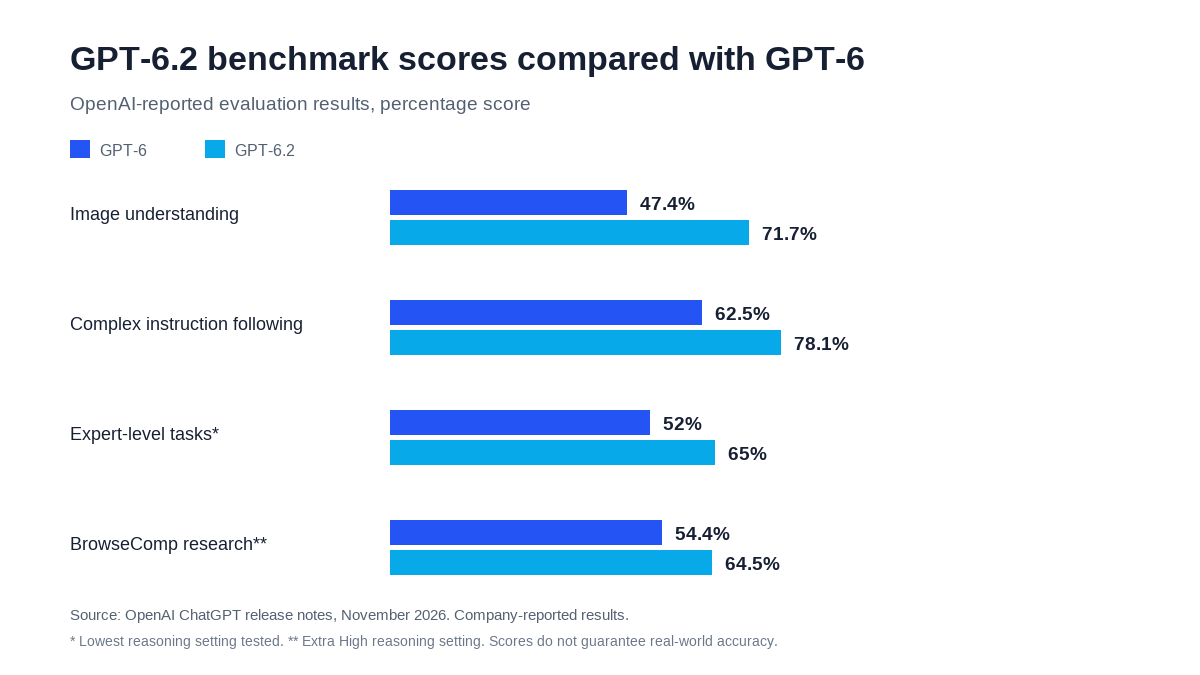
OpenAI has published comparisons with GPT-6 across several evaluations.
| Test published by OpenAI | GPT-6 | GPT-6.2 | Change |
|---|---|---|---|
| Image understanding | 47.4% | 71.7% | +24.3 percentage points |
| Complex instruction following | 62.5% | 78.1% | +15.6 percentage points |
| Expert-level tasks, lowest reasoning setting tested | 52% | 65% | +13 percentage points |
| BrowseComp, Extra High | 54.4% | 64.5% | +10.1 percentage points |
These are results reported by OpenAI, not independent tests. The company says the BrowseComp result comes from an internal version of the evaluation. The figures show progress on defined tests, but they do not guarantee the same improvement across every subject, language or real-world task.
The difference between percentage points and percentage growth is also important. Image understanding increased by 24.3 percentage points, from 47.4% to 71.7%. That is not the same as saying the score improved by 24.3% in relative terms.
Will GPT-6.2 understand screenshots, charts and images better?
That is one of the clearest intended improvements.
A user might upload a Google Analytics screenshot and ask why traffic has dropped. Another might share a chart from a research report and ask what changed between two periods. A student could upload a diagram and ask for an explanation of how the parts connect.
A stronger image-understanding result could help ChatGPT interpret the visual information before answering. It may reduce the need to describe every element manually.
But there is a limit. Reading a chart is not the same as verifying whether the underlying data is correct. A screenshot may be cropped, a label may be unclear or a graph may use a misleading scale. Check important figures against the original spreadsheet, report or source.
Will GPT-6.2 follow long instructions more accurately?
OpenAI reports a score of 78.1% for complex instruction following, compared with 62.5% for GPT-6.
This matters when a task has several conditions. Imagine asking ChatGPT to review an article, preserve the existing tone, use only verified sources, add FAQs, avoid certain headings and return the result in a specific content format. A model that follows more of those instructions can reduce the time spent correcting the output.
For a newsroom, the same improvement could help with extracting facts from a document, building a timeline and separating confirmed details from claims. For an ecommerce team, it could help compare product attributes across a catalogue while following a fixed output structure.
The benchmark still leaves room for missed instructions. Users should check the final output against the original brief, especially when a requirement is important.
Does GPT-6.2 give better web research and more reliable answers?
OpenAI reports a higher score on BrowseComp, an evaluation focused on finding answers to difficult web research questions. At the Extra High reasoning setting, GPT-6.2 scored 64.5%, compared with 54.4% for GPT-6.
This suggests improvement in the model’s ability to find information for complex research tasks. It does not prove that every answer is more accurate, that every source is reliable or that ChatGPT will always cite the best original document.
For example, if you ask for the latest change in a government policy, the model may find a news report quickly. But the final answer should still be checked against the government notification or official department page. If you ask for a study’s findings, open the original paper and verify the sample, method and limitations.
A useful research workflow is to ask for primary sources, open those sources, check whether each one supports the exact claim and separate published facts from interpretation.
Does GPT-6.2 mean fewer citations in ChatGPT answers?
OpenAI’s announcement does not say that GPT-6.2 will use fewer citations. It reports improvements in image understanding, instruction following, research performance and safety evaluations.
Citation behaviour depends on the task, whether web search is used, the sources found and how the answer is presented. A model that performs better at research should not be assumed to cite fewer websites or produce more citations. Neither conclusion is established by the published benchmark table.
If source attribution matters, ask ChatGPT to link each important factual claim to the source that supports it. Then open the links and check the evidence yourself.
What do the safety improvements mean?
OpenAI says GPT-6.2 performed better in its teen safety evaluations, including tests involving emotional reliance, disordered eating, age-restricted goods and dangerous activities.
The company also reports that responses met its safety policies 91% to 94% of the time in challenging conversations, compared with 77% to 80% for GPT-6.
These are company-reported results against defined evaluations. They do not mean the model cannot produce an unsafe response or that it can replace professional judgement in health, legal or financial matters.
How should teams test GPT-6.2 on real work?
Do not judge the update only by asking it a few general knowledge questions. Use tasks your team actually performs.
A newsroom can test whether it extracts facts accurately from a press release, identifies missing evidence and builds a sourced timeline. An ecommerce team can upload product images and test attribute extraction. An SEO or AEO team can give it a content brief and check whether it preserves the required keywords, headings, source links and editorial voice.
Use the same prompt and input before and after the update. Score factual accuracy, missed instructions, source quality, time spent correcting the output and the amount of human editing required. This makes the comparison more useful than a subjective impression.
Questions about the GPT-6.2 ChatGPT update
Is GPT-6.2 available in ChatGPT now?
OpenAI began a gradual rollout on November 23 to Plus, Pro, Business and Enterprise users in the Chat tab. Availability may vary by account and workspace settings.
Will GPT-6.2 make fewer mistakes?
The published evaluations show improvement on selected tasks. They do not prove that the model will make fewer mistakes in every conversation. Important facts and decisions still need verification.
Does GPT-6.2 improve ChatGPT image analysis?
OpenAI reports a higher image-understanding score than GPT-6. This is relevant to screenshots, charts and diagrams, but it does not guarantee that every visual detail will be interpreted correctly.
Will GPT-6.2 change ChatGPT citations or web links?
OpenAI’s release notes do not announce a reduction in citations or a specific change to citation frequency. Do not infer citation behaviour from the benchmark improvements.
Is GPT-6.2 also powering Work and Codex?
The November 23 announcement is for the Chat tab. OpenAI says the models powering Work and Codex are not changing as part of this release. The earlier GPT-6.2 Astra and Sol announcement covered those experiences separately.
GPT-6.2 is intended to make ChatGPT more capable at reading images, following detailed instructions and researching difficult questions. For everyday users, that could mean less time explaining a screenshot or correcting a multi-part brief. For businesses and publishers, it is worth testing against real tasks and measuring accuracy, source quality and editing time. The benchmarks are a useful starting point, but the quality of the answer still depends on the evidence and the human checks around it.