A B2B buyer asks an AI assistant to compare marketing automation platforms. The answer names three vendors and links to a LinkedIn post written by an industry practitioner. The source is not the vendor’s website. It is an individual expert’s post.
This kind of result makes LinkedIn relevant to AEO. But an important distinction remains: a LinkedIn URL appearing as a citation is evidence of source visibility, not proof that publishing on LinkedIn directly causes a brand recommendation.
Recent research gives us a reason to investigate LinkedIn more seriously, especially in B2B categories.
Is LinkedIn cited by AI search platforms?
Yes, LinkedIn URLs appear in AI search citations in several published datasets.
In March 2026, Semrush published an analysis of 89,000 unique LinkedIn URLs cited by ChatGPT Search, Google AI Mode and Perplexity. Its study covered 325,000 unique prompts across 12 industry categories in January and February 2026. Semrush reported that LinkedIn appeared in an average of 11% of responses in its dataset, with differences by platform.
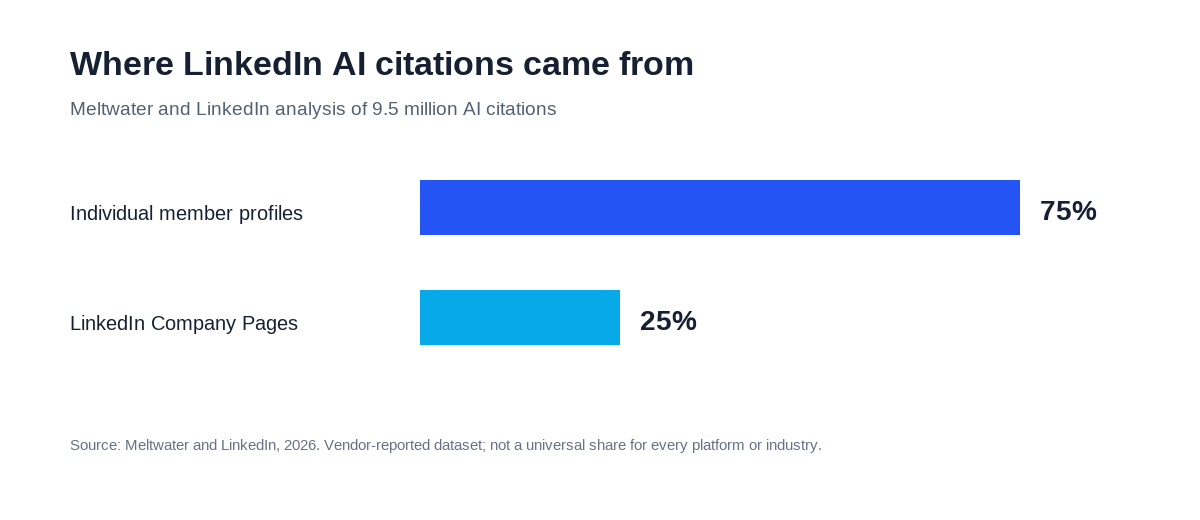
A separate May 2026 analysis from Meltwater and LinkedIn reported 9.5 million AI citations across six AI models. The companies said LinkedIn was the second most-cited source in their B2B-focused dataset, behind YouTube. They also reported that individual member profiles accounted for 75% of LinkedIn citations in their analysis, compared with 25% for Company Pages.
These findings are useful signals. They are not a universal ranking of every source across every prompt, industry and AI platform. Both studies are vendor-led research, and their prompt samples, platforms and measurement windows differ.
Why might LinkedIn appear in AI answers?
LinkedIn contains several kinds of information that can be relevant to business questions:
- Individual professional perspectives.
- Company descriptions and product information.
- Long-form articles and practical guides.
- Job roles, expertise and organisational context.
- Discussions about tools, services and industry practices.
A user asking about B2B software, hiring, consulting or professional services may receive an answer that draws on content from people who work in those fields.
That does not mean every post is equally useful or that engagement automatically translates into citations. The cited page still needs to match the question and provide information that can support the answer.
Do individual LinkedIn profiles get cited more than company pages?
In the Meltwater and LinkedIn analysis of 9.5 million citations, 75% of LinkedIn citations came from individual member profiles and 25% from Company Pages. This is a finding from that dataset, not a guarantee that personal profiles will outperform company pages in every industry.
It does raise a practical question for B2B marketing teams. Is the organisation publishing useful expertise only through its corporate page while its subject experts remain invisible?
A balanced programme can include both:
- Company pages for accurate product, service and organisation information.
- Expert profiles for professional experience, practical explanations and original viewpoints.
- Long-form articles for detailed guides and analysis.
- Posts that answer specific customer questions with evidence and examples.
What LinkedIn content should B2B teams test?
Rather than publishing generic motivational posts, test content formats that directly address buyer questions.
Practical how-to content
Explain how a process works, what decisions are involved and what mistakes to avoid. Include concrete steps and examples.
Comparisons and decision frameworks
Help buyers understand the trade-offs between approaches, tools or operating models. Be transparent about limitations.
Original data and professional experience
Share first-hand findings, implementation lessons, survey results or operational examples. Clearly state how the information was collected.
Expert explanations
Ask subject experts to explain a specific issue in their own words. The aim is useful knowledge, not manufactured personal branding.
The Semrush study and Meltwater analysis both describe structured, specific content in their findings. These are associations within their datasets. They should guide experiments, not be treated as a guaranteed formula for AI citations.
How to measure LinkedIn’s contribution to AI visibility
Track LinkedIn at URL level, not only as a domain.
| Field | What to capture |
|---|---|
| AI platform | ChatGPT Search, Google AI Mode, Perplexity and others tested |
| Prompt | Exact B2B question |
| LinkedIn URL | Exact cited post, article or profile |
| Content type | Member post, article, company page or job listing |
| Author type | Individual expert or organisation |
| Brand mention | Whether the brand is named |
| Recommendation | Whether the brand is suggested |
| Citation context | Which statement the LinkedIn URL supports |
| Repeat appearances | Whether the URL appears in later runs |
| Referral visits | Identifiable visits from the LinkedIn source or AI platform |
Also compare the LinkedIn citation with the brand’s own website. If AI answers cite an employee’s explanation but not the company’s product documentation, there may be an opportunity to make the official information clearer and more useful.
A practical LinkedIn AEO experiment for a B2B company
Choose one service category and 20 buyer prompts. Run each prompt on the same AI platforms before the experiment. Record brand mentions, recommendations and cited URLs.
Then publish a small set of original LinkedIn articles or expert posts answering the questions. Do not change the website and social programme simultaneously if the aim is to understand which activity may be associated with a change.
Repeat the same prompts over several weeks. Record whether the new LinkedIn URLs appear, whether the brand is described more accurately and whether the recommendation pattern changes.
This is an observational experiment. AI answers can change for reasons unrelated to the posts, so it cannot establish causation on its own.
What B2B marketers should avoid
- Do not ask employees to publish identical promotional posts.
- Do not manufacture comments or engagement.
- Do not assume a high follower count guarantees citations.
- Do not treat every LinkedIn mention as a recommendation.
- Do not use a vendor study as a universal benchmark.
- Do not neglect the company’s own website and documentation.
LinkedIn can add another source of professional information around a brand. It should complement accurate website content, not replace it.
Frequently asked questions
Does LinkedIn content appear in ChatGPT answers?
Semrush’s 2026 study identified LinkedIn URLs cited in ChatGPT Search, Google AI Mode and Perplexity. The frequency varied by platform and the study’s prompt set.
Are LinkedIn personal profiles cited more than Company Pages?
Meltwater and LinkedIn reported that individual member profiles accounted for 75% of LinkedIn citations in their 9.5 million citation analysis. This is specific to their dataset.
Does posting on LinkedIn improve AI brand recommendations?
The available studies show LinkedIn citations in AI answers. They do not prove that posting causes an increase in brand recommendations. Brands should test this with a documented prompt set.
What type of LinkedIn content should companies publish?
Useful guides, comparisons, expert explanations and original findings are sensible formats to test. Content should answer a real professional question and support its claims.
Should B2B companies prioritise LinkedIn over their website?
No. LinkedIn can provide additional expert and social context. The company website remains important for authoritative product information, documentation, pricing and conversion.
How can I check whether my LinkedIn posts are cited by AI?
Run a fixed set of relevant prompts, inspect the visible source links and record the exact LinkedIn URLs. Repeat the tests and keep platform and prompt conditions consistent.