

Ask Google AI Mode for general advice and it can use information from the web. Connect selected personal apps, and the answer may also take your own documents, spending information or previous Gemini conversations into account.
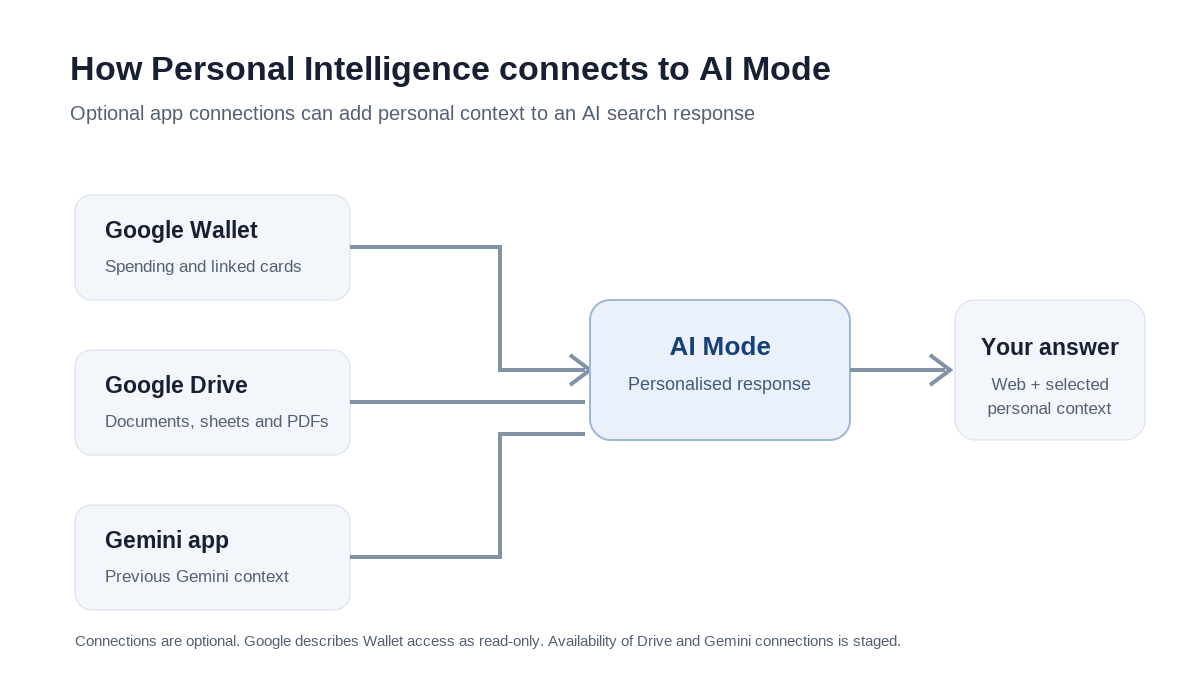
Google announced an expansion of Personal Intelligence in AI Mode on November 23. Google Wallet is beginning to roll out as a connection, while support for Google Drive and the Gemini app is expected in the coming weeks.
This moves AI search towards answers shaped by a person’s own context, not just the words in the search box. It could save users from repeating details across conversations. It also makes privacy, data access and the accuracy of personal information much more important.
What is Google Personal Intelligence in AI Mode?
Personal Intelligence is Google’s approach to tailoring AI responses using information from apps a user chooses to connect. The November 23 announcement adds Google Wallet, Google Drive and Gemini app context to AI Mode.
Google says these additions build on existing connections with Gmail, Calendar and Photos. The rollout is staged, so the availability of each connection may differ by account and over time.
The key point is that these connections are optional. The announcement does not mean AI Mode automatically reads every user’s Wallet, Drive files or Gemini conversations.
What can Google AI Mode do with Wallet, Drive and Gemini?
Each connection brings a different kind of personal information into the search experience.
Google Wallet: Google says Wallet can provide information about spending and linked cards. AI Mode may use this context to help users understand spending patterns, plan financial milestones or review card benefits. Google says the access is read-only: AI Mode cannot move, manage or invest the user’s money.
Google Drive: Support is expected in the coming weeks. Google says AI Mode will be able to use context from documents, spreadsheets and PDFs to tailor responses. This could help when a user asks about a project, a plan or information stored in personal files.
Gemini app: Google plans to let users connect context from the Gemini app. This could help carry an earlier idea or discussion into a later search without requiring the user to explain everything again.
The exact availability and behaviour should be checked in the product as the rollout reaches users.
How could personalised AI search change everyday use?
Imagine planning a large purchase. A conventional search can explain the options, compare publicly available prices and list factors to consider. With a connected Wallet, AI Mode may be able to use relevant spending information to make the response more specific to the user’s circumstances.
Or consider a work project. A general AI search can explain how to prepare a proposal. If Drive is connected and the relevant documents are available to the feature, the answer may be able to take the user’s existing project notes or spreadsheets into account.
The benefit is continuity. The user may not have to repeat the same background information in every conversation.
But personalisation does not guarantee correctness. An old spreadsheet, an incomplete spending record or a misunderstood document can lead to a confident answer based on the wrong context. Users should check the information before relying on it for important decisions.
Does Google AI Mode have access to your money or private files?
Google says Wallet access is read-only. AI Mode can use relevant information to generate responses, but it cannot move, manage or invest money through the connection.
For Drive and the Gemini app, users should review the connection settings and understand what information they are choosing to make available. Do not assume that every file or conversation is automatically connected.
Google says users can manage connected apps through Search Personalization and Connected Apps settings. The company also says it plans to show a Personalization icon below tailored responses so users can inspect the context used. Users should check the controls available in their account as the feature rolls out.
A personalised response is not a substitute for checking bank statements, card terms, official documents or professional advice where the decision has financial or legal consequences.
What does this mean for SEO, AEO and publishers?
This announcement does not show that personalisation will change a website’s organic ranking or guarantee more AI citations. It changes the context that may shape an individual user’s answer.
Public information still matters. AI Mode needs accurate information about products, services, policies, prices and the wider world. But the same public information may be interpreted differently when a user has connected personal context.
For businesses, keep product details, pricing, eligibility rules, service areas and support documents accurate. State conditions clearly rather than relying on marketing language.
For publishers, distinguish general facts from advice that depends on an individual’s circumstances. An article about a financial product should explain fees, eligibility and limitations. It should not suggest that one product is right for every person.
AEO teams should continue checking whether AI systems describe brands and products accurately. But do not assume that connected personal data is available to publishers or that it can be used to target an individual through search.
What Google has not confirmed
The announcement does not mean that all integrations are available immediately to every user. Wallet is beginning to roll out, while Drive and Gemini app support are planned for the coming weeks.
It does not mean every file, transaction or conversation is automatically used. The connections are opt-in, and users should review the available controls.
It also does not prove that personalised answers will always be more accurate, that they will change organic rankings or that they will increase publisher traffic. Those outcomes have not been established by the announcement.
Questions about Google AI Mode Personal Intelligence
Can Google AI Mode read Google Wallet information?
Google says users can choose to connect Wallet so AI Mode can use relevant spending and linked-card information to tailor responses. Google describes this access as read-only.
Can AI Mode access Google Drive files?
Google announced Drive integration for AI Mode, with support expected in the coming weeks. Users should check their account settings and the rollout status rather than assume it is already available.
Will Google AI Mode use my Gemini conversations?
Google plans to let users connect context from the Gemini app to AI Mode. This is part of the staged rollout announced on November 23, 2026.
Is Google Personal Intelligence turned on automatically?
The new app connections are optional. Users choose whether to connect supported apps and should review Search Personalization and Connected Apps settings.
Will Personal Intelligence change Google rankings or AEO visibility?
Google’s announcement does not establish a change to organic ranking systems or a guaranteed effect on AI citations. The feature is intended to tailor responses using personal context selected by the user.
Google is making AI Mode more personal by allowing it to use information from selected apps alongside public web information. For users, that could make searches more relevant and reduce the need to repeat background details. The trade-off is that people need to understand what they connect, what context is being used and how to correct mistakes. For publishers and businesses, accurate public information remains essential, but personalised AI answers add another reason to be precise about facts, conditions and limitations.