

A research paper by six Google authors describes how Google Discover removes outdated stories from its feed. It was submitted to arXiv in August 2026 and is listed for the CIKM 2026 conference. Search Engine Journal reported on it on October 21, 2026.
What the system does
The paper calls its system SDF, short for Supersession-Decay Filtering. It treats staleness as two separate problems, each with its own filter.
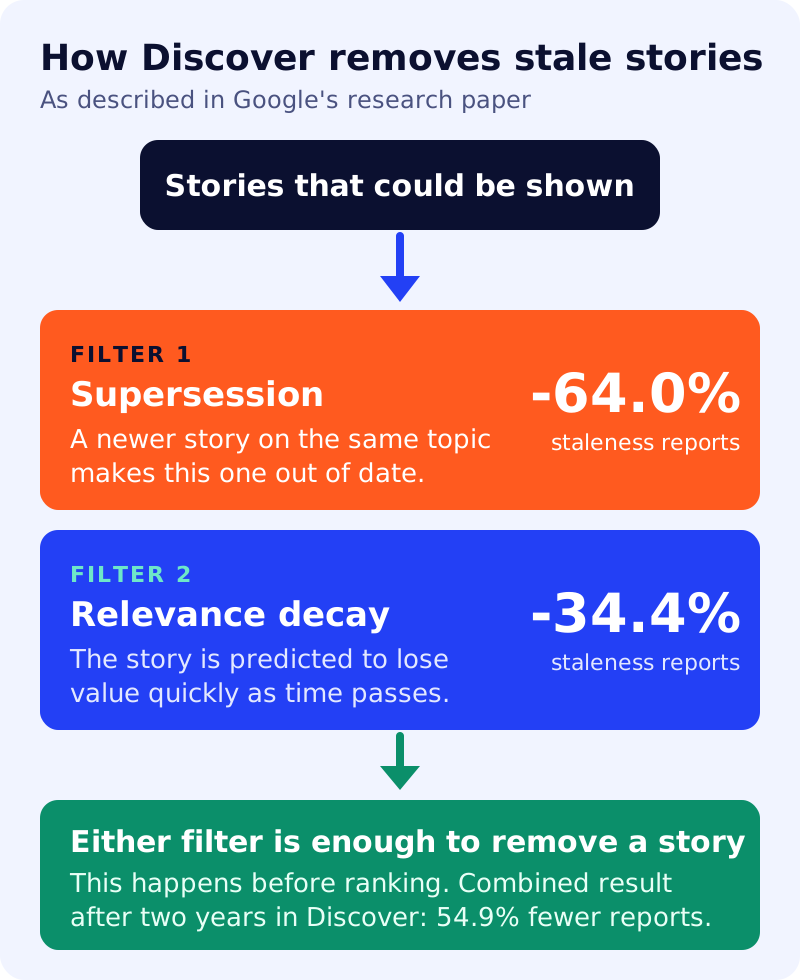
- Supersession. A story becomes stale when newer coverage replaces it. The paper describes a model that detects, for pairs of items, whether one supersedes the other.
- Relevance decay. Some stories lose value fast even if nothing replaces them. A second model predicts how much of a story’s total traffic it has already earned, using the story’s content, and is trained on lifetime traffic data.
The two filters are combined so that either one is enough to remove a story. They run before ranking, so a filtered story does not enter the ranking stage at all. The paper says SDF is fully deployed in Google Discover.
What the paper measured
According to the paper’s abstract, after two years of production use:
| Measure | Change in user-filed staleness reports |
|---|---|
| Supersession filter | down 64.0% |
| Relevance decay filter | down 34.4% |
| Both filters together | down 54.9% |
These are reductions in reports that users filed about stale stories, not changes in traffic to publishers. We have read the abstract and the coverage, not the full text, so check the paper for the method and details.
What this means for publishers
The paper describes a system, not advice. These points are our own reading of it:
- Time-sensitive stories fade by design. A story about an event that has passed may be removed even if it was once strong in Discover.
- A newer story on the same topic can replace an older one. If you cover a developing story, consider updating the main page with the latest facts instead of leaving an outdated version live next to a new one.
- Evergreen pages are less exposed to decay than news, though the paper does not say how it treats them.
- This is about removal, not penalties. The paper describes pruning candidates before ranking. It does not describe a ranking penalty.
More coverage of Google Search changes is in our Google section.