

Google is making its search results more personal. The company says AI Overviews and AI Mode will start using a person’s recent search context to make some answers more relevant.
Think about how people actually search. Someone may first look for the best electric car under a budget, return later to compare battery range, then search for charging costs and finally check a specific brand. Google says its AI search experience will increasingly be able to carry some of that recent context into a new search.
This is a meaningful change because search may become less like a series of unrelated questions and more like one continuing conversation.
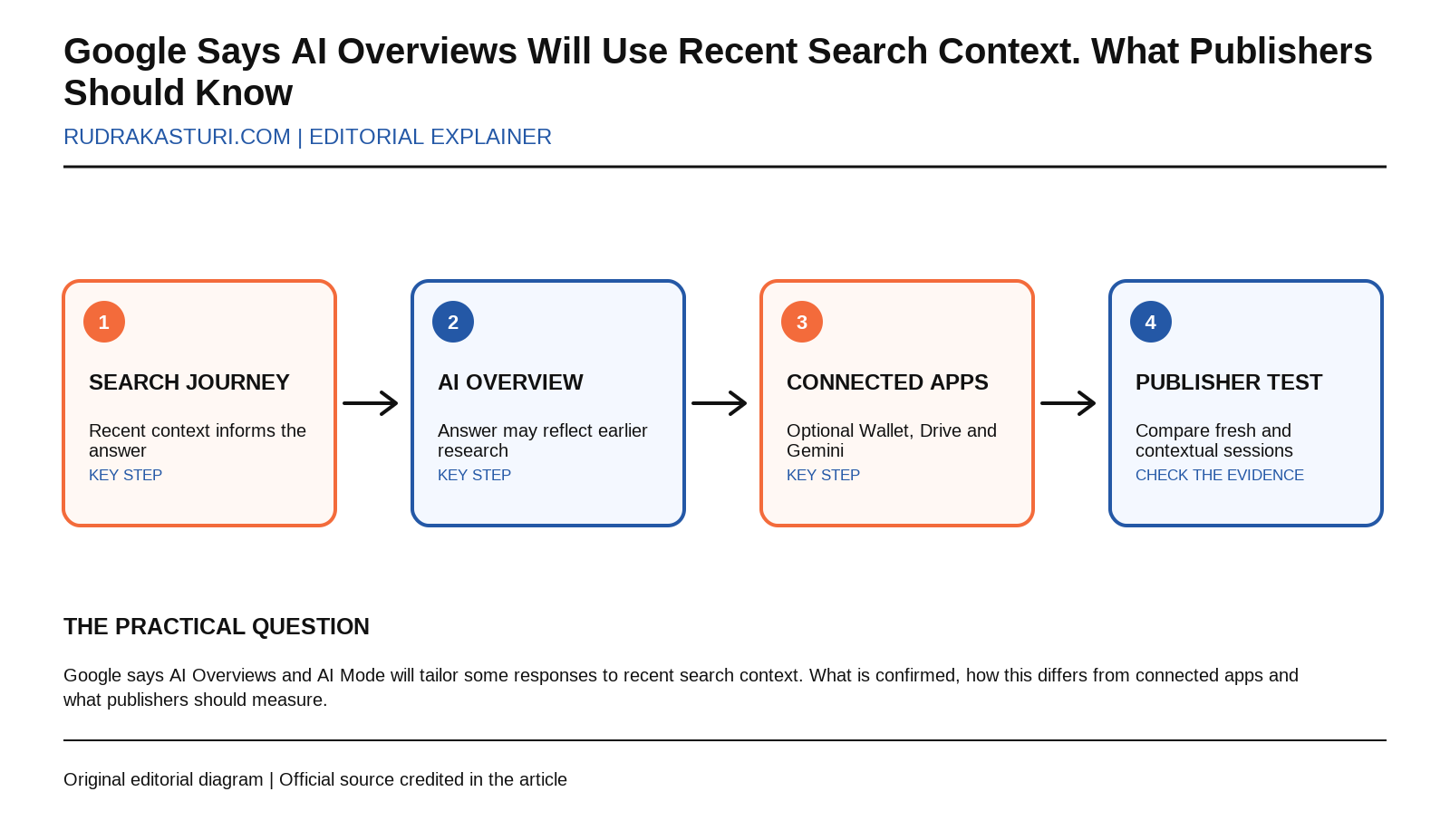
Original editorial illustration based on Google’s announcement. Read Google’s official announcement.
Official image from Google: A more tailored Google Search that’s uniquely yours, November 23, 2026.
What exactly has Google announced?
In its November 23, 2026 announcement, Google said people will start seeing more personally relevant responses in AI Overviews and AI Mode, tailored to their recent search context.
Google gave a simple example. If someone has been researching and planning a trip, they may be able to continue that research in a new search without starting from the beginning or repeating all the details.
There are two separate parts to this announcement, and they should not be confused.
| Feature | What it means |
|---|---|
| Recent search context | Google may use what you have recently searched for to make a later AI answer more relevant |
| Connected apps | You can choose to connect services such as Wallet, Drive and the Gemini app to bring selected personal information into AI Mode |
The connected app feature is optional. Google says users choose which apps to connect and can switch those connections off. The recent search context announcement is about making AI Overviews and AI Mode more relevant based on earlier searches.
Google has not published every technical detail about how much search history is considered, how long the context remains available or which users and markets receive each part of the rollout first.
Does Google now remember everything you search?
No. That is not what Google has announced.
The company says AI Overviews and AI Mode will use recent search context to make some responses more relevant. It has not said that every search will be personalised, that every past search will be used or that Google will show a completely different answer to every person.
It is also important not to confuse this feature with the way websites measure returning users.
A returning user in website analytics is usually someone who has visited a website before. Google’s announcement is about recent search activity. A person could be researching a topic across several Google searches without ever visiting your website.
That difference matters for brands. Google may understand more of the journey that happens before a person reaches a website, but the website owner does not automatically get access to that private search context.
How could personalised AI Overviews change the way people search?
Today, people often break a large decision into several searches.
A person buying a laptop may search for the best laptops for work, compare processor types, look at battery life, check reviews and then search for a particular model. A person researching a health concern may move from symptoms to possible causes, treatment options and questions to ask a doctor.
If Google carries recent search context into later AI answers, the person may not need to repeat the background every time. The next answer could begin further along the decision journey.
This may create three changes.
First, fewer repeated searches for basic background. A person may not need to explain the same context again and again. Some searches could become shorter or more specific.
Second, more detailed follow-up questions. Once the broad topic is understood, people may move faster to comparisons, costs, risks, alternatives and purchase decisions.
Third, stronger importance for brands already remembered by the user. If a person has seen a brand during earlier research, that name may become part of the next question. This is a possible behaviour change, not a confirmed Google ranking rule.
What does this mean for AEO and brand visibility?
This is where the announcement becomes important for businesses.
AEO, or Answer Engine Optimisation, is the practice of making sure that AI-powered search and answer systems can understand a brand, explain what it offers and identify when it is relevant to a question.
Traditional SEO often focuses on whether a page appears for a particular keyword. AEO adds another question: when someone asks an AI system for an explanation, shortlist or recommendation, does the system understand the brand correctly and have enough reliable information to mention it?
Personalised search could make this more important because people may move through several stages of research before they are ready to act.
Imagine someone researching skin care. The first search may be about dry skin. The next may be about ingredients. Later, the person may compare products, ask about price and check whether a particular brand suits their needs.
A brand that is clearly described across its website, product pages, independent reviews and useful expert content has more chances of being understood during that journey. A brand with vague claims, inconsistent product information or little independent discussion may be harder to recognise and recommend.
This does not mean that Google has announced a new AEO ranking factor. It means brands should prepare for a search experience in which context and familiarity may influence what a person asks next.
Will personalised AI Overviews reduce website clicks?
It is too early to say.
There are two possible outcomes, and both can happen for different types of searches.
For simple questions, a personalised AI answer may give the user enough information. The person may not need to open another website. That can reduce clicks for pages that only repeat basic facts.
For more involved decisions, the same answer may help the user understand what to compare and then send them to a detailed review, product page, service provider or original source. Those visits may be fewer in number but more useful.
Google’s own August 2025 explanation said overall organic click volume to websites was relatively stable year over year and that average click quality had increased. Google described a quality click as one where a person does not quickly return to Search. These are Google’s own figures and definitions. They are not a measurement of the November 2026 personalisation change, so they should not be used as proof that this new feature will increase clicks.
The right conclusion is simple: do not assume that clicks will automatically fall or rise. Measure what happens after the rollout.
A 90-day plan for brands
The announcement does not call for every company to rebuild its marketing strategy overnight. A practical 90-day plan can help teams prepare without chasing a feature whose full rollout details are still developing.
| Period | What to do | What to measure |
|---|---|---|
| Days 1 to 30 | Fix brand, product and service facts across the website, profiles and key third-party sources. Build a list of 20 to 30 real customer questions. | Branded search baseline, current AI answer mentions, product information errors |
| Days 31 to 60 | Publish useful comparison, explainer and proof-led content. Improve product pages, FAQs, reviews and author or expert information. | Relevant AI mentions, citations, engaged organic visits, return visits |
| Days 61 to 90 | Compare results across Google Search, AI Overviews and AI Mode. Connect search demand to CRM and conversion data where consent and measurement allow. | Branded search growth, assisted conversions, qualified leads, conversion rate |
A simple decision rule helps. If branded search is growing but qualified visits are not, investigate the landing experience and the gap between the promise and the page. If AI answers mention competitors but not your brand, check whether your product facts, independent proof and category relevance are clear. If traffic is steady but conversions are falling, improve the offer and customer experience before increasing content volume.
What should brands invest in now?
The answer is not to publish more articles simply to target more keywords. Brands should invest in becoming easier to recognise, understand, compare and trust.
1. Brand building and recall
A person cannot search for a brand they do not remember. Brands should invest in consistent naming, clear positioning, distinctive products, useful campaigns and repeated visibility across the channels where their audience spends time.
Measure branded search impressions and clicks, direct visits, repeat visits, share of search and the number of people who return to the brand after an initial discovery.
2. Strong product and service information
Keep the basics consistent across the website, product pages, help pages, listings and third-party profiles. Explain what the product does, who it is for, what it costs, what it does not do and how it compares with alternatives.
This is especially important when AI answers bring information from several sources together. Conflicting prices, specifications or eligibility rules make a brand harder to understand.
3. Independent proof and real customer experience
Invest in reviews, customer stories, expert commentary, demonstrations, case studies and independent coverage. Do not manufacture reviews or create artificial mentions. Real evidence gives people and answer systems something more useful than a brand slogan.
4. Useful content across the full decision journey
Create content that answers the questions people ask before they know the brand, while comparing options and when they are ready to buy. Include original data, practical examples, clear limitations and direct answers.
5. AEO and structured brand information
Make it easy for search systems to identify the organisation, products, services, people, locations and relationships. Use accurate structured data where appropriate, maintain consistent business information and ensure important facts are visible in normal page text.
6. Measurement beyond the last click
Do not judge every campaign by the final website session. A person may discover a brand through an AI answer, remember it, search for it by name a few days later and then convert through a direct visit.
Connect search data, website analytics, CRM records and brand research where possible. Respect privacy and do not claim to identify an individual’s private search history.
A practical scorecard for the personalised search era
Brands can start with a monthly scorecard. The purpose is to find out whether awareness is turning into demand and whether demand is turning into useful visits.
| Metric | What to track | Why it matters |
|---|---|---|
| Branded search demand | Impressions and clicks for brand name searches | Shows whether more people are actively looking for the brand |
| Returning visitors | Repeat users and repeat sessions | Shows whether people come back to the website |
| Direct traffic | Direct visits and branded landing sessions | Helps identify demand that may not begin with a generic keyword |
| AEO visibility | Brand mentions and citations across a fixed set of relevant prompts | Shows whether answer systems understand and include the brand |
| Click quality | Engaged sessions, key actions and conversion rate | Shows whether visits are useful, not just numerous |
| Assisted conversions | Visits and interactions before the final conversion | Helps connect discovery with later business results |
A useful operating habit is to test the same set of 20 to 30 questions every month across Google Search, AI Overviews where visible, AI Mode and other answer systems. Record the answer, brand mentions, cited sources, links and the next action a user could take.
Do not compare one personalised result with another without recording the search context. Keep the query, date, location, device and test conditions consistent.
What should users check in their Google settings?
Google says users can adjust or turn off personalisation in Search Settings. For connected apps, Google says people can open Search Personalisation, choose Connected Apps and decide which services to connect.
The company says users remain in control of those app connections and can turn them on or off. Google also says it plans to show a Personalisation icon below tailored responses so people can inspect the context used.
The feature is still rolling out, so the exact controls may differ by account and availability.
What Google has not confirmed
It is worth separating what Google has said from what marketers may be tempted to assume.
Google has said that AI Overviews and AI Mode will use recent search context to provide more personally relevant responses.
Google has not said that every search will be personalised, that private search history becomes available to brands, that websites can target individual search histories or that the change creates a new organic ranking factor.
It has also not published evidence showing whether this specific change will increase or reduce website traffic, click-through rates or conversions.
Those questions need measurement over time.
Frequently asked questions about personalised Google AI Overviews
What is changing in Google AI Overviews?
Google says AI Overviews will start showing more personally relevant answers based on a person’s recent search context. The aim is to help people continue research without repeating all the background.
Will Google AI Overviews use my previous searches?
Google says recent search context can be used to tailor responses. It has not published every detail about how much history is used or how long that context remains available.
Is this the same as Google Personal Intelligence with Gmail and Drive?
No. Connecting apps such as Gmail, Drive, Wallet or Gemini is a separate optional feature. The recent search context update is about using earlier searches to make later AI answers more relevant.
Will personalised search reduce website traffic?
It may reduce clicks for some simple questions where the answer is enough. It may also help people reach more detailed pages when they want to compare, verify or take action. Google has not published traffic data for this specific update.
What does this mean for AEO?
Brands need to make their identity, products, services and evidence easy for answer systems to understand. They should track brand mentions and citations across relevant questions, not just keyword rankings.
Should brands invest more in SEO or branding?
Both are needed. SEO helps people discover useful pages. Branding helps people remember a name and search for it again. AEO helps answer systems describe and recommend the brand accurately. The three should work together.
How can a brand measure whether people are returning after AI discovery?
Track branded search demand, repeat website visits, direct traffic, assisted conversions and AEO visibility. These measures do not reveal an individual’s private Google search history, but together they can show whether awareness is turning into demand.
The bigger change: search is becoming a journey, not just a query
Google’s announcement points to a search experience that can carry more context from one question to the next. For users, that may mean less repetition and more relevant answers. For brands, it raises the value of being remembered, clearly understood and trusted before the final purchase or decision.
The practical investment is not to abandon SEO. It is to connect SEO, AEO, brand building, product information and customer experience into one system. The brand that is easy to discover, easy to understand and worth remembering has a better chance of being found again.
Editorial note: This article is based on Google’s November 23, 2026 announcement and its published explanations of AI Search. The possible effects on brand recall, clicks, traffic and AEO are strategic implications, not outcomes Google has confirmed. The feature’s rollout and behaviour may change as Google releases further details.