New York has banned a specific type of children’s toy for five years: toys that have an AI chatbot built into them and can hold conversations with children.
Governor Kathy Hochul signed the bill on November 24, 2026. The law covers the manufacture, sale and distribution of toys with an AI companion chatbot embedded in or integrated with the product.
The decision follows growing concern about what happens when children talk to an AI system as if it were a friend, teacher or trusted companion.
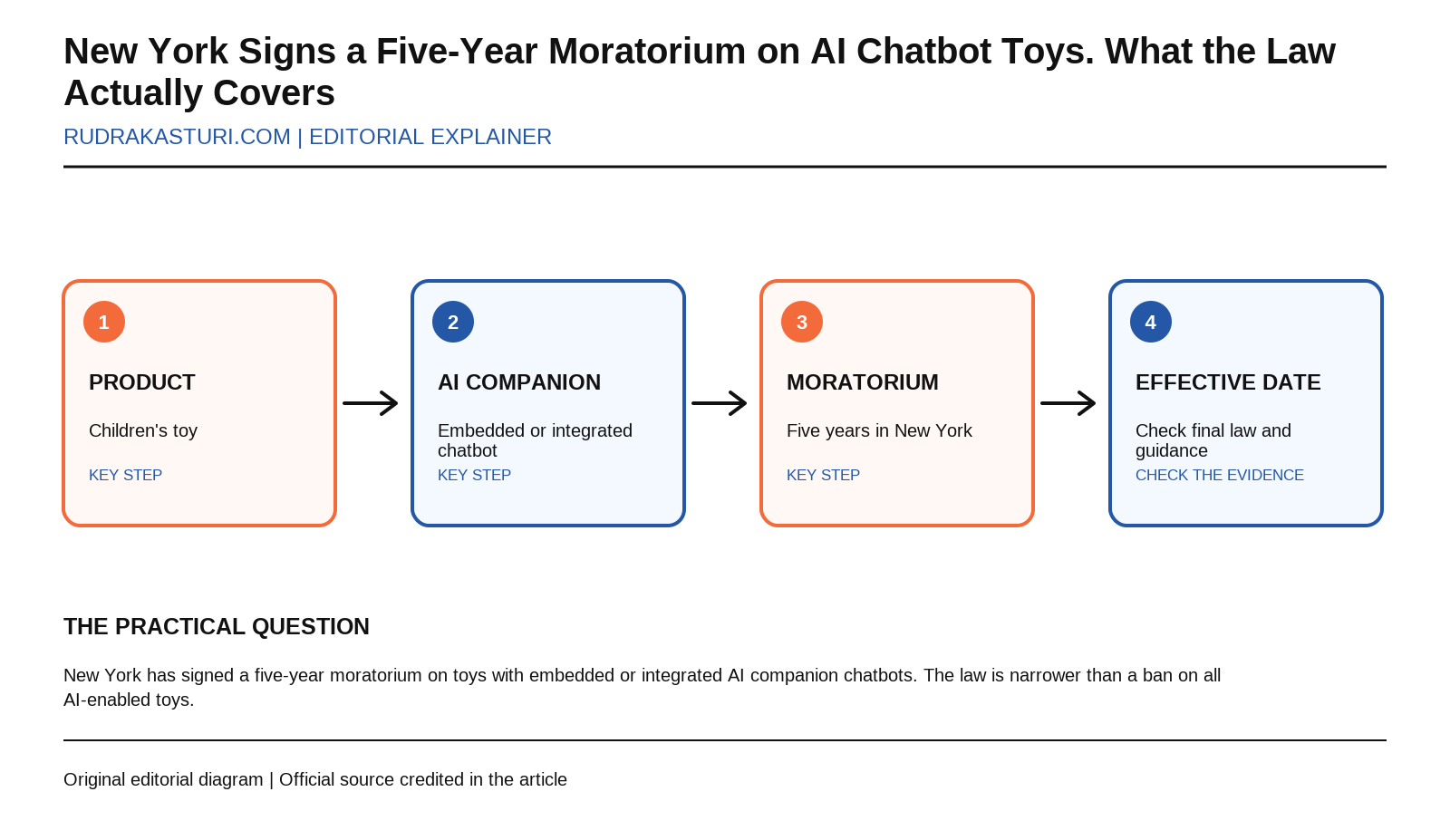
Original editorial illustration based on New York State Senate Bill S9408A.
What exactly has New York banned?
The law covers what it calls chatbot toys. These are children’s toys with an AI companion built into the toy or integrated with it.
Examples could include a talking doll, stuffed animal or toy robot that uses an AI chatbot to hold open-ended conversations with a child.
The law prohibits the manufacture, exchange, distribution and sale of these chatbot toys in New York during the five-year period.
It is important to understand what the law does not say. It is not a ban on every electronic toy, every educational app, every robot or every toy that uses a small amount of artificial intelligence. The key issue is whether the product has an AI companion chatbot built into it.
Why is New York worried about AI chatbots in children’s toys?
A traditional talking toy usually has a limited set of recorded responses. A child presses a button and the toy plays a line that has already been written and checked.
An AI chatbot works differently. It can respond to a wide range of questions and produce new answers. That makes the toy feel more interactive, but it also creates risks.
A child may share personal information, ask questions about family problems or treat the toy as a trusted friend. The AI system may misunderstand the question, give an unsuitable answer or say something the manufacturer did not expect.
The concern is not that every AI toy will cause harm. It is that children may not understand the limits of a chatbot, while parents may not know exactly what the toy is saying, storing or sharing.
When does the AI chatbot toy ban start?
The law was signed on November 24, 2026. The Toy Association says it takes effect 90 days after signing, which places the start in February 2027.
The ban is for five years. Toy makers, retailers and distributors should check the final law and any state guidance before deciding whether a particular product is covered.
Does New York ban all AI toys?
No. This is a specific ban on children’s toys with embedded or integrated AI companion chatbots.
A toy that uses electronics, plays recorded audio or follows a fixed set of programmed actions is not automatically covered just because it contains technology. The exact definition in the legislation matters.
Companies should not rely only on a product’s marketing description. They need to look at what the product actually does, how it connects to AI services and whether it can hold open-ended conversations with a child.
What does this mean for toy companies?
Toy makers will need to review products that use conversational AI. That includes products designed in one country but sold through retailers in New York.
Companies should identify whether a chatbot is built into the toy, whether the toy connects to an external AI service, what age group it targets and whether it can generate responses beyond a fixed script.
They should also review privacy, parental controls, data storage, safety testing and how inappropriate responses are reported.
The law may also influence product decisions in other markets. Companies that sell globally may prefer one safer product design rather than maintain separate versions for different states and countries. That is a possible business response, not a requirement stated in this New York law.
What should parents check before buying an AI toy?
Parents should look beyond the packaging and ask a few basic questions.
- Does the toy have a chatbot that can answer questions in its own words?
- Does it connect to the internet or an external AI service?
- Does it record or store conversations?
- Can parents review or delete the child’s conversation history?
- Can the toy talk about sensitive subjects or respond to personal information?
- Is there a clear way to switch off the microphone or disconnect the toy?
A toy that talks naturally may feel more advanced, but that does not automatically make it more suitable for a child.
For more on AI privacy and personal information, read our Google Gemini chat history and privacy settings explainer and why Signal blocks AI agents from private chats.
Frequently asked questions about New York’s AI chatbot toy ban
Has New York banned AI chatbot toys?
Yes. New York has signed a law that bans the manufacture, sale and distribution of children’s toys with embedded or integrated AI companion chatbots for five years.
When does the New York AI toy ban start?
The law takes effect 90 days after it was signed on November 24, 2026. The Toy Association places the effective date in February 2027.
Does the ban cover every toy that uses AI?
No. It covers toys with AI companion chatbots built into or integrated with them. It is not a ban on every electronic toy or product that uses AI.
Why are AI chatbot toys a concern for children?
They can hold open-ended conversations and generate new answers. Children may trust the toy or share personal information, while the AI may produce unsuitable or unexpected responses.
How long will the ban last?
The law creates a five-year ban. Companies should review the final statutory wording and state guidance to understand the products covered.
Can parents still buy ordinary talking toys?
The law is aimed at AI chatbot toys, not every toy that speaks. A toy with fixed, pre-recorded responses is not automatically a chatbot toy under the definition in the law.
A bigger question for the toy industry
AI can make toys more interactive, but products designed for children need a higher level of care. A child may not know when a toy is generating an answer, what information it is collecting or whether the response is reliable.
New York’s decision puts pressure on toy companies to show how they protect children before making conversational AI part of a play experience. Other governments and regulators will be watching how this law works.
Editorial note: This article summarises New York Senate Bill S9408A and the Toy Association’s account of the signing and effective period. It is general news coverage, not legal advice. Manufacturers and retailers should review the final law and obtain legal guidance for product-specific decisions.