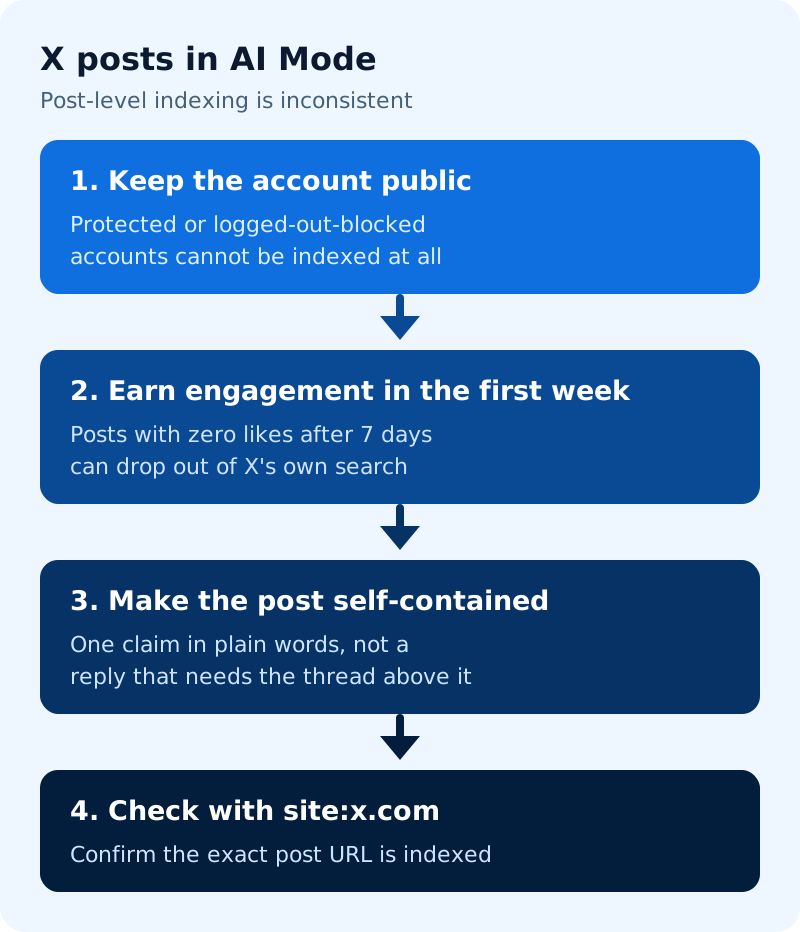

Quick answer: Getting a single tweet cited inside a Google AI Overview or AI Mode answer is harder than it looks, because individual post indexing on X has been unreliable through 2026, even though profile pages index well. If you want visibility from X content in AI search, the profile page and the post’s own engagement matter as much as anything you can do to the text itself.
Best for: brands, journalists and creators who use X for commentary, announcements or data, and want that content to also surface in Google.
What reporting says, and what it doesn’t
A few points are repeated across independent write-ups in 2026, though none trace back to an official X or Google statement we could open directly in this session:
- Profile pages index more reliably than individual posts. If you want anything from your X activity to show up in Google at all, a complete, keyword-clear bio and pinned post matter more than any one tweet.
- Post-level indexing tightened after X restricted logged-out browsing. A crawler that cannot read a post without logging in generally cannot index it either.
- Engagement affects visibility on X’s own search, separately from Google. One August 2026 report says posts older than seven days with zero likes can stop appearing in X’s internal search, which removes them from the discovery path that often leads to a Google citation in the first place.
- Google Discover has shown X posts, which is a different surface from AI Overviews and AI Mode, and has drawn complaints about frequency, according to Search Engine Roundtable.
None of this is Google publishing a method for citing tweets in an AI Overview. Write for the reader first, and treat AI citation as a possible side effect, not a target you can hit precisely.
What to do
- Make the post stand on its own. A tweet that only makes sense as a reply three levels into a thread gives an AI summarizer nothing to extract cleanly. State the claim, the number or the update in the post itself.
- Front-load the specific fact. “Our Q3 numbers: 42% YoY growth, details below” beats a vague teaser, for the same reason a direct video answer beats a slow build-up.
- Keep the account public and avoid relying on logged-out-restricted features if being findable on Google matters to you.
- Build engagement in the first days. Reply to relevant larger accounts and conversations near your post’s topic; a quiet post is both harder to find on X and less likely to be crawled in time.
- Check indexing directly. Search
site:x.com "your exact phrase"in Google, or paste the post’s share link into Search Console’s URL Inspection tool, as described in the weekly social content Search Console routine. - Don’t depend on a single post. Say the important thing in your post, and also publish the fuller version on a page you control, so you are not relying on inconsistent post-level indexing for your main traffic.
Common mistakes
- Expecting the same indexing reliability from a tweet as from a web page you own.
- Writing a post that requires the reader to already know the context.
- Deleting and reposting instead of fixing and letting the original index.
For the same question applied to Threads, see how to rank Threads posts in AI Mode and AI Overviews.